Showing posts with label Head Hand Heart. Show all posts

Thursday, November 21, 2013

The Head The Heart The Hand: Bryn Perrott


"Friend Sleeping"  
"Wolf Jumping"
Bryn Perrott is a woodblock artist based in Morgantown, West Virginia. Drawing from the extensive visual repertoire of traditional americana tattoo imagery, she creates beautifully intricate wood carvings. I like the idea of using the visual vocabulary of tattooing for woodblock prints -- in a tattoo, black ink is carved into the skin; in a woodblock carving, the "white," negative space is carved into the wood and the ink rests gently on top. This inversion is interesting not only in a metaphoric sense, but also in a concrete, visual sense. The tattoo flash is transformed into 3-Dimensional objects with the image hovering in the foreground, rather than bleeding and merging deeper into the skin.
"Rock of Ages"
"Jeso"
There is an incredible amount of detail in each piece (those tiny dots and swirls!) that make each one rich and satisfying. She also adds unique elements to the recognizable, traditional images--perhaps because the medium requires her to at times, but also likely because the vision she is creating only uses tattoo imagery as a point of departure...

One of the reasons I love woodblock work so much is that you can always see the artist's hand. Just observe the below image; you can see each little stroke of the carving knife in the white space. You are almost able to follow the process with your eyes, noting each dig into the surface of the wood. On the other hand, in a tattoo, all the little strokes of the artist's hand eventually blend together, while on these carvings they remain forever visible in the wood's "skin."
"Japanese cat"
"Tea Sloth"
"Mermaid" 
"Russian Arms"
"Manchester United"
Perrott does custom woodblock work, and there are several examples of commissioned pieces on her tumblr site. I think this work is awesome! I hope you enjoy it too...

***
Until next time, fair petticoat rustlers-- keep rustling!

Tuesday, August 20, 2013

The Head, The Hand, The Heart: Amund Dietzel

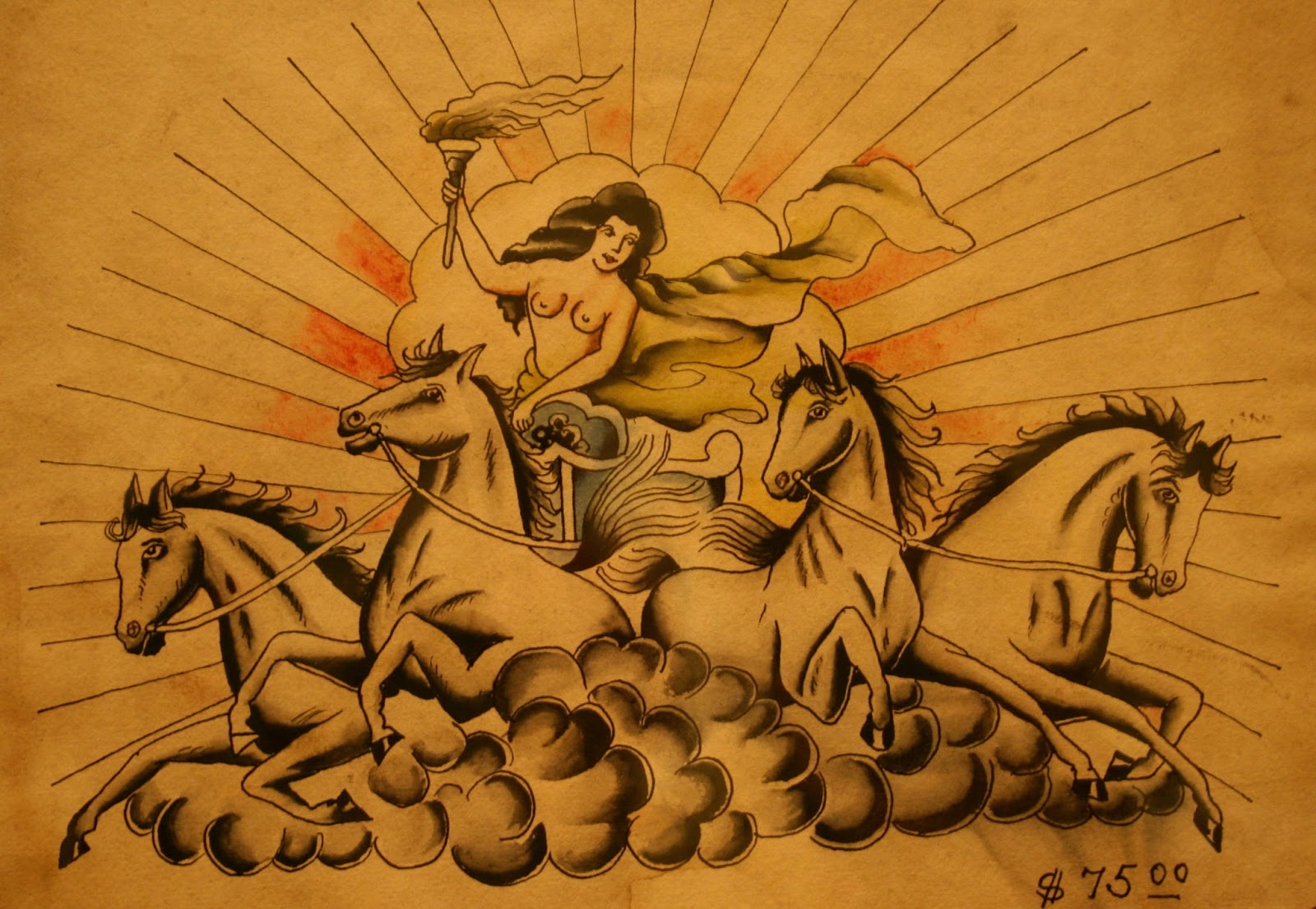
Tattoo flash by Amund Dietzel
During our 6-hour visit to Milwaukee last week, we made sure to go check out the Amund Dietzel tattoo flash art currently on view at the Milwaukee Art Museum. It was a phenomenal exhibit, showing the fine detailed work of a master's hand.

It is (sadly) unusual for tattoo flash to be displayed in art museums. There are several possible explanations for this: 1) the stigmatism of Western formalism prohibits self-taught artists from achieving their rightful place within the hallowed, white walls of fine art; 2) tattoo flash is portable and fragile and likely was not stored archivally by its creators, leading to a dearth of this kind of turn-of-the-century artwork surviving today; 3) the essence of flash itself is to be an inspiration, an opportunity for art, not a finished piece of work-- the finished piece is unique every time it is crafted onto a living, breathing canvas.

Amund Dietzel tattoos a customer
In honor of Harley-Davidson's 110-year anniversary, the Milwaukee Art Museum curated this special exhibit of an artist who, after serving as a sailor on transatlantic merchant ships during his adolescence, found himself shipwrecked in North America, where he eventually came to stay.

Amund Dietzel began developing his craft while aboard the merchant ships upon which he worked. Tattooing fellow crew members, he used a series of needles tied to a piece of wood with a strip of cotton cloth. I can only image what it must've been like to have to trust so completely in your own hand as you agonizingly stitched an image into a friend's arm, chest, or back. Sailor tattoos almost always commemorated an important event in their career, such as crossing an ocean, surviving a storm, and so forth, lending even more significance to the image that the tattooist was to create. In fact, the first tattoo that Amund himself received was to commemorate his first successful crossing of the Atlantic.


This traditional tattoo depicts the biblical Pharaoh's horses drowning in the Red Sea after Moses collapses the walls of water on the Egyptian's chariots. It symbolizes having successfully defeated one's enemy. 
As he became more and more immersed in the development of his craft, he met many tattooist mentors with whom he exchanged tattoos. Tattooing one another was a way for the artists to practice, try things out, and get free ink. Amund took several courses in painting at Yale (earning tuition money as a tattooist), but ultimately couldn't afford to continue going.

While in New Haven, however, he met one of his mentors: William Grimshaw. Grimshaw tattooed Amund from neck to ankles, covering his body in ink. Amund returned the favor, and the two travelled with circuses as tattooed men, a popular way of earning additional income at the time. Eventually, Amund's travels with the circus lead him to Milwaukee, Wisconsin, which is where he made a life and a name for himself, tattooing in his shop until the city outlawed tattooing in 1967. He died in 1974, at the age of 83.


The collection of flash on display at the Milwaukee Art Museum all comes from the private collection of a Milwaukee tattooist named Jon Reiter. After years of collecting Dietzel flash and other material related to Dietzel's tattooing career and life, Reiter published a two-volume biography of Amund Dietzel. These books are just gorgeous-- full of rich color plates of the flash and old photos of Amund and his friends tattooing or getting tattooed. Plus, Reiter has painstakingly researched old newspapers and other archives in order to piece together the story of Dietzel's adventurous life (including the legends and myths that Dietzel himself invented).


The exhibit of Dietzel's work reveals the art of tattooing to be a beautiful, old, americana folk art form that remains vibrantly alive today. You can see in each piece the control and steadiness of the artist's hand, a skill that was no doubt honed while tattooing aboard a moving ship. His images contain carefully shaded chiaroscuro contours on his ink-on-paper works, a testament to the way he must've been able to expertly manipulate his ink-on-skin works-- carefully drawing out the colors into soft yet dramatic gradients of light and dark.


The subject matter of this genre of art has a traditional repertoire, but that repertoire is continuously expanding. The semiotic language of tattoos can be universal-- once their meaning is established, these images become a pidgin that facilitates inter-linguistic and cross-cultural communication (which is what art is supposed to do). The fact that the collectors of this art must commit their very skin to each acquisition means that this art form is liberated of the "art stock exchange" that major art auction houses and galleries have come to represent in recent years. In other words, no one gets a tattoo so that they can later "flip it" and make millions of dollars on it-- rather, they acquire each piece out of a love for that piece.

Yeah, yeah. I know, there are drunken tattoos going on in basements all over the world. And there are celtic knots surrounding ambiguous Chinese characters, flanked by Tweety bird and Betty Boop. But there is bad art in galleries all over the world, too. Quality of technique, design, color and shading, content and concept factor as much into the critique and analysis of a tattoo as they do in a painting or sculpture. The tattooer also has to consider placement on a person's body, any blemishes or scars on the skin, and the way the ink is going to bleed into their "canvas" over time. It is an incredible artistic exchange that offers an intense and profound connection between artist, art, and collector.

It was fascinating to look at Amund Dietzel's flash art and begin to learn about his life in Rieter's biography of him (I still have some of the first volume and the whole second volume to get through!). But the exhibit seemed to be more a testament to the absence of an artist's oeuvre than to its presence.

Who were the people who came through his shop doors, pointed to one of those pieces of flash, handed over some dollar bills, and sat down to get tattooed? Where did they go? Where did they take their tattoos, Diezel's art?

At the end of the exhibit, one is left with the feeling that these small representations of a vast creative output are a floating piece of a larger artistic narrative that will never be linearly expressed or understood. The story of Amund Dietzel's art is dispersed in the world, in graves, in other countries, on wrinkled skin, in photographs, in flash.

This idea that the narrative of a tattooer's creative output will never be available to a viewer in one, comprehensive retrospective is beautifully demonstrated by author Shelley Jackson's short story, "Skin," published in tattoo form on the bodies of 2000-some volunteers. Each volunteer received a single word of the short story and got it tattooed on their bodies somewhere. The story will never be published in any other format... just like the story of Dietzel's art.

***
Please note, the Milwaukee Art Museum permitted photography in the Dietzel exhibit. All the photos in this post were taken by me.
***

Until next time, fair petticoat rustlers-- keep rustling!

Thursday, August 1, 2013

The Head, The Heart, The Hand: Anonymous Portraits of Strangers

I've often heard the claim--and I'm sure you have too--that technology and social media tear apart "real" relationships and diminish humans' ability to experience "true" interaction. I've always been wary of this claim, however, as I feel social media and technology, rather than isolate us, bring together human thoughts, words, and images that may otherwise never have encountered one another.

An interactive art project demonstrates beautifully this very phenomenon. NYC-based designer Jeff Greenspan (creator of the hilarious "Hipster Traps") recently helped to launch the project "Selfless Portraits," a website that allows people to submit their Facebook profile picture to a complete stranger, somewhere in the world, who will create a hand-drawn portrait using your photo. You receive this portrait only after you create a hand-drawn portrait of some other stranger's profile photo. The photos with their accompanying portrait are then displayed on the website's gallery.


These portraits take on all different artistic forms-- some are very literal renderings while others are totally abstract. I love the idea that someone who does not know you at all (and likely does not even speak the same language as you) can communicate something potentially quite profound (or at least humorous!) about the way you present yourself to the world.


When you hover over each photo in the gallery, it shows the name and country of the person who submitted the photo on the left, and the name and country of the person who created the portrait on the right. Often, the countries have oceans between them, miles and miles and countless cultural differences, but communication happens nevertheless through this emerging techno-visual vocabulary, interpreting the human face and proposing a new representation of that (unknown and yet so familiar) human face...


Lucian Freud, famous for the portraits he painted, said "I paint people, not because of what they are like, not exactly in spite of what they are like, but how they happen to be." While these internet-based portraits are vastly different in their execution from the meticulous hand of Lucian Freud, they share an almost identical concept as the one Freud expressed-- regardless of who this person may think they are, the artist must always make a decisions about how they see a person being at the moment they are "sitting" for their portrait.

While its true that so much of social media can serve as a testament to our most vapid and inane tendencies, it has also opened the door to this novel kind of visual interaction. In circumventing the interference of language, the academy, money, and labels, these portraits are allowed to be created out of sheer joy of creating portraits, offering us a new and fascinating way to experience total strangers. I think that's pretty wonderful.

I am tempted to submit my photo and give it a try myself! Who's with me?!


***
Until next time, fair petticoat rustlers-- keep rustling! 

Sunday, July 21, 2013

The Hand, The Head, The Heart: Ana Serrano

John Ruskin, the Victorian age art critic, said in his 1895 lecture titled "Unity in Art" that, "Fine art is that in which the hand, the head, and the heart of man go together." He explains that the heart is where emotions are formed, and those emotions are then sent to the head where they are processed, and finally those emotions, once contemplated, are sent to the human hand, which Ruskin regards as a perfect technology ("No machine yet contrived, or hereafter contrivable, will ever equal the fine machinery of the human fingers"). Only with the perfect coordination of the hand, the head, and the heart is it possible to create true fine art. 

One of the things that I like most about the how Ruskin defines fine art here is what he hasn't defined: he doesn't talk about subject matter, medium, or concept. He gives authority only to the sincerity of the heart, the intelligence of the mind, and the ability of the hand-- which means that any artist, producing a work that is honest and true, in any medium, creates fine art. 

That is why, starting today, I am starting a new feature for the blog called (unsurprisingly) The Hand, The Head, The Heart, in which I present the work of a visual artist I feel has these three elements working in harmony. 

The first artist to be featured is the Los Angeles-based sculptor/painter Ana Serrano. I saw her stuff and instantly fell in love with it. 

She works mostly paper and cardboard to create works that gaze openly and honestly at the urban environment in which she lives. A first-generation Mexican-American from LA, Serrano's work speaks eloquently with a Spanglish visual vocabulary to playfully express real hardship, pain, and danger in her home city, at the same time she captures the beauty, love, and persistence. 


The artist Ana Serrano, creating "Cartonlandia" 
"Cartonlandia" 
On her website, her artistic vision is described like this: Her work bears reference to those in low socioeconomic positions, with particular interest in the customs and beliefs, as well as the architecture, fashion, and informal economies present within this segment of society. A current theme explored in her work is the socio-cultural aspects of drug trafficking, and the branding and acceptance of the drug lord lifestyle.


"Chalino" (detail)
"Tres Animales"
"Road to Malverde" (detail)
Serrano makes cardboard versions of buildings - in both small scale and life size. These buildings are definitely evidence that her heart, head, and hands are working perfectly together...


A year ago, the Rice Gallery in Houston, Texas commissioned her to do a whole life-sized neighborhood in their gallery. You can watch a short video of Serrano talking about that work (called Salon of Beauty), her creative process, and her artistic vision here:


You can keep up with her most recent work on her blog.

***
What are your thoughts about this artist?? What are your thoughts on Ruskin's idea of fine art??

Until next time!