|
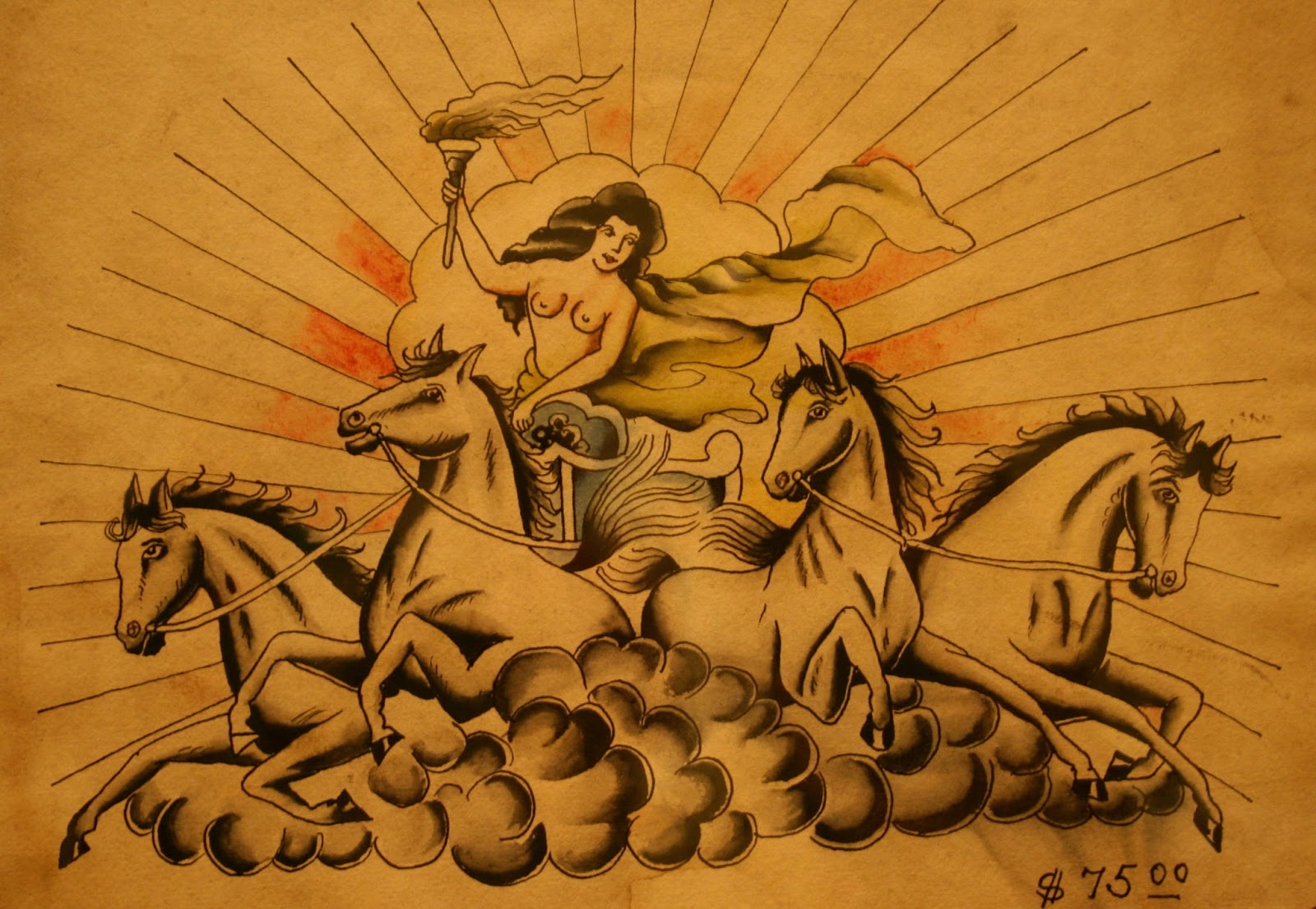
| Tattoo flash by Amund Dietzel |
During our 6-hour visit to Milwaukee last week, we made sure to go check out the Amund Dietzel tattoo flash art currently on view at the Milwaukee Art Museum. It was a phenomenal exhibit, showing the fine detailed work of a master's hand.
It is (sadly) unusual for tattoo flash to be displayed in art museums. There are several possible explanations for this: 1) the stigmatism of Western formalism prohibits self-taught artists from achieving their rightful place within the hallowed, white walls of fine art; 2) tattoo flash is portable and fragile and likely was not stored archivally by its creators, leading to a dearth of this kind of turn-of-the-century artwork surviving today; 3) the essence of flash itself is to be an inspiration, an opportunity for art, not a finished piece of work-- the finished piece is unique every time it is crafted onto a living, breathing canvas.
 |
| Amund Dietzel tattoos a customer |
In honor of Harley-Davidson's 110-year anniversary, the Milwaukee Art Museum curated this special exhibit of an artist who, after serving as a sailor on transatlantic merchant ships during his adolescence, found himself shipwrecked in North America, where he eventually came to stay.
Amund Dietzel began developing his craft while aboard the merchant ships upon which he worked. Tattooing fellow crew members, he used a series of needles tied to a piece of wood with a strip of cotton cloth. I can only image what it must've been like to have to trust so completely in your own hand as you agonizingly stitched an image into a friend's arm, chest, or back. Sailor tattoos almost always commemorated an important event in their career, such as crossing an ocean, surviving a storm, and so forth, lending even more significance to the image that the tattooist was to create. In fact, the first tattoo that Amund himself received was to commemorate his first successful crossing of the Atlantic.

 |
| This traditional tattoo depicts the biblical Pharaoh's horses drowning in the Red Sea after Moses collapses the walls of water on the Egyptian's chariots. It symbolizes having successfully defeated one's enemy. |
As he became more and more immersed in the development of his craft, he met many tattooist mentors with whom he exchanged tattoos. Tattooing one another was a way for the artists to practice, try things out, and get free ink. Amund took several courses in painting at Yale (earning tuition money as a tattooist), but ultimately couldn't afford to continue going.
While in New Haven, however, he met one of his mentors: William Grimshaw. Grimshaw tattooed Amund from neck to ankles, covering his body in ink. Amund returned the favor, and the two travelled with circuses as tattooed men, a popular way of earning additional income at the time. Eventually, Amund's travels with the circus lead him to Milwaukee, Wisconsin, which is where he made a life and a name for himself, tattooing in his shop until the city outlawed tattooing in 1967. He died in 1974, at the age of 83.
The collection of flash on display at the Milwaukee Art Museum all comes from the private collection of a Milwaukee tattooist named Jon Reiter. After years of collecting Dietzel flash and other material related to Dietzel's tattooing career and life, Reiter published a
two-volume biography of Amund Dietzel. These books are just gorgeous-- full of rich color plates of the flash and old photos of Amund and his friends tattooing or getting tattooed. Plus, Reiter has painstakingly researched old newspapers and other archives in order to piece together the story of Dietzel's adventurous life (including the legends and myths that Dietzel himself invented).


The exhibit of Dietzel's work reveals the art of tattooing to be a beautiful, old, americana folk art form that remains vibrantly alive today. You can see in each piece the control and steadiness of the artist's hand, a skill that was no doubt honed while tattooing aboard a moving ship. His images contain carefully shaded chiaroscuro contours on his ink-on-paper works, a testament to the way he must've been able to expertly manipulate his ink-on-skin works-- carefully drawing out the colors into soft yet dramatic gradients of light and dark.


The subject matter of this genre of art has a traditional repertoire, but that repertoire is continuously expanding. The semiotic language of tattoos can be universal-- once their meaning is established, these images become a pidgin that facilitates inter-linguistic and cross-cultural communication (which is what art is supposed to do). The fact that the collectors of this art must commit their very skin to each acquisition means that this art form is liberated of the "art stock exchange" that major art auction houses and galleries have come to represent in recent years. In other words, no one gets a tattoo so that they can later "flip it" and make millions of dollars on it-- rather, they acquire each piece out of a love for that piece.
Yeah, yeah. I know, there are drunken tattoos going on in basements all over the world. And there are celtic knots surrounding ambiguous Chinese characters, flanked by Tweety bird and Betty Boop. But there is bad art in galleries all over the world, too. Quality of technique, design, color and shading, content and concept factor as much into the critique and analysis of a tattoo as they do in a painting or sculpture. The tattooer also has to consider placement on a person's body, any blemishes or scars on the skin, and the way the ink is going to bleed into their "canvas" over time. It is an incredible artistic exchange that offers an intense and profound connection between artist, art, and collector.
It was fascinating to look at Amund Dietzel's flash art and begin to learn about his life in Rieter's biography of him (I still have some of the first volume and the whole second volume to get through!). But the exhibit seemed to be more a testament to the
absence of an artist's oeuvre than to its presence.
Who were the people who came through his shop doors, pointed to one of those pieces of flash, handed over some dollar bills, and sat down to get tattooed? Where did they go? Where did they take their tattoos, Diezel's art?
At the end of the exhibit, one is left with the feeling that these small representations of a vast creative output are a floating piece of a larger artistic narrative that will never be linearly expressed or understood. The story of Amund Dietzel's art is dispersed in the world, in graves, in other countries, on wrinkled skin, in photographs, in flash.
This idea that the narrative of a tattooer's creative output will never be available to a viewer in one, comprehensive retrospective is beautifully demonstrated by author Shelley Jackson's short story, "
Skin," published in tattoo form on the bodies of 2000-some volunteers. Each volunteer received a single word of the short story and got it tattooed on their bodies somewhere. The story will never be published in any other format... just like the story of Dietzel's art.
***
Please note, the Milwaukee Art Museum permitted photography in the Dietzel exhibit. All the photos in this post were taken by me.
***
Until next time, fair petticoat rustlers-- keep rustling!