Showing posts with label tattoos. Show all posts

Thursday, November 21, 2013

The Head The Heart The Hand: Bryn Perrott


"Friend Sleeping"  
"Wolf Jumping"
Bryn Perrott is a woodblock artist based in Morgantown, West Virginia. Drawing from the extensive visual repertoire of traditional americana tattoo imagery, she creates beautifully intricate wood carvings. I like the idea of using the visual vocabulary of tattooing for woodblock prints -- in a tattoo, black ink is carved into the skin; in a woodblock carving, the "white," negative space is carved into the wood and the ink rests gently on top. This inversion is interesting not only in a metaphoric sense, but also in a concrete, visual sense. The tattoo flash is transformed into 3-Dimensional objects with the image hovering in the foreground, rather than bleeding and merging deeper into the skin.
"Rock of Ages"
"Jeso"
There is an incredible amount of detail in each piece (those tiny dots and swirls!) that make each one rich and satisfying. She also adds unique elements to the recognizable, traditional images--perhaps because the medium requires her to at times, but also likely because the vision she is creating only uses tattoo imagery as a point of departure...

One of the reasons I love woodblock work so much is that you can always see the artist's hand. Just observe the below image; you can see each little stroke of the carving knife in the white space. You are almost able to follow the process with your eyes, noting each dig into the surface of the wood. On the other hand, in a tattoo, all the little strokes of the artist's hand eventually blend together, while on these carvings they remain forever visible in the wood's "skin."
"Japanese cat"
"Tea Sloth"
"Mermaid" 
"Russian Arms"
"Manchester United"
Perrott does custom woodblock work, and there are several examples of commissioned pieces on her tumblr site. I think this work is awesome! I hope you enjoy it too...

***
Until next time, fair petticoat rustlers-- keep rustling!

Tuesday, August 20, 2013

The Head, The Hand, The Heart: Amund Dietzel

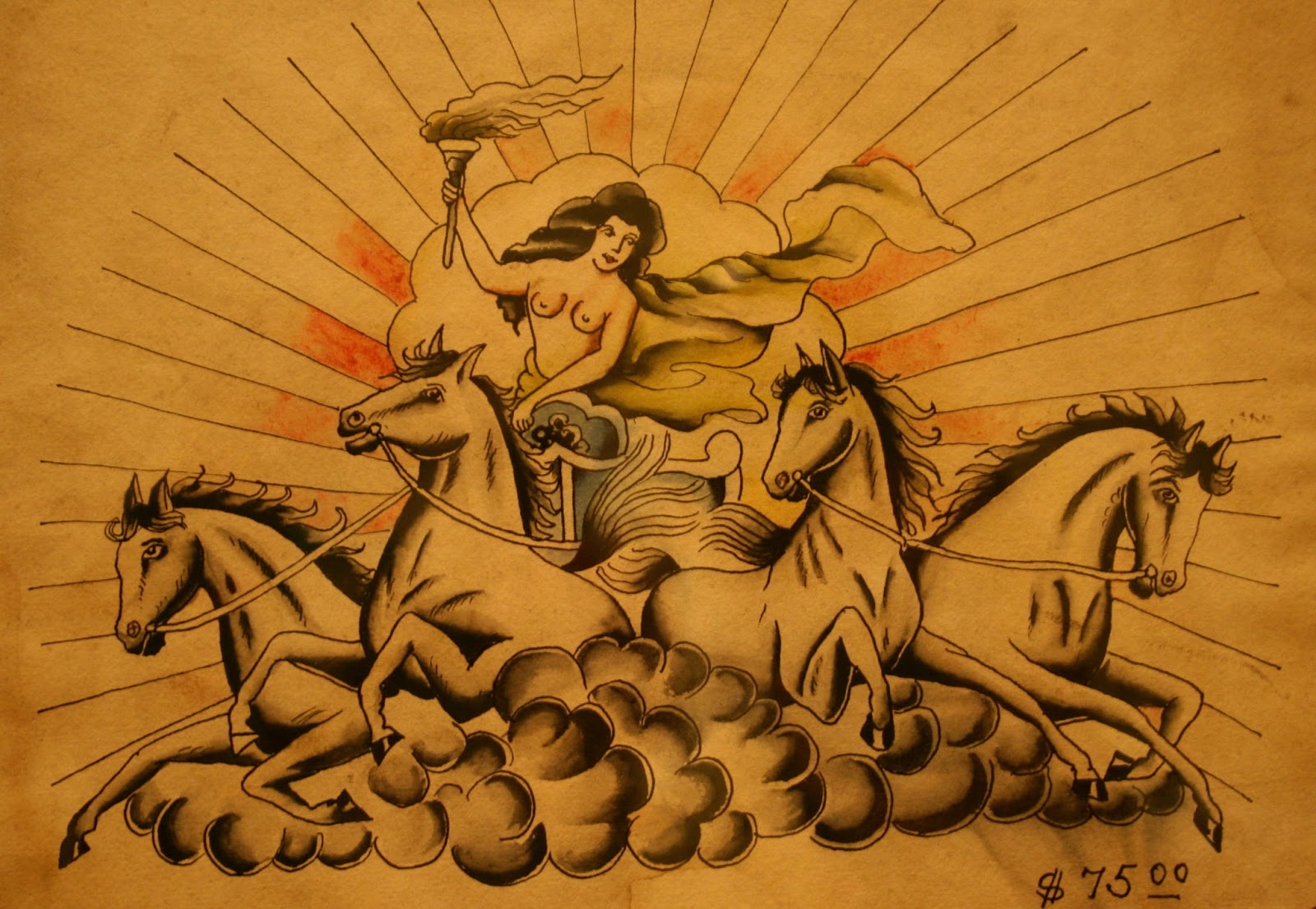
Tattoo flash by Amund Dietzel
During our 6-hour visit to Milwaukee last week, we made sure to go check out the Amund Dietzel tattoo flash art currently on view at the Milwaukee Art Museum. It was a phenomenal exhibit, showing the fine detailed work of a master's hand.

It is (sadly) unusual for tattoo flash to be displayed in art museums. There are several possible explanations for this: 1) the stigmatism of Western formalism prohibits self-taught artists from achieving their rightful place within the hallowed, white walls of fine art; 2) tattoo flash is portable and fragile and likely was not stored archivally by its creators, leading to a dearth of this kind of turn-of-the-century artwork surviving today; 3) the essence of flash itself is to be an inspiration, an opportunity for art, not a finished piece of work-- the finished piece is unique every time it is crafted onto a living, breathing canvas.

Amund Dietzel tattoos a customer
In honor of Harley-Davidson's 110-year anniversary, the Milwaukee Art Museum curated this special exhibit of an artist who, after serving as a sailor on transatlantic merchant ships during his adolescence, found himself shipwrecked in North America, where he eventually came to stay.

Amund Dietzel began developing his craft while aboard the merchant ships upon which he worked. Tattooing fellow crew members, he used a series of needles tied to a piece of wood with a strip of cotton cloth. I can only image what it must've been like to have to trust so completely in your own hand as you agonizingly stitched an image into a friend's arm, chest, or back. Sailor tattoos almost always commemorated an important event in their career, such as crossing an ocean, surviving a storm, and so forth, lending even more significance to the image that the tattooist was to create. In fact, the first tattoo that Amund himself received was to commemorate his first successful crossing of the Atlantic.


This traditional tattoo depicts the biblical Pharaoh's horses drowning in the Red Sea after Moses collapses the walls of water on the Egyptian's chariots. It symbolizes having successfully defeated one's enemy. 
As he became more and more immersed in the development of his craft, he met many tattooist mentors with whom he exchanged tattoos. Tattooing one another was a way for the artists to practice, try things out, and get free ink. Amund took several courses in painting at Yale (earning tuition money as a tattooist), but ultimately couldn't afford to continue going.

While in New Haven, however, he met one of his mentors: William Grimshaw. Grimshaw tattooed Amund from neck to ankles, covering his body in ink. Amund returned the favor, and the two travelled with circuses as tattooed men, a popular way of earning additional income at the time. Eventually, Amund's travels with the circus lead him to Milwaukee, Wisconsin, which is where he made a life and a name for himself, tattooing in his shop until the city outlawed tattooing in 1967. He died in 1974, at the age of 83.


The collection of flash on display at the Milwaukee Art Museum all comes from the private collection of a Milwaukee tattooist named Jon Reiter. After years of collecting Dietzel flash and other material related to Dietzel's tattooing career and life, Reiter published a two-volume biography of Amund Dietzel. These books are just gorgeous-- full of rich color plates of the flash and old photos of Amund and his friends tattooing or getting tattooed. Plus, Reiter has painstakingly researched old newspapers and other archives in order to piece together the story of Dietzel's adventurous life (including the legends and myths that Dietzel himself invented).


The exhibit of Dietzel's work reveals the art of tattooing to be a beautiful, old, americana folk art form that remains vibrantly alive today. You can see in each piece the control and steadiness of the artist's hand, a skill that was no doubt honed while tattooing aboard a moving ship. His images contain carefully shaded chiaroscuro contours on his ink-on-paper works, a testament to the way he must've been able to expertly manipulate his ink-on-skin works-- carefully drawing out the colors into soft yet dramatic gradients of light and dark.


The subject matter of this genre of art has a traditional repertoire, but that repertoire is continuously expanding. The semiotic language of tattoos can be universal-- once their meaning is established, these images become a pidgin that facilitates inter-linguistic and cross-cultural communication (which is what art is supposed to do). The fact that the collectors of this art must commit their very skin to each acquisition means that this art form is liberated of the "art stock exchange" that major art auction houses and galleries have come to represent in recent years. In other words, no one gets a tattoo so that they can later "flip it" and make millions of dollars on it-- rather, they acquire each piece out of a love for that piece.

Yeah, yeah. I know, there are drunken tattoos going on in basements all over the world. And there are celtic knots surrounding ambiguous Chinese characters, flanked by Tweety bird and Betty Boop. But there is bad art in galleries all over the world, too. Quality of technique, design, color and shading, content and concept factor as much into the critique and analysis of a tattoo as they do in a painting or sculpture. The tattooer also has to consider placement on a person's body, any blemishes or scars on the skin, and the way the ink is going to bleed into their "canvas" over time. It is an incredible artistic exchange that offers an intense and profound connection between artist, art, and collector.

It was fascinating to look at Amund Dietzel's flash art and begin to learn about his life in Rieter's biography of him (I still have some of the first volume and the whole second volume to get through!). But the exhibit seemed to be more a testament to the absence of an artist's oeuvre than to its presence.

Who were the people who came through his shop doors, pointed to one of those pieces of flash, handed over some dollar bills, and sat down to get tattooed? Where did they go? Where did they take their tattoos, Diezel's art?

At the end of the exhibit, one is left with the feeling that these small representations of a vast creative output are a floating piece of a larger artistic narrative that will never be linearly expressed or understood. The story of Amund Dietzel's art is dispersed in the world, in graves, in other countries, on wrinkled skin, in photographs, in flash.

This idea that the narrative of a tattooer's creative output will never be available to a viewer in one, comprehensive retrospective is beautifully demonstrated by author Shelley Jackson's short story, "Skin," published in tattoo form on the bodies of 2000-some volunteers. Each volunteer received a single word of the short story and got it tattooed on their bodies somewhere. The story will never be published in any other format... just like the story of Dietzel's art.

***
Please note, the Milwaukee Art Museum permitted photography in the Dietzel exhibit. All the photos in this post were taken by me.
***

Until next time, fair petticoat rustlers-- keep rustling!

Thursday, July 25, 2013

In Short: Harry Crews

I love short stories. They come by the book full; a whole collection of different little stories that you can read in an hour, sometimes less, and feel as utterly satisfied by that story as if you'd just finished a novel. You can read the stories in any order you chose. You can skip a story if you don't like its title. You can become attached to a character in the span of a page, and then you can leave that character as you found him, several pages later.

Welcome to the first installment of "In Short," the aptly named new feature here on the blog in which I will dedicate a weekly post to a short story and its author.

I decided that I need to read more short stories and write about them here. I arrived at this decision after recently (and voraciously) reading a collection of short stories in a couple of hours. My husband had insisted I read this one short story by Harry Crews called "L.L. Bean Has Your Number, America!"

Harry Crews. Photo by Tom Graves.  
"C'mon," he kept saying, "it's only seven pages. That'll take you, like, five minutes. And its a really great story." He had just finished reading this author's memoir and was now getting into a collection of his short stories called Blood and Grits. Every meal my husband and I shared included some episode, some remark, from the things he'd just read by this author. I had been wrapped up in reading the Brazilian epic, Os sertões (which will be a post unto itself), but when I finished that book there was nothing standing between me and reading those seven little pages anymore, so I did. And then I knew I had to read the rest of the collection.

Harry Crews was a beer-drinking man. And a vodka-drinking man. And a whisky-drinking man. And he wrote as if, after having been drinking all of those things all morning, he had gotten a little uncomfortably sober in the afternoon sun, irritated by anyone who happened to enter his periphery, and probably even self-consciously irritated by having to keep himself company if he was alone.

Yet, in spite of the jagged edge with which much of his writing is presented, there is a vulnerability that permeates each line-- the true brute masculinity of his writing is most evident in the moments of fear, melancholy, uncertainty, awkwardness. Crews has a remarkable way of looking shyly at something and then proceeding to describe it, always a little bashfully, in a savagely raw and accurate way. No frills, no apologies-- no attacks or accusations either-- just a timid observer with an unflinching gaze, a relentless power to see. The force of his narrative voice moves over his literary landscape with authority, but does not bulldoze it.

Here's an example from "L.L. Bean Has Your Number, America!":

The building in front of me, the L.L. Bean store, was a miserable-looking structure. ... For no good reason, I though it looked like the kind of building that would house a third-rate plumbing company on the verge of bankruptcy.

Source
The stories of Blood and Grits are strangely real, too. By strangely real, I mean they're non-fiction. Blood and Grits is a collection of this man's experiences and thoughts. All but one of these short stories were originally published in Esquire, Playboy, or Sport magazine in the 70s. These stories describe the confusion of the forest and its natural and unnatural inhabitants, the comfort of lonely dive bars along highways, the threat of violence from animals, the threat of violence from men, the crude impulses that we indulge in when we think no one (or everyone) is looking. They describe how many stupid ways we've come up with to stop hearing ourselves think, at the same time they listen deeply to the longing a man's soul can harbor.

One of his former students, Lucy Harrison, describes the collection like this: "It's a funny book. It's also awfully sad. It's about living the best you can with whatever burden you've chosen for yourself. It's about getting rid of that burden and dancing around like a crazy person. It's a book, largely, about drinking. ... It's a man's book. It isn't a guy's book. But I'm a girl, and I get every word of it. Got it?" 

Yep. That's about right. 


Source 
Probably one of my favorite stories from the collection was "Tuesday Night with Cody, Jimbo and a Fish of Some Proportion." It is such a simply story, all of 8 pages, in which nothing really significant happens. It takes place in a dark old bar sparsely populated with dedicated, professional drinkers. Crews describes the pleasure and downright necessity of such a worn-down  worn-in place: "Say it's sentimental or romantic or silly, but I'm convinced nothing new will work with whiskey because whiskey is never new. It's old and likes old things." 

The story is about two friends that don't shy away from demonstrating their "mutual admiration" by getting "locked up toe to toe and beat[ing] each other severely about the head and shoulders." One of the friends, Cody, brought a fish he caught that day into the bar and was estimating how much he thought it weighed. His friend, Jimbo, disagreed with that estimation. To settle the matter, the men took to the empty parking lot to put the powers of their pick-up trucks to the test in a reckless competition in which the friends, with trucks hitched to one another at the rear, tried to dominate his opponent's truck by putting full force on the gas peddle.

It's a funny story, but its also deadly serious, in the way you can tell a joke to a drunk who laughs at first but then suddenly becomes angry and dangerous. You watch two men take their lives into their hands, over the weight of a fish, on a Tuesday night, in a near-empty bar. And then they laugh about it and head back to their stools to finish their beers. Think about it.

Source
I am inspired to read more of Harry Crews' work, especially his fiction. He died just last year on March 12th, but he left behind a large collection of work. In precious few words, the Crews short stories I read today seemed to say so much about life. The tattoo on the author's arm, an excerpt from an e.e. cummings poem, shows in equally few words the way Crews felt about death-- at once taunting it and fearing it:


how do you like your blueeyed boy 

  Mister Death


***
What are your favorite short stories?? Have you read any Harry Crews?? What are your favorite author tattoos??

Until next time, fair petticoat rustlers-- keep rustling!!