Showing posts with label art. Show all posts

Tuesday, October 28, 2014

The Life and Afterlife of Things

Things, and the preservation of things, was as important in the Middle Ages as today. Image from a 15th-century edition of Boccaccio's Decameron. 
A network of medieval scholars from multiple different departments here on campus organized an incredible event that took place this last weekend. The Medieval Materialities conference brought together a huge variety of academics who, as the conference's title implies, are all working on projects that approach medieval history through specific objects or bodies, presenting ideas about the "life and afterlife of things."

The conference opened with what was for me the highlight of the event: a plenary discussion by the esteemed professor, Caroline Walker Bynum. I had just begun reading what is considered one of Bynum's most important books, Holy Feast and Holy Fast (1987), a book that recounts the fascinating role of food in medieval religious practice, particularly among women. After reading only the first chapter of this text, I knew I wanted to hear her speak in person, and am so glad I had the opportunity - Professor Bynum delivered a dynamite presentation. 

Her talk began with a paradox: the world's best preserved Catholic reliquaries and altars are to be found today, not in Rome or Castile, but in Protestant Saxony. While it is true that Rome's and other historically Catholic countries' museums are bursting with medieval objects of devotion, they are no longer in situ, a fact which changes their context and thus our ability to observe how medieval communities interacted with these objects. To illustrate this point, Bynum traced the histories of three particular objects of devotion that reside today in their original medieval location, Saxony, beautifully preserved. 
"Holy Blood Altar" in Rothenburg. The center
cross contains the relic. Image source.
She began in Rothenburg ob der Tauber, the location of the "Holy Blood Altar." This magnificent altarpiece was hand carved in the 15th-century by Tilman Riemenschneider, and features Judas as the central figure. The monstrance of this altarpiece was at some point replaced with a cross, delicately constructed to hold a crystal receptacle containing a small amount of Christ's blood. The continued and undisturbed presence of this relic as part of a main altarpiece complicated previous periodization theories of Protestantism's entrance into Saxony. 

Bynum explained that some scholars have ventured explanations for this curious persistence of Catholic practices in Protestant areas of Europe throughout early-modern history by studying Martin Luther's teachings. Luther believed that objects had no inherent sacrality and that likewise, images (art), were indifferent. This objection to the use of religious iconography as an integral part of worship accompanied by a staunch opposition to any form of iconoclasm. This has lead several researchers to posit what they consider a particularly Protestant method of "accidental" preservation: as the image is neither sacred nor a source of conflict, they must simply be left where they were found. 

Bynum's talk put forth a more nuanced theory by demonstrating that while the "let it be" theory seems satisfactory on the surface, it begins to lose ground when applied to Catholic objects that were preserved, not by Protestant indifference, but by continued and intense interaction with these objects through worship. 

The Holy Sepulcher in the Wienhausen cloister church. Ignore the little red circle on the tomb - this was the only image online I could find! Image source

In the Wienhausen cloister in lower Saxony, a figure of the dead Christ with exposed wounds rests in a decorated tomb. The Christ figure was made around 1290, when it came into the possession of the nuns of the Wienhausen cloister, and remains there today. Several marks and even medieval graffiti on the figure indicate to art historians that this Christ was approached from the right-hand side by the congregation, on a very regular basis, for devotional practices including the anointing of his forehead. Though nailed down now, the figure is hollow and believed to have been processed in performative styles of worship. Furthermore, there is evidence that a reliquary bundle had been inserted into his head. 

St. Barbara, painted in the 15th
century by the Master of Frankfurt
Bynum had examined multiple historical documents from the cloister which revealed the intensity with which the nuns protected this figure and fought to keep it in their church. Several abbesses outright defied the direct orders of Protestant bishops, who had told the sisters to send the statute to a museum. The abbesses cited the strong devotion of the community as their reason for noncompliance.  The continued use and vehement defense of this statue problematizes not only the periodization of Protestantism's entrance into Saxony, but also the reasons for the preservation of certain Catholic devotional objects and practices. 

Towards the end of her talk, Bynum highlighted the practice of sewing and embroidering clothes for statues of saints and angels, a devotional practice surviving in parts of Saxony long past Protestantism's supposed entrance into the region. She displayed images of the beautiful garments, full of ornamental embroidery, created by the nuns of the cloister for their church's statuary. Each saint and angel had several different outfits, reserved for different feast days and special moments in the liturgical calendar. Tags were sewn into the garments with the saint or angel's name and the day on which they were to dress the statues with these particular articles of clothing. (Unfortunately, for all the wonders of the Internet, I was unable to find images of the beautifully detailed garments professor Bynum showed. She did, however, mention the Madonna of 115th Street as a modern example of a similar practice.)

In the end, Bynum pointed to a fundamental disagreement people had then and continue to have today over the meaning of objects and our interactions with them. While one school of thought proposes that, in dressing and manipulating objects in the ways described above, we subject them to our authority and demonstrate their lifelessness by exerting our power over them. On the other hand, the contrasting school of thought believes that these practices enhance the mystery and aura of an object, giving it more life than they would've had without our interaction and, in some cases, turn the objects into a material connection to the divine. This question, Bynum indicated, is at the heart of the debate over medieval devotional objects and that our ability to reconcile the two polar opposite schools of thought is likely related to our understanding of performance. 

The remainder of the conference exposed the vast array of intellectual interpretations of medieval materialities, some related to devotion and others related to daily life: literature, architecture, gifts, birthmarks (!), pastimes. I believe, though, that each panel related back to professor Bynum's initial plenary session, by asking the question which ultimately needed to lay at the heart of a conference on Medieval Materiality: "What does the object do and, more importantly, what does it make me do?" 

***
The conference was full of so many engaging discussions - hopefully a few more of them will make it onto the blog! 

Until next time - keep rustling!

Tuesday, October 21, 2014

Painted Geneology


As will happen while obsessively pursuing details about the life and posthumous fame of a single historical figure, a moment of pure serendipity has granted me a rare look at a beautiful (and relevant!) illuminated manuscript. As I was preparing my post last week on Saint Isabel, I searched for images of her online to help tell her story.

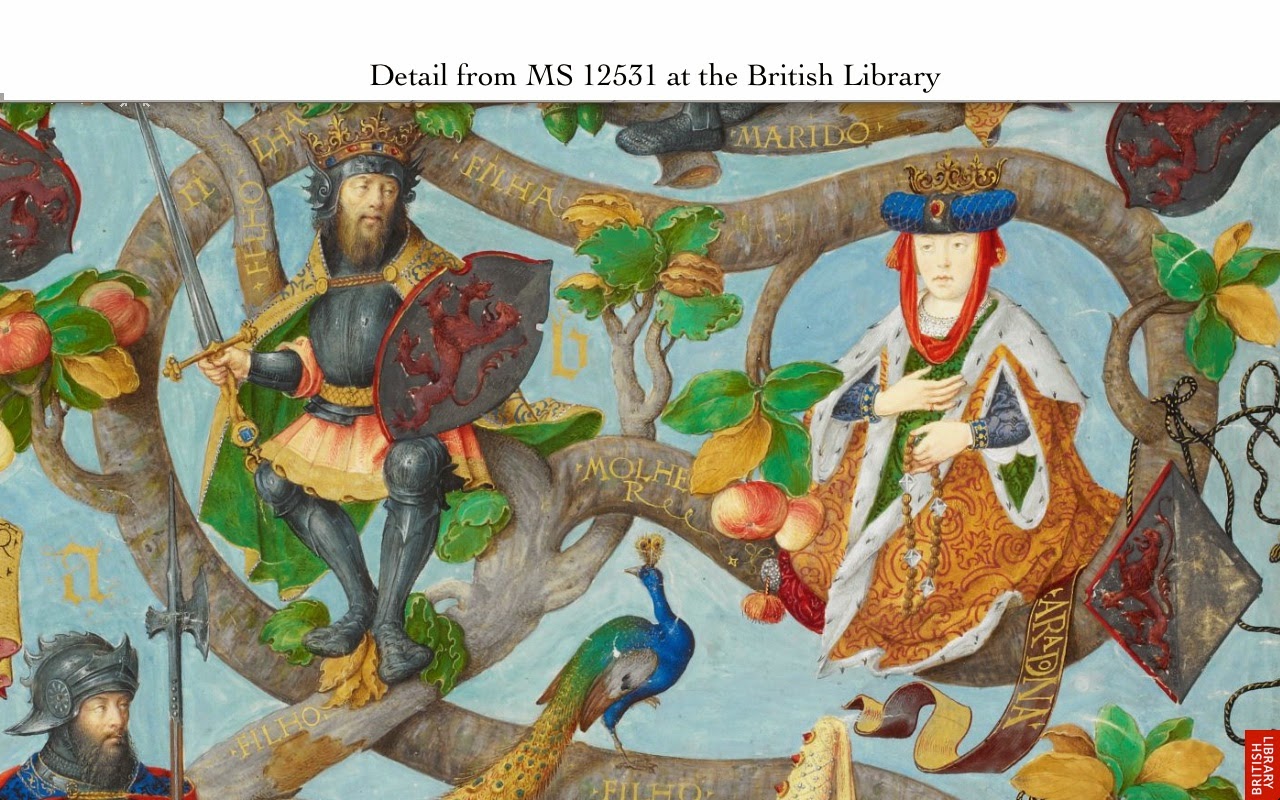
The two XVII-century paintings I found, little did I know at the time, turned out to be a part of a never-completed pictorial genealogy of Portuguese kings and queens. Thanks to the expediency of digital technology, I was able to easily track down the manuscript and happily find its digitized version on the British Library website.


The images in this post are my own screen-captures of that manuscript which, although unfinished, boasts several gorgeous and richly detailed miniatures and full-page paintings. There are large blank spaces where the text would have gone, but as the manuscript was never completed (that we know of), these 11 leaves provide an interesting look at the process of illumination, including unpainted drawings.


I invite you to look closely at these incredible leaves, available on the British Library site here. To find the images of Saint Isabel, you will find them on the Recto side of the 9th leaf - she is down at the very bottom of the page, elaborated with surprisingly precise and prolific detail, in spite of being quite tiny.

***
Until next time -- keep rustling!

Wednesday, October 15, 2014

The Scent of Roses

Isabel de Aragão, Queen of Portugal, arrives at Santiago de Compostela after completing a long pilgrimage on foot.
Painting by Antonio de Hollanda, c. 1530
Queen Isabel depicted with roses.
Painting by
Francisco de Zurbarán, c. 1635
My reading has taken on a particularly intense focus, now that I have a definitive dissertation topic and am able to read daily with the beautiful backdrop of the autumn campus. I have begun research on a 14th-century queen of Portugal, Isabel de Aragão. Isabel was first made queen, then became a mother, and two centuries after her death, was made a saint through the official canonization process of the Catholic Church. 

Of the miracles attributed to her, the most popular among her devotees seems to have been the tale of how she discovered roses, all around her, during a season in which it was impossible for them to grow. After her death, her tomb and incorruptible body were said to give off an intense and pleasant aroma that resembled roses. 

Roses are not in bloom here on campus, but I sense the power of her story all around me. Her life, told and retold in many different ways over the centuries, offers a unique perspective on medieval Queenship, motherhood, sainthood, female identity, and most importantly, how all of these things could be brought into harmony under very specific, very dire circumstances... 

The Queen gifts her crown to the Archbishop of Santiago de Compostela. Antonio de Hollanda, c. 1530
The 14th-century was witness to a particularly catastrophic confluence of events. The rampant spread of plague led to the underpopulation of huge swaths of rural land. This lead to both economic downturn as well as easily disputed borders between territories; fighting to maintain hard-won land often resulted in dismayingly high death tolls which only served to further weaken the populations of the countryside. 

Isabel Queen of Portugal heals a woman
on the Camino de Santiago.
Francisco de Goya. 
The sometimes tenuous claims to the Portuguese throne also exacerbated conflict within the kingdom. Isabel de Aragão's own son, for instance, launched a civil war against his father, King Dinis and one of the king's illegitimate sons who was rumored to have been favored as heir. Through all the turmoil, Isabel must have appeared as a beacon of hope: her impressively calm and rational demeanor (traits typically associated with men during that time) made her much beloved by the Portuguese people, who called her saint even before her death and canonization. And yet, in spite of her socio-political and mythic importance to people throughout Portugal, her native Aragon, and neighboring Castile, her story has more recently been relegated to the archives.

For centuries following her death, she was depicted in poetry and theater, celebrated as a popular hero and saint on what became her feast day (July 4), and ascribed a powerful position in the collective Iberian memory. In the late 17th-century, the chapel she built and the order of Clarisas (Franciscan nuns) that she founded was flooded by a river that had outgrown its 14th-century banks. The basement of the church was filled with water and left to rot for a small eternity: it was not until the 20th-century that the church was finally cleared out and restoration began. 

Isabel de Aragão's tomb in Coimbra
Her tomb had of course been previously removed, to a second church of the same order, but nevertheless the original 14th-century church that lay in disrepair, all but forgotten, had at one time contained important artifacts and documents pertaining to Isabel's life. How can it be that the material legacy of this beloved woman was left unattended for so long by those who loved her? 

Isabel's story fascinates me. She is the daughter and mother of kings, and granddaughter of another queen-saint (Elizabeth of Hungary). She was powerful, but considered poor and humble; she was a mother, but considered chaste and holy; she was an important stateswoman, remembered for her peacekeeping efforts, but also for her transcendence of terrestrial powers, owing to her connection with the divine. Isabel performed very few miracles when she was alive, but she was called saint by all who knew her during her life nonetheless. After her death, her popularity continued strong for centuries and then seemed to abruptly decline. What explains this dramatic rise and fall in the popular imagination? 

In a recent conversation with my advisor, I remarked on how small and humble the miracles were that Isabel had performed during her life. I marveled at how strong the devotion was to her in spite having almost no high profile miracles. "You're right," began my advisors reply, and with her sparingly-used droll sense of humor, "only a queen, mother and saint. Why wouldn't she have had time for more miracles?" 

***

Until next time -- keep rustling!

Sunday, March 30, 2014

Spring is Like a Perhaps Hand

Allegory of Spring by Sandro Botticelli, c. 1482
Spring is nearly upon us. To celebrate: e.e. cummings and Renaissance paintings featuring the spirit of the season.

"Spring is like a perhaps hand" - e.e. cummings

Spring is like a perhaps hand
(which comes carefully
out of Nowhere) arranging
a window, into which people look (while
people stare
arranging and changing placing
carefully there a strange
thins and a known thing here) and

changing everything carefully

spring is like a perhaps
Hand in a window
(carefully to
and fro moving New and
Old things, while
people stare carefully
moving a perhaps
fraction of a flower here placing
an inch of air there) and

without breaking anything.

Spring by Pieter Brueghel the Younger, c. 1622-35
[in Just -] - e.e. cummings

in Just-
spring         when the world is mud-
luscious the little
lame balloonman

whistles       far      and wee

and eddieandbill come
running from marbles and
piracies and it's
spring

when the world is puddle-wonderful

the queer
old balloon man whistles
far      and         wee
and bettyandisbel come dancing

from hop-scotch and jump-rope and

it's
spring
and

     the

          goat-footed

balloonMan       whistles

far
and
wee

Nymph of Spring by Lucas Cranach the Younger, c. 1545-50
***

Until next time - keep rustling!

Saturday, March 29, 2014

Ghost Lovers

Orpheus and Eurydice by Sir Edward John Poynter (19th century)
The last couple of posts (here, here, and here) have dealt with the way in which love and death are intertwined in Renaissance literature, provoking melodramatic liebestod finales to a host of 15th and 16th century narratives. In the process of considering these narratives in which the desire to love lead to a desire for death, however, I was reminded of the stories in which death failed to create an insurmountable boundary for the lovers. The surge in popularity of classical Greek mythology in humanist Renaissance Europe makes me think that it would not be a huge leap of faith to assume the tale of Orpheus and Eurydice was fresh in the minds of poets and authors composing sentimental romances.

Orpheus is prepared to descend to the underworld to bring back his lover, not accepting death as the final act of his love story. But in his refusal to accept Eurydice's death, he confirms its permanence, looking back over his shoulder to catch a glimpse of her ghost materializing behind him. In popular folk narratives, stories in which lovers return from the grave for one final visit are not uncommon. This "one final visit," I believe, can be seen to function in two ways. On the one hand, the ghost returns to comfort their lover and properly say goodbye. On the other hand, it affirms the finality and permanence of death's grip, ending with the ghost vanishing back into the realm of the dead.
Orpheus and Eurydice on the Banks of the Styx by John Roddam Spencer Stanhope (19th century)
Although none of the 15th century Iberian stories that I've looked at over the past week narrate a lover returned from the dead, I do recall an Irish folksong that my mother always used to sing when I was little. It is a night visiting song, in which the ghost of a young woman's lover who died at sea wakes her one night to say one last farewell.

Here is a nice version of the song:


A similar tale is recounted in "The Night Visiting Song" by Luke Kelly:


These are potent stories that emerge across many cultures and historical periods. I recently stumbled across a cajun-French song from Louisiana, "Pa Janvier," performed beautifully by the International Blues Express. The song is a sorrowful appeal to Father January (Pa Janvier), the allegorical figure for winter, whose icy cold wind stole the health and life of a young woman. The song is the lament of the young woman's lover who has survived her, and he pleads with Father January to return to him his love.

They were recorded doing the song by the 78 Project, a husband and wife duo traveling the country recording traditional musicians on a 78 recording machine, very much in the style of Alan Lomax. Take a listen to these incredible musicians (who hail from the American Delta and West Africa) perform the doleful tune for their recording session:


***
Do you know any night visiting songs? What are your favorite tales of ghost lovers?

Until next time - keep rustling!

Friday, March 28, 2014

They Stand on the Earth and They Cast Their Own Shadows

Detail from Masaccio's painting of the Expulsion of Adam and Eve in the Brancacci Chapel

The many star-crossed lovers of yesterday's post may have come from different literary traditions, but they were all unified by the way in which suffering and desire became hopelessly and fatally tangled in their stories. These tragedies, unfolding at the intersection of pleasure and pain, presented themselves as not only believable love stories but natural ones. The sentimental romances and lyric of the late-Medieval/early-Renaissance Mediterranean make it seem hauntingly natural that the birth of love should lead to the death of lovers.
Masaccio's painting of
Adam and Eve in the
Brancacci Chapel

In grappling with what makes death and desire so inextricably linked in the literary production of this time period, I decided my research needed to go back to the beginning - all the way to the beginning - in order to ascertain the origin of this link. And by "the beginning," I mean the book of Genesis.

The story of Adam and Eve sheds a great deal of light on the connection of desire and death. As a result of their expulsion, they became mortal and died. But at this same moment death becomes their reality, they are born into their humanity and therefore sexuality. As Adam and Eve leave the garden, they experience a sudden awareness of their bodies. This awareness inspires both a tragic self-consciousness full of shame and a thrilling awakening to the possibilities of material connection with one another. In the story of Adam and Eve the origin of human death and suffering is also the origin of human sexuality.

Although it was not the love Adam and Eve had for one another that caused their suffering, as is the case in the sentimental romances, their relationship was defined by the moment in which they became fully human and began experiencing together love, suffering, and death. This confused and terrible moment of leaving Eden unites Adam and Eve (archetypes of all women and men) in both love and death forever.

Patricia Grieve, in her book Desire and Death in the Sentimental Romance, has referred to love and death as the two great mysteries of humanity and thus as necessarily occurring side-by-side in literary representation: "As the two great topics of poetry - unsolvable mysteries both - it is no surprise that [love and death] should appear with great frequency in literature."

Masaccio, the Italian painter of the 15th-century, had a profound influence on other painters of his century and on the Renaissance in general. His depiction of the Expulsion of Adam and Eve in the Brancacci Chapel eloquently narrates a scene of great suffering and great beauty, all embodied by the human form.

When renowned art historian and critic, Sister Wendy, contemplated this image, she noted how representational it was of the overarching ethos of the Renaissance. To the denizens of the Renaissance world, humanity was dignified, in spite of the suffering and grief with which it also constantly had to contend. "They stand on the earth and they cast their own shadows," Sister Wendy said, "that's what the Renaissance was about: humanity as upright, suffering but responsible."

This insight, I believe, is crucial to understanding the link between desire and death in Renaissance works of literature. The overwhelming feelings of love experienced by the protagonists of 15th-century sentimental romances were invariably accompanied by a sense of immense responsibility owed to the object of their feelings. Love allowed the protagonist to encounter the eternal for the first time - feeling love was connecting with a never-ending current of human emotion. But the precarious business of ensuring that their love was fully requited by the object of their desire endangered their experience of the "eternal" nature of love. This caused great anxiety and suffering until it seemed their only recourse was to experience eternity in the only other bodily way available: death.

***
To hear the rest of Sister Wendy's incredibly preceptive discussion of Masaccio's painting, watch this video from minutes 2:00 - 5:00. If you happen to have 30 minutes available, I highly recommend watching the entire episode.


***
Until next time - kept rustling!

Saturday, March 8, 2014

Art and Voodoo

Today was beautifully sunny and the smell of fresh spring grass filled the air. The optimistic sound of melting snow could be heard around every corner. The snow that was melting all day today, however, only fell just yesterday... it snowed all day yesterday! To beat the gloomy weight of the gray sky, my husband and I spent the day in Denver. We went to see the brand new exhibit at the Denver Art Museum called "Modern Masters." I'm so glad we went - the exhibit was fantastic and we spent an amazing day exploring the city.   

Frida Kahlo - now on view at the
Denver Art Museum
The art exhibit displayed works that ranged from 1880-1980, demonstrating the trajectory of visual vocabularies throughout the twentieth century. Emiliano remarked that this exhibit would've been the "whole chapter" in an art text book on the 20th century, and I agree with him - all the canonical artists were there, from Georgia O'Keeffe to Roy Lichtenstein. There were several rooms filled with pieces from the early avant-garde of the 10s, 20s and 30s, and other rooms displaying pieces from the avant-garde's subsequent resurgence in the 60s and 70s. Art decorated room after room of gallery space, leading the viewer on a journey through some of the most iconic images of the last century.

I learned so much at this exhibit. For instance, I learned that I am a huge fan of Arthur Dove and Clyfford Still, of Chaïm Soutine and Giacomo Balla. I also had the opportunity to see, for the first time in person, some works with which I already felt a great connection. One of those works was a self-portrait by Frida Kahlo. I had never seen her work up-close and personal before, and it was truly a different experience than looking at reproductions in books. To the chagrin of several other museum-goers, I stared at the piece for quite a long while...

Recently, my attention has been so focused on medieval art and writing; perhaps for this reason I found myself shocked and almost overwhelmed with surprise in this exhibit. I had a sense, as I moved from room to room, that the twentieth century was already a distant past of human history - no more distant or near to us as than the medieval. But how can that be? I was born in the 20th century!

The themes and techniques of the Modern Masters on display in Denver seemed, in many ways, to be of a bygone era. The 20th-century sensibility: informed by two world wars and a cold war, death and rebirth on national scales, the advent of the modern car, the dishwasher, the video camera, the home computer, and a moon landing. The demands on artists and art viewers seem to have been so different then - with artists often seeking deliberately to antagonize their viewers and their viewers frequently responding with defiant enthusiasm. The role of the academy even seems to have been more successfully eschewed by artists prolifically producing new aesthetics faster than the academy could appropriate and normalize them.

This feeling that the 20th-century was now a distant past became especially acute when I approached what became one of my favorite pieces of the entire exhibit: "Dynamism of a Dog on a Leash" by Giacomo Balla (1912). The study of movement, reproduced in paint almost "frame by frame" in a pre-film art world:
Giacomo Balla - now on view at the Denver Art Museum
Yet at the same time, as I look again at this piece, I realize that maybe the concerns of 20th-century artists are closer than I think. Are we not still grappling with understanding how the world moves and how we witness that movement or mark our time spent moving in it? Isn't that what 21st-century performance art and installation art attempts to address, at least to some extent? What do you think?

While it is true that we now have tiny universes in our palms (smart phones) and that we can photograph or film anything we want whenever we wish, we are still astonished by our own movement, shadow, landscape, transparency, time. Painting is a technology, just like a tablet or a smart phone. We are still obsessed with putting our technologies at the service of artistic aesthetics, still using it to launch ourselves faster into the future of cultural production, evading standardization.

I have so many thoughts on the exhibit and plan to dedicate some future posts to artists that I discovered there. In the meantime, here are some photos from the rest of the day, which included wandering around the permanent collections, grabbing an amazing fish-fry, and then standing in line (in the snow) for about half an hour to experience the mind-blowingly delicious doughnuts of Voodoo Doughnuts.


***

Until next time - keep rustling!

Tuesday, March 4, 2014

Medieval Women (and their fans)

Miniature of a woman painting, from a 1440 manuscript of Boccaccio's "De claris mulieribus"
The role of women in medieval mediterranean culture was the subject of a large-scale debate, carried out in the writing of various intellectuals throughout the XV century. Not only male intellectuals but also several women writers participated in the debate. Among the female writers who offered contributions to the discourse on women was Sor Teresa de Cartagena. She suffered illness most of her life and subsequently penned the "Grove of the Infirm," a work which extolled the inherent virtues of women and the holiness of all those who suffered bodily sickness. Her stance is considered today (somewhat anachronistically) as "proto-feminist," although I think that a more appropriate designation would be "pro-women," as the term "feminism" tends to conjure up a repertoire of 20th-century issues and stances not present in the medieval mediterranean context.
Woman painting self-portrait; from 1440 manuscript of Boccaccio's "De claris mulieribus"
The work of the poet and humanist of the French court, Christine de Pizan, also circulated widely and was responsible for adding formidable arguments to the debate: she demonstrated both in her writing and in the example of her own life, the many ways women could enrich intellectual and political culture.

These women's voices were joined by male contemporaries, such as Diego Valera and Juan Rodríguez de la Cámara, who both defended the value and virtue of Christian women by revindicating the narrative of Eve, displacing to Adam any role in the Fall and the creation of Original Sin. Martín de Córdoba added to this chorus of male voices with his El jardín de nobles doncellas ("The Garden of Noble Maidens"), which was written specifically for the soon-to-be Queen Isabel the Catholic.

A significant contributor to the debate over women was the courtier, Álvaro de Luna. The Libro de las virtuosos e claras mugeres ("Book of Virtuous and True Women") is a collection of exemplary tales that he wrote about illustrious female figures from the Bible, Greek and Roman mythology, and ancient history. He begins this work with the Virgin Mary, whom Álvaro de Luna writes is responsible for the reversal of Original Sin. He follows his marian narrative with the story of Eve, in which he relieves her of any guilt in the Fall, placing blame instead on Adam, in line with the reasoning of the other authors mentioned above. He continues to enumerate the exceptional lives of various biblical women (including Judith, one of my favorites).

Peter Paul Rubens, "Cimon and Pero" c. 1630
Example after example of extraordinary women makes up the body of Álvaro de Luna's text. Like female Hercules they form a pro-woman narrative that makes women seem saintly, unerring, and ever-wise. In two short chapters, the author recalls the Classic stories of women who allowed their parents to survive dire circumstances by feeding them with their breast milk. The proliferation of stories of women doing whatever necessary to ensure the utmost moral conduct eventually begins to make the mere mortal female reader (such as myself) doubt her ability to ever live up to such expectations - or even wish to. The physical and psychological torment that many of these exemplary women experience makes it seem near impossible to live a comfortable life and be a virtuous woman. The women of the Libro are prepared to endure hideous torture and death to preserve their extraordinary virtue, guided always by their own moral compass and the hand of God Himself. Meanwhile, a contemporary text that addresses virtuous men, written by Fernando del Pulgar, offers a much more attainable vision of masculine virtue (think: "sure, he may have committed adultery a bunch of times... but he's such a great soldier!").

And yet Álvaro de Luna's enthusiasm for women resounds with an optimism for the future role of women in his society. His series of prologues offers the reader an important framework with which to understand the rest of his text. On multiple occasions, he notes that women are not "inherently" bad or good, they are a product of their habits and habitual actions, as are men. Last week I got the opportunity to discuss this work with my colleagues in a seminar and we all noted how modern Álvaro de Luna's thesis seemed to be. After discussing his Libro, we proceeded to read aloud several of his poems. ...They were so saucy! I can't say that I was surprised to read sensual poems about being hopelessly in love with women (including women other than his wife) from a man who vehemently defended his female contemporaries.
Woman painting self-portrait from 1440 manuscript of Boccaccio's "De claris mulieribus" 
Álvaro de Luna's Libro was greatly influenced by Di claris mulieribus by Italian author, Boccaccio. Interestingly, Boccaccio wrote works that fit into both the pro-women and the anti-women categories. Of course, Di claris mulieribus fits into the former category. Although I have not yet read the Italian author's text, I plan to do so soon, especially after finding this article which displays various miniatures adorning the original manuscript and depicts women as painters and sculptures!

Finally, in honor of today being Fat Tuesday, I leave you with a picture of my 9-year-old self at carnivale in Venice. Donning a mask my parents got for me earlier that day from a magical little mask shop perching above the glass-green water of the canal, I have my arms outstretched, as if trying to embrace the whole city, all of its masked inhabitants, and the women-loving tricksters that had populated its narrow streets since medieval times...

***
Happy Fat Tuesday!

Until next time -- keep rustling!

Tuesday, January 28, 2014

Tricksters and Devils

Source
Recently my reading has focused on the evolution of the devil figure in mythic and folkloric narrative of the judeo-christian tradition. In order to understand how he came to be depicted in both the comical and moralizing verse in 20th century Brazil, I wanted to know how readers' or audiences' attitudes towards this figure evolved over time; what socio-cultural narratives may have contributed to the image of the devil found in modern cordel literature.

One of the devil's most important proxies is the Trickster. With the audacity to reveal our base human impulses, and with the wisdom to annunciate core philosophical realities of human experience, the Trickster is a near-ubiquitous character in folk narrative - from all over the world. There are striking similarities in the way in which the devil and the Trickster are portrayed. 

Although I am but a beginner in Trickster studies, Professor Harold Scheub is most certainly not. His book, Trickster and Hero (2012), provides a global perspective on the Trickster figure... Here are some excepts from his fantastic book, which I've been simply devouring. Accompanying his insights are some images of the Zanni tricksters of the Commedia Dell'arte repertoire. 

Jacques Callot (1592-1635) Engraving
"The profane or earth-bound trickster is, like the divine trickster, obscene, aggressive, selfish, amoral. In this, he is closest to the basest of humans. ... Yet, in a way, the profane trickster does retain an echo of the divine connection, if tenuously: he also creates in the sense that he creates a world of illusion; he imposes his own corrupt sense of order on the real world. An agent of chaos, he disrupts harmony; when he establishes harmony, it is according to his own whim, his own sense of order. Trickster combines horror and glee: his is the comedy of the grotesque." 

"The trickster through performance binds present and past. The tale is the moment in which past and present are blended in a performance." 

"Trickster would have no existence, would have no meaning, would make no sense whatsoever if we did not understand the frame in which he operates. He is forever theatrical. He creates theater in the world that we know, the real world. Without that frame, Trickster's antics are merely obscene and silly But within that frame, he becomes significant and eternal. Trickster makes the flawed moment eternal." 

"There are mighty forces, represented by God, Leopard, Lion. The weak cannot prevail over them, they have all the power. They create, they establish boundaries. But in the trickster tale, those boundaries are loosened, violated; the power of gods, of the great animals, is called into question, and chaos results." 

Source
***
Who are your favorite tricksters? What are your favorite books about the history of the trickster or devil? 

Until next time - keep rustling!

Thursday, January 9, 2014

The Devil on the Road Home

"Landscape with the Temptation of Christ," Pieter Bruegel the Elder; mid-18th century
Yesterday's post described the tumultuous public life of Antônio José da Silva, "The Jew," and offered a brief overview of his artistic production. This post will be dedicated to one of his works in particular: Obras do diabinho da mão furada, which can be roughly translated as: Tales of the devil with the pierced hand. Other versions of this story have surfaced in alternate re-copyings of the original manuscript under the title Obras do fradinho da mão furada which replaces the word "devil" with the word "friar."

Published in the early part of the 18th century, a time in which the Inquisition retained a strong and widespread presence throughout the Iberian peninsula and its colonies, da Silva's portrayal of the devil disguised as a friar both in the story and in the story's title was potentially quite risky -- especially given his already-tenuous relationship with the Holy Office. However, the devil dressed in a friar's robes was not without its precedent in Europe by the time da Silva wrote his tale.

In the German tradition, for instance, plays and pamphlets about Bruder Rausch ("Friar Rush") enjoyed several centuries of success. First appearing in the high middle ages, the story of this demonic trickster in holy garb was reworked and retold throughout Germany from the 15th-19th centuries, including a contribution from Stuttgart native, Wilhelm Hertz, who published a novel-length tale based on the Friar Rush lore in 1882.

Although it is difficult to say if these German tales were retold in Portugal, the devil-disguised-as-friar motif was undoubtedly widespread in Europe since as early as the 15th century. Manuscript marginalia produced by monastic scribes of the medieval period made healthy use of the motif. In her book on humor in the middle ages, Valarie Allen has written about a recurring image of a wolf in Dutch marginalia: a wolf in friar's robes preaching to a flock of sheep.

Da Silva's devil-disguised-as-friar narrative, in spite of these possible influences, is truly unique thanks to the devil's supporting lead character. André Peralta is a broke and weary soldier, trying to make his home to Lisbon after almost a decade of continuous battle in Flanders. The story opens in the midst of a terrible nighttime storm; Perlata is on the road, still far from Lisbon, and desperately he seeks some kind of refuge from the tempest.
"Soldiers in landscape," Pieter Bruegel the Younger; 16th century
Before long, he comes upon what appeared to be an unoccupied house. After warming himself by a fire and consuming the last of his food provisions, he drifts off to sleep, only to be awakened at midnight. Standing before him is a hideous old man, dressed as a friar, with cloven feet.

After only a few minutes of conversation, Peralta figures out who his new companion is, and he is appropriately wary and guarded, trying at the same time not to anger the "friar" nor coalesce with his plans entirely. During their first conversation, the devil tells Peralta that he will accompany him on the rest of his journey home. Peralta quickly declines this offer, whereupon the devil makes the rain pour inside the house, as a warning.

The devil explains that because Peralta has chosen to take refuge the devil's own house, he must show the devil some respect. The devil adds, however, that he feels compelled by some "causa secreta" ("secret cause") to help the poor soldier through to the end of his journey. This is a fairly transparent threat: the "secret cause" that inspires the devil to "help" Peralta is most likely the same impulse the devil has to meddle in anyone's life -- he wants to stir up mischief, hopefully leading to Peralta's downfall, and the devil will not be denied.

Without any other recourse, Peralta agrees, but makes it clear that he has made several promises to God that he will not break, considering the fact that it was God who helped him survive the hideous, endless battles. The pact is sealed. 

From here, a series of fantastical encounters unfold along way home, each one affecting Peralta more and more. The first night, the devil hosts a meeting of witches where he praises them for having sucked the lifeblood from unbaptized children. The next night, Peralta has a Dantesque dream (which may be also understood as "reality") in which his devil companion leads him through Hell.  

Unlike Dante's vision of Hell, there is no hierarchical organization -- things are quite chaotic and there is a lot of running around. Instead of orderly levels that descend into ultimate evil, Peralta seems to be making his way through a series of rooms or caves that have no particular order, a vision of Hell that recalls Spaniard Francisco de Quevedo's early 17th-century Sueños.

Many of the condemned quarrel with their demonic tortures, requesting an audience with Satan himself, arguing that their punishment should be forgiven because their sins helped the cause of Hell. After a while, Peralta approaches the most graphically and painfully tortured residents of Hell, those who do not even try to grapple with their torturers. These poor souls, the devil informs him, are those who in life "judged others" and "interfered with religion" -- an overt allusion to the Inquisition. 

I would argue, too, that an implicit critique of the Inquisition lies in the general chaotic nature of Hell itself. The self-righteous arguing of the condemned with their torturers, the requests to "see the boss," as if they'd be able to reach a deal if only they could talk to someone in charge -- all of these actions seem very, very like the way people (especially powerful people) interacted with the secular bureaucracy of the time. 

"A peasant brawl," Lucas Vorsterman I, circa 1620
When Peralta wakes up from this dream, the two continue their journey. Along the way, the soldier witnesses the way in which the devil sows mischief and anger everywhere he goes. He repeatedly insights townspeople to "jurar," or "swear," with popular expressions of exasperation: "Devil may take it," or "Devil take you!" As people utter these curses, the devil collects what has been commended to him. These scenes are more funny than cautionary, full of scatological and sexual anecdotes, along with a favorite source of humor during the day, a woman's wrath. 

In another folio, the devil shows Peralta a vision in a river that depicts palaces of the 7 deadly sins, personified allegorically as women, inviting sinners into their dwellings. The soldier is almost trapped permanently in this vision by Greed, who does not want to let him go. Her silent bodyguard, Midas, approaches Peralta with fingers outstretched, attempting to turn him into gold so his master can keep him forever. 
"The Allegory of Greed," Pieter Bruegel the Younger, early 16th century
What makes this scene particularly interesting, aside from the fact that da Silva has mixed medieval judeo-christian allegory with Greek mythology, is that in the first folio the devil helped Peralta dig up a forgotten chest of gold. Peralta sowed the coins into his clothes, so that the devil could not take them back. In a way, then, Peralta's physical person is already covered in "bedeviled" gold. This gold eventually serves to help Peralta escape his companion, when Peralta offers it all to a traveling priest's monastery if Peralta is allowed to take the cloth there.

In the end, Peralta succeeds in tricking the devil. He sneaks off one morning while the devil is settling a score with some boatmen (the devil had it in for the boatmen because he heard local people swearing that lot was worse than the devil, replacing their popular curses with "Boatman make take you!"). Peralta enters the monastery, thereby commending his own soul to God and the devil's gold to the service of Good. This ending reveals Peralta to be a more picaresque character than he initially appeared. The devil continues to wander in his friar's robes, recalling another classic trope, the Wandering Jew, as he travels from town to town, never settling, alway meddling.

I find this story fascinating not only because of the political risks it takes but also its mastery of popular style, humor and wisdom. Da Silva deftly interweaves a complex Good and a complex Bad, refusing paradoxically to allow the archetypal characters to occupy 2-dimensional roles. His idiosyncratic portrayal Hell and even the allegorical figures demonstrates his intense creativity and the high literary merit of his writing. Although his life was short, his writing has become immortal and echoes da Silva's criticisms, jokes... and ultimately, his deepest fears.

***
What are your favorite tales about the devil or other tricksters? How are they outwitted?

Until next time -- keep rustling!

Monday, January 6, 2014

La Belle et la Bête

by Mercer Mayer
As a child, I was read Marianna Mayer's beautiful telling of the Beauty and the Beast story. Her husband, Mercer Mayer, illustrated the book with gorgeous paintings that greatly influenced the way I imagined the story in my mind ever-after.

by Mercer Mayer
As an adolescent, I watched the 1946 Jean Cocteau film version of this French tale, encountering a new set of visual vocabulary with which to understand and imagine it. In the film, the dark corners of Beast's enchanted castle throw black shadows across the pale youthful face of Beauty, engaging simultaneously the magical-myterious and the realistic-dangerous elements of coming-of-age. At 14 years-old, I felt deeply the struggle between acting upon instinct and acting out of obedience; the benefits and pitfalls of acting solely out of either instinct or obedience are exemplified by the main characters. 

I also watched Beauty attempt to establish a safe barrier between herself and her companion--a friend with whom she lived and who daily provoked the idea of marriage and thus physical union. As the Beast's voice grew more gentle to Beauty's ear, she found it increasingly more difficult to refuse experimenting with his touch and exploring the reaches of her love for him. Here is the scene from the film I think best attests to these feelings: 


I love how here we see Beast's ears and eyes become riveted instinctually upon a helpless doe, in the middle of conversation with Beauty. Although Beast struggles to tame his animal impulses and appear to Beauty as a "civilized" and gentle creature, he unwittingly reveals the continued influence of the impulses of a predator. Beauty, then, goes to the fountain and invites him to drink water from her hands, reestablishing his domesticity and allowing herself to feel the touch of his lips, even if only on her hands.

Yesterday, my husband and I came across the trailer for a brand new film version of the story. The costumes look fabulous, and the highly evolved CGI technology promises to bring to life a particularly interesting Beast...


The film is scheduled to debut on February 12, 2014 in France. Although I'm not sure when it is set to arrive in American cinemas, I look forward to seeing this latest iteration of the beautiful 18th century tale.

For more information on the history of Beauty and the Beast and its many literary renderings, please see Terri Windling's engaging article on the subject.

***
What are your favorite tales? What are the tales that have stayed with you through the years?

Until next time- keep rustling!
***

UPDATE: Just found a great post over at Once Upon a Blog on this film! She has some really nice screen grabs of the trailer as well as the video of the film's theme song. Check it out!

Tuesday, December 31, 2013

My Year in Petticoats

Happy New Year and Happy Birthday, my Band of Wild Petticoats! January 4th will mark exactly one year of petticoat rustling and peeking at the underthings of literature. And, oh my! It has been quite a year... One of the best things about the year has been sharing life, literature, and art on this blog. The Band of Wild Petticoats now has over 50 posts and has generated over 11,700 views--that's a lot of petticoat rustling! On the Eve of the New Year, before we all eat our grapes and bid farewell to 2013, I thought it would be fun to look back and see what we've been up to...

The 5 most popular posts of the blog so far, according to my stats, were:


And some of my favorite moments from the year were:

#1 Rustling petticoats across the United States and abroad. 
My journey to Maranhão, Brazil
My journey to the Midwest
Small journeys in Colorado
Finding the meaning of Home
#2 Becoming a Master (code for: getting my wizard's robes).
The preparation
The commencement 
  #3 Natural disasters and the End Times. 
Colorado rains
Reading the apocalypse 
#4 Some poems, some prose
                      
                        Cross-dressing in Golden Age Spanish fiction


Cowpuncher Poets
The short fiction of Harry Crews

#5 Some song, some dance, some nice ideas
Neo Fantasy Music

                      
Here's to rustling for another year! May you have a very happy New Year filled with art, books, songs and petticoats. Until next year--keep rustling!