Showing posts with label history. Show all posts

Tuesday, October 28, 2014

The Life and Afterlife of Things

Things, and the preservation of things, was as important in the Middle Ages as today. Image from a 15th-century edition of Boccaccio's Decameron. 
A network of medieval scholars from multiple different departments here on campus organized an incredible event that took place this last weekend. The Medieval Materialities conference brought together a huge variety of academics who, as the conference's title implies, are all working on projects that approach medieval history through specific objects or bodies, presenting ideas about the "life and afterlife of things."

The conference opened with what was for me the highlight of the event: a plenary discussion by the esteemed professor, Caroline Walker Bynum. I had just begun reading what is considered one of Bynum's most important books, Holy Feast and Holy Fast (1987), a book that recounts the fascinating role of food in medieval religious practice, particularly among women. After reading only the first chapter of this text, I knew I wanted to hear her speak in person, and am so glad I had the opportunity - Professor Bynum delivered a dynamite presentation. 

Her talk began with a paradox: the world's best preserved Catholic reliquaries and altars are to be found today, not in Rome or Castile, but in Protestant Saxony. While it is true that Rome's and other historically Catholic countries' museums are bursting with medieval objects of devotion, they are no longer in situ, a fact which changes their context and thus our ability to observe how medieval communities interacted with these objects. To illustrate this point, Bynum traced the histories of three particular objects of devotion that reside today in their original medieval location, Saxony, beautifully preserved. 
"Holy Blood Altar" in Rothenburg. The center
cross contains the relic. Image source.
She began in Rothenburg ob der Tauber, the location of the "Holy Blood Altar." This magnificent altarpiece was hand carved in the 15th-century by Tilman Riemenschneider, and features Judas as the central figure. The monstrance of this altarpiece was at some point replaced with a cross, delicately constructed to hold a crystal receptacle containing a small amount of Christ's blood. The continued and undisturbed presence of this relic as part of a main altarpiece complicated previous periodization theories of Protestantism's entrance into Saxony. 

Bynum explained that some scholars have ventured explanations for this curious persistence of Catholic practices in Protestant areas of Europe throughout early-modern history by studying Martin Luther's teachings. Luther believed that objects had no inherent sacrality and that likewise, images (art), were indifferent. This objection to the use of religious iconography as an integral part of worship accompanied by a staunch opposition to any form of iconoclasm. This has lead several researchers to posit what they consider a particularly Protestant method of "accidental" preservation: as the image is neither sacred nor a source of conflict, they must simply be left where they were found. 

Bynum's talk put forth a more nuanced theory by demonstrating that while the "let it be" theory seems satisfactory on the surface, it begins to lose ground when applied to Catholic objects that were preserved, not by Protestant indifference, but by continued and intense interaction with these objects through worship. 

The Holy Sepulcher in the Wienhausen cloister church. Ignore the little red circle on the tomb - this was the only image online I could find! Image source

In the Wienhausen cloister in lower Saxony, a figure of the dead Christ with exposed wounds rests in a decorated tomb. The Christ figure was made around 1290, when it came into the possession of the nuns of the Wienhausen cloister, and remains there today. Several marks and even medieval graffiti on the figure indicate to art historians that this Christ was approached from the right-hand side by the congregation, on a very regular basis, for devotional practices including the anointing of his forehead. Though nailed down now, the figure is hollow and believed to have been processed in performative styles of worship. Furthermore, there is evidence that a reliquary bundle had been inserted into his head. 

St. Barbara, painted in the 15th
century by the Master of Frankfurt
Bynum had examined multiple historical documents from the cloister which revealed the intensity with which the nuns protected this figure and fought to keep it in their church. Several abbesses outright defied the direct orders of Protestant bishops, who had told the sisters to send the statute to a museum. The abbesses cited the strong devotion of the community as their reason for noncompliance.  The continued use and vehement defense of this statue problematizes not only the periodization of Protestantism's entrance into Saxony, but also the reasons for the preservation of certain Catholic devotional objects and practices. 

Towards the end of her talk, Bynum highlighted the practice of sewing and embroidering clothes for statues of saints and angels, a devotional practice surviving in parts of Saxony long past Protestantism's supposed entrance into the region. She displayed images of the beautiful garments, full of ornamental embroidery, created by the nuns of the cloister for their church's statuary. Each saint and angel had several different outfits, reserved for different feast days and special moments in the liturgical calendar. Tags were sewn into the garments with the saint or angel's name and the day on which they were to dress the statues with these particular articles of clothing. (Unfortunately, for all the wonders of the Internet, I was unable to find images of the beautifully detailed garments professor Bynum showed. She did, however, mention the Madonna of 115th Street as a modern example of a similar practice.)

In the end, Bynum pointed to a fundamental disagreement people had then and continue to have today over the meaning of objects and our interactions with them. While one school of thought proposes that, in dressing and manipulating objects in the ways described above, we subject them to our authority and demonstrate their lifelessness by exerting our power over them. On the other hand, the contrasting school of thought believes that these practices enhance the mystery and aura of an object, giving it more life than they would've had without our interaction and, in some cases, turn the objects into a material connection to the divine. This question, Bynum indicated, is at the heart of the debate over medieval devotional objects and that our ability to reconcile the two polar opposite schools of thought is likely related to our understanding of performance. 

The remainder of the conference exposed the vast array of intellectual interpretations of medieval materialities, some related to devotion and others related to daily life: literature, architecture, gifts, birthmarks (!), pastimes. I believe, though, that each panel related back to professor Bynum's initial plenary session, by asking the question which ultimately needed to lay at the heart of a conference on Medieval Materiality: "What does the object do and, more importantly, what does it make me do?" 

***
The conference was full of so many engaging discussions - hopefully a few more of them will make it onto the blog! 

Until next time - keep rustling!

Tuesday, October 21, 2014

Painted Geneology


As will happen while obsessively pursuing details about the life and posthumous fame of a single historical figure, a moment of pure serendipity has granted me a rare look at a beautiful (and relevant!) illuminated manuscript. As I was preparing my post last week on Saint Isabel, I searched for images of her online to help tell her story.

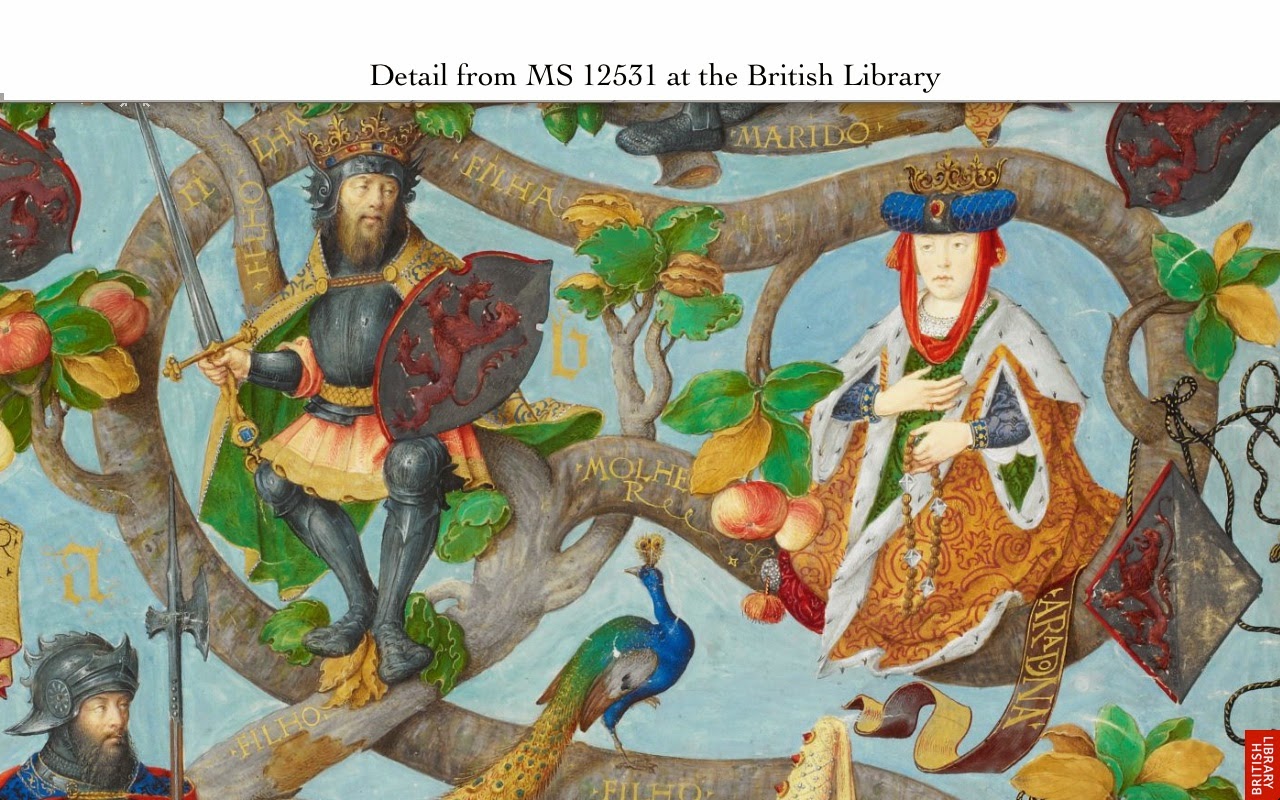
The two XVII-century paintings I found, little did I know at the time, turned out to be a part of a never-completed pictorial genealogy of Portuguese kings and queens. Thanks to the expediency of digital technology, I was able to easily track down the manuscript and happily find its digitized version on the British Library website.


The images in this post are my own screen-captures of that manuscript which, although unfinished, boasts several gorgeous and richly detailed miniatures and full-page paintings. There are large blank spaces where the text would have gone, but as the manuscript was never completed (that we know of), these 11 leaves provide an interesting look at the process of illumination, including unpainted drawings.


I invite you to look closely at these incredible leaves, available on the British Library site here. To find the images of Saint Isabel, you will find them on the Recto side of the 9th leaf - she is down at the very bottom of the page, elaborated with surprisingly precise and prolific detail, in spite of being quite tiny.

***
Until next time -- keep rustling!

Monday, October 20, 2014

Sorbus Domestica

The blooming Sorbus domestica
Over the weekend, I indulged in some well-deserved pleasure reading. A new book, The King in the North (2013), by Max Adams, details the life of VII-century warrior king, Oswald of Northumbria. As a young boy, Oswald had fled his homeland in the midst of heavy fighting and carnage. As a man, known as Whiteblade, he returned with a force of his fellow exiled Northumbrians as a Christian warrior-king to reclaim his kingdom and take back his seat on the throne. In c. 634, he and his men succeeded in destroying the Welsh host occupying Northumbria.

I originally became interested in this history because Oswald of Northumbria was apparently the historical figure upon which JRR Tolkien loosely based Aragorn, one of the main characters in the Lord of the Rings trilogy.

While I have only just begun reading, I am already being treated to various unexpected historical details. One such detail concerns the Sorbus domestica, or "service tree."

In the first chapter of his book, Adams uses the Sorbus domestica to illustrate the rich and complex array of medieval beliefs that, though may initially seem strange, turn out to be no stranger nor any less real than the world in which we live today:

One of the Wonders of Britain, from a list written down at the beginning of the ninth century but surely recited to children and kings for hundreds of years before and after, was an ash tree that grew on the banks of the River Wye and which was said to bear apples. Such poetic imaginings are easily dismissed by academics as fancy; and yet the distinguished woodland historian Oliver Rackham has recently shown that the famous tree in question must have been a very rare Sorbus domestica, the true service tree, which has leaves like a rowan or ash, and which bears tiny apple- or pear-shaped fruit. In 1993, one was found growing on cliffs in the Wye Valley in Wales. Early Medieval Britain was full of such eccentricities ... 

I love this small, yet relevant, example of the infinite world we study when we look into history; not a distant and unknowable collection of places and people, but rather, a part of our own continuing human drama. The magic and mystery of the past remains part of our lives today, hovering in the bows of rare and common trees alike, waiting for us to once again pay attention to it. I am reassured by this little episode that all of the reading I am doing for my thesis, about great battles and modest miracles, will reveal a small but significant piece of magic from both Saint Isabel's world as well as from my own.

***
Until next time -- keep rustling!


Wednesday, October 15, 2014

The Scent of Roses

Isabel de Aragão, Queen of Portugal, arrives at Santiago de Compostela after completing a long pilgrimage on foot.
Painting by Antonio de Hollanda, c. 1530
Queen Isabel depicted with roses.
Painting by
Francisco de Zurbarán, c. 1635
My reading has taken on a particularly intense focus, now that I have a definitive dissertation topic and am able to read daily with the beautiful backdrop of the autumn campus. I have begun research on a 14th-century queen of Portugal, Isabel de Aragão. Isabel was first made queen, then became a mother, and two centuries after her death, was made a saint through the official canonization process of the Catholic Church. 

Of the miracles attributed to her, the most popular among her devotees seems to have been the tale of how she discovered roses, all around her, during a season in which it was impossible for them to grow. After her death, her tomb and incorruptible body were said to give off an intense and pleasant aroma that resembled roses. 

Roses are not in bloom here on campus, but I sense the power of her story all around me. Her life, told and retold in many different ways over the centuries, offers a unique perspective on medieval Queenship, motherhood, sainthood, female identity, and most importantly, how all of these things could be brought into harmony under very specific, very dire circumstances... 

The Queen gifts her crown to the Archbishop of Santiago de Compostela. Antonio de Hollanda, c. 1530
The 14th-century was witness to a particularly catastrophic confluence of events. The rampant spread of plague led to the underpopulation of huge swaths of rural land. This lead to both economic downturn as well as easily disputed borders between territories; fighting to maintain hard-won land often resulted in dismayingly high death tolls which only served to further weaken the populations of the countryside. 

Isabel Queen of Portugal heals a woman
on the Camino de Santiago.
Francisco de Goya. 
The sometimes tenuous claims to the Portuguese throne also exacerbated conflict within the kingdom. Isabel de Aragão's own son, for instance, launched a civil war against his father, King Dinis and one of the king's illegitimate sons who was rumored to have been favored as heir. Through all the turmoil, Isabel must have appeared as a beacon of hope: her impressively calm and rational demeanor (traits typically associated with men during that time) made her much beloved by the Portuguese people, who called her saint even before her death and canonization. And yet, in spite of her socio-political and mythic importance to people throughout Portugal, her native Aragon, and neighboring Castile, her story has more recently been relegated to the archives.

For centuries following her death, she was depicted in poetry and theater, celebrated as a popular hero and saint on what became her feast day (July 4), and ascribed a powerful position in the collective Iberian memory. In the late 17th-century, the chapel she built and the order of Clarisas (Franciscan nuns) that she founded was flooded by a river that had outgrown its 14th-century banks. The basement of the church was filled with water and left to rot for a small eternity: it was not until the 20th-century that the church was finally cleared out and restoration began. 

Isabel de Aragão's tomb in Coimbra
Her tomb had of course been previously removed, to a second church of the same order, but nevertheless the original 14th-century church that lay in disrepair, all but forgotten, had at one time contained important artifacts and documents pertaining to Isabel's life. How can it be that the material legacy of this beloved woman was left unattended for so long by those who loved her? 

Isabel's story fascinates me. She is the daughter and mother of kings, and granddaughter of another queen-saint (Elizabeth of Hungary). She was powerful, but considered poor and humble; she was a mother, but considered chaste and holy; she was an important stateswoman, remembered for her peacekeeping efforts, but also for her transcendence of terrestrial powers, owing to her connection with the divine. Isabel performed very few miracles when she was alive, but she was called saint by all who knew her during her life nonetheless. After her death, her popularity continued strong for centuries and then seemed to abruptly decline. What explains this dramatic rise and fall in the popular imagination? 

In a recent conversation with my advisor, I remarked on how small and humble the miracles were that Isabel had performed during her life. I marveled at how strong the devotion was to her in spite having almost no high profile miracles. "You're right," began my advisors reply, and with her sparingly-used droll sense of humor, "only a queen, mother and saint. Why wouldn't she have had time for more miracles?" 

***

Until next time -- keep rustling!

Tuesday, October 14, 2014

Autumn Hues at the Ivory Tower


This morning I brought my camera with me to the university campus to document the gorgeous display of autumn foliage, to which I am daily treated, as I walk along the path to my office and to the library. It has never been possible for me to distract myself so completely with the stresses of deadlines and research that I cease to notice the beauty of this campus. Flowers in bloom dot the walkways, running streams cut between stone buildings, and a glance to the west offers a view of the Flat Iron mountains.


Sun filters down to the campus through an auburn canopy which has tinted the light gold. There is a satisfying crunch of leaves underfoot and the occasional snap of a crisp mountain breeze, which sweeps up the corners of scarves and threatens to bring snow down from the high peaks, whose white caps are now visible over the shorter mountains still covered with evergreen.


Everything about the campus seems to be burning in one final blaze of color before the whitewash of winter sets in upon us. Vines creep up the trees towards the dwindling light next to old staircases that twist up the sides of buildings; water reflects the bright trees standing around it; wool sweaters and hot tea turn the wind into a welcomed friend, refreshing and reviving students reading on the grass. It is truly a beautiful season - one in which I have been getting much reading and imagining accomplished...


***
Until next time -- keep rustling!

Thursday, March 27, 2014

Chivalry and the Sentimental Novel

Tristan and Iseult by Edmund Blair Leighton (1853-1922)
Yesterday's post began a discussion on the curious intersection of love and suffering in 14th and 15th century literature, specifically the sentimental romance. While we looked at the mythologized life story of Macías the Lover yesterday, today I would like to talk about some historical factors influencing the emergence of the genre.

The literature produced in this genre generally had an extremely predictable plot, which in turn placed greater emphasis on the authors' ability to invent and describe new forms of love-induced torture for their characters. Some of the suffering was allegorical (for example, The Prison of Love opens with the protagonist allowing himself to be lead by a wildman - symbol of loss of reason - into a tower where he sits upon a burning throne where he will always hurt but never be consumed - symbol of the burning passion of the heart and the fiery punishments for such passions awaiting him in hell). In other cases, the suffering was real and physical, and certainly the deaths at the end were always permanent. 
Entering the allegorical
"prison of love"

Unlike other European renditions of fated love stories (see the stories of Tristam or Lancelot), the characters in Iberian sentimental romances never enjoyed any kind of physical union - there was no kissing or embracing and there certainly was no sex. Frequently, the lovers only occupied the same physical space for a few brief, fleeting moments. The pain and punishment resulting from those few moments came in spite of an utter lack of hope that love would've ever manifested itself physically. Truly, then, this is a genre of all pain and no pleasure. The desire, it seems, grows in the pain and not the temporary fulfillment of sexual fantasy. 

In her book Clio, Eros, Thanatos: The 'Novela Sentimental' in Context, Theresa Ann Sears posits that a shift in social and economic relationships lead to such aesthetic trends in 15th and 16th century western European literature. "National monarchies had slowly undermined the feudal relationships based on exchanges of protection for goods and services," she writes. "Advances in weaponry were eroding the efficacy of troops of mounted, armored knights, putting greater emphasis on, on the one hand, a professional soldiery, and on the other, conscripted or hired infantries. Such changes resulted in an increasingly idle aristocracy that indulged (negatively) considerable social disruption and decadence, and (more ambiguously) in an aesthetization of its role." 
Image of Amadis of Gaul, Spain's most beloved
protagonist of a chivalric novel

These changes in social dynamics undoubtedly influenced artistic production. I believe that as the role of the knight became destabilized by changing strategies in armed conflict, a gap widened in the popular imagination of heroism. Slowly, the chivalric knight of the high middle ages faded - the noble and proud figure, mounted on his horse and prepared to suffer any hardship in service of his king, receded from reality into fiction. In the absence of a heroic cause for which to suffer and die, a different one was summoned to take its place: women. 

The so-called "religion of love" integrated religious imagery with sexual metaphors, blasphemously elevating the "perfect" feminine to god-like status (think: Act 1, Scene 5 of Romeo and Juliet, in which Romeo convinces Juliet to kiss him by equating their lips to the hands of saints that press together in prayer). Knights needed to serve a higher purpose, and if their king had no urgent save-the-Christian-world errand on which to send them, they remained at home, surrounded by the people who had always remained home (women!). Women became the inspiration for "heroic" deeds and tragically "noble" deaths. 

Frontispiece of La Celestina revealing
the text's ending
Of course, this lead to some problems for women (see my previous post on the wide-spread, public debate on women during this same time period). But this was also indicative of a growing problem for men. The masculine identity was in crisis, and I believe that the pain, torture, and deaths of the male characters in sentimental romances are indicative of this profound cultural crisis. Attempting to define themselves negatively (i.e. writing about the defining characteristics of women to indicate what men are not) only succeeded in turning the once-herioc male trope of chivalric novels into a purposeless, impotent, lost soul, pinning after little more than an affair.

Women were lambasted repeatedly and as a result the "religion of love." Clergy were scandalized by the idolatrous fascination with "perfect" women that were supposedly suddenly in abundance; other men of the court also rejected this idealized image of women. So the "religion of love" faltered - the perfect object of desire was now painted in popular imagination as nagging and emotionally unstable. Along with this debate, the sentimental romance genre waned in popularity until coming to an abrupt and definitive halt in 1499, with the publication of Fernando de Rojas' La Celestina
From Chapter 5 of La Celestina 
Note: Celestina is depicted as a nun
Written as if it were a play (though not necessarily intended to be performed), this text parodied all of the fundamental elements of the sentimental novel. The star-crossed lovers were not all that attractive, they were half-witted and decidedly uncharming, their servants found them pedantic and silly and made no effort to hide their disdain. Worst of all, rather than appealing to the "godliness" of the object of desire, the story appeals to the black magic of the alcahueta (go-between, procuress, "witch") who gives the work its name. (Interestingly, the title of the work was not originally La Celestina, but because this ugly, greedy, devil-consorting witch was such a great character, her name quickly replaced the original title to sell more copies).

Much of La Celestina is quite funny but it comes to the same customarily tragic ending that all sentimental novels do. But the damage to the genre has been done - the successful parody of the entire pleasure/pain trope had been reduced to foolhardiness and superstition.

Nevertheless, La Celestina came at the end of almost a century of sentimental romance production. The proliferation of Macías' story alone in these novels, in lyric, in Spain, in Portugal, is enough to indicate that pleasure and pain have a natural alliance, in spite of Fernando de Rojas' parody of the sentimental genre. I am interested in finding out more about how that alliance worked in the minds and hearts of 15th-century writers and readers... so stay tuned!

***
Until next time -- keep rustling!

Monday, March 3, 2014

Found in Translation

February was a month of discovery for me. I attended a symposium here on campus, called "Cultural Translation in Medieval and Early-Modern Studies," which brought together scholars from around the country (and even from exotic Canada!) to talk about themes and issues associated with medieval translation. The speakers included professors in religious studies departments, modern language departments (Spanish, Portuguese, Italian, French), history, art history, and classics departments. The talks covered a range of problems associated with medieval translation projects - from the way medieval Christian scholars translated the Qur'an to contemporary translations of Marco Polo's travel writing (originally written in the coiné, Franco-Italian).

Marco Polo
Professor Sharon Kinoshita gave the talk on Marco Polo, and I had the privilege of picking her up from the airport - an opportunity graduate students covet, as it provides an hour of one-on-one conversation with the professor. Her work is fascinating to me because she approaches medieval literature as part of broader process of cultural production, one that stretched across linguistic, geographic, and socio-economic boundaries. While she specializes in Francophone medieval literature, Professor Kinoshita (and a growing number of her colleagues) views the entire Mediterranean region as a highly communicative community of cultural production (see her most recent book). This community often shared interests and imagination and responded to one another's experiences through writing. This interaction is exemplified by translations of a diverse array of texts that circulated the Mediterranean region.

Professor Kinoshita addressed one case in particular, Marco Polo's The Travels, a work for which no two translations seemed to be the same. In some translated versions, entire passages were changed to reflect local fears or perceptions of "the Other" (who, in this case, happened to be dog-headed cannibalistic Africans). In other translators' versions, the style was altered to enhance the literary beauty of the text (a controversial choice, made even by today's translators of the work-- see: the Penguin edition). In the translation that Professor Kinoshita herself is elaborating, Marco Polo's repetitive style in the original Franco-Italian is more faithfully transmitted, allowing the reader to fully experience the barebones language of the coiné. 

St. Bernard Vanquishing the Devil
German, XV-century
Metropolitan Museum of Art collection 
Side note: This summer, I'll be taking Italian lessons so that I too can approach medieval literary production as an element of a broader Mediterranean culture. I plan to develop a corpus for my dissertation which incorporates Castilian, Portuguese, and Italian literature - the tricksy devil character pops up all over the Mediterranean region in varying guises, responding to both local and universal perceptions of evil and punishment...

Another of my favorite moments from the symposium was Professor Mark Meyerson's talk on ritual violence during Holy Week in medieval Valencia. His talk featured a particular case dating back to 1380, a case that he discovered while researching in judicial archives. Apparently, every year during Holy Week (the week preceding Easter in the Catholic tradition), the Christian community of Valencia would engage in ritualized, performative acts of destruction and violence that consisted mainly of throwing rocks at the wall surrounding the Jewish quarter. In many cases, Christians and Jews were neighbors and friends, living in such close proximity that they even shared walls. Christian and Jewish families remained friends before and after Holy Week, in spite of this destructive ritual performance.

Detail from "Feast of the Passover" by
Dieric the Elder Boutis
circa 1465
Rarely did Jewish families protest this ritual - only in extreme cases of injury, death, or property destruction did they bring complaints to the King. For the most part, this ritual was viewed simply as part of the collective judeo-christian calendar. Some scholars have understood the tradition as a performance that, rather than teach Christian children to hate Jews, taught them about the shared history of Christians and Jews and jewish custom, and served as a "release valve" for the Christian community during the most intense week of the liturgical calendar.

Professor Meyerson's talk detailed a special (and tragic) case from the year 1380 that he discovered in the archives. The story was preserved in the form of juridical documents from the proceedings of a murder trail, in which two jewish men were accused of causing the death of a young Christian boy. The accused men were thought to have perpetrated an act of retaliatory violence against the Christian community, in the wake of Holy Week activities.

The distraught father of the deceased child levied accusations against Salamo and Mosae, jewish residents from his same neighborhood. According to the legal documents, witnesses informed the boy's father that they'd seen an arm throw a rock from the window the Salamo and Mosae's house. The rock struck the boy's head as he walked his dog below, and the head wound he sustained killed him several days later.

Of the 20 witnesses for the defense, however, 17 were the Christian neighbors of the two young Jewish men. They testified that it seemed extremely unlikely to them that these stand-up citizens would be capable of harming a child. One of the Christian witnesses for the defense even displayed his knowledge of jewish custom claiming that, as the fateful event took place on the Sabbath, the young men's own religious tradition would have prohibited carrying out this work. The defense's explanation of the events posited that, as many rocks had been thrown at the house the day before the boy was struck, it was likely that one of the rocks had been up on the roof and was simply blown off in a high wind and fell accidentally on the poor boy's head.

Surprisingly, there was no lynch mob. In spite of heightened emotions during Holy Week, the two young men received due process and were defended by their neighbors, Christians and Jews alike. In the end, however, some damning evidence against one of the young men was brought forth and he was sentenced to death. Although we will never know if the sentenced man was truly guilty or not, the case provided many interesting details of quotidian life in Valencia in the late fourteenth-century - details about how Christian and Jewish children played together every night in the street, and how Christian families would have their fancy Easter clothes made and tailored by Jews who, the day before, had been targets of the Holy Week rock-throwing.

These are the kinds of cases that really make a girl want to dig in to some vellum archives! Which is why, since the symposium, I have been investigating the collections of different libraries' medieval texts. Through this research, I've found my newest fascination: the Merton University Library. Merton is the world's oldest, continuously active university library, located in Oxford, England. Take a look at its unparalleled beauty:

I can't imagine a more perfect place on earth. 
Merton University Library was constructed and began housing books in 1276 and has provided a space for scholars to read and learn since then. This week, I went to our campus library and checked out the (gigantic) index book of all the medieval texts Merton houses. I am looking through this index now, to try to find some relevant texts for my dissertation... I'm hoping there's a trip to Merton in my not-so-distant future!

Luttrell Psalter, "Milking Sheep," England - circa 1325-1340
British Library collection 
I am riding a wave of inspiration from this medieval translation symposium, organized by my advisor, Professor Núria Silleras-Fernández, and her husband, Professor Brian Catlos, and also included incredible talks by Professors Thomas Burman and John Slater (which each could've been the subject of an entire post!)...

***
What have you been up to recently, fair petticoat rustlers? Where is your favorite library?

Until next time - keep rustling!

Tuesday, January 28, 2014

Tricksters and Devils

Source
Recently my reading has focused on the evolution of the devil figure in mythic and folkloric narrative of the judeo-christian tradition. In order to understand how he came to be depicted in both the comical and moralizing verse in 20th century Brazil, I wanted to know how readers' or audiences' attitudes towards this figure evolved over time; what socio-cultural narratives may have contributed to the image of the devil found in modern cordel literature.

One of the devil's most important proxies is the Trickster. With the audacity to reveal our base human impulses, and with the wisdom to annunciate core philosophical realities of human experience, the Trickster is a near-ubiquitous character in folk narrative - from all over the world. There are striking similarities in the way in which the devil and the Trickster are portrayed. 

Although I am but a beginner in Trickster studies, Professor Harold Scheub is most certainly not. His book, Trickster and Hero (2012), provides a global perspective on the Trickster figure... Here are some excepts from his fantastic book, which I've been simply devouring. Accompanying his insights are some images of the Zanni tricksters of the Commedia Dell'arte repertoire. 

Jacques Callot (1592-1635) Engraving
"The profane or earth-bound trickster is, like the divine trickster, obscene, aggressive, selfish, amoral. In this, he is closest to the basest of humans. ... Yet, in a way, the profane trickster does retain an echo of the divine connection, if tenuously: he also creates in the sense that he creates a world of illusion; he imposes his own corrupt sense of order on the real world. An agent of chaos, he disrupts harmony; when he establishes harmony, it is according to his own whim, his own sense of order. Trickster combines horror and glee: his is the comedy of the grotesque." 

"The trickster through performance binds present and past. The tale is the moment in which past and present are blended in a performance." 

"Trickster would have no existence, would have no meaning, would make no sense whatsoever if we did not understand the frame in which he operates. He is forever theatrical. He creates theater in the world that we know, the real world. Without that frame, Trickster's antics are merely obscene and silly But within that frame, he becomes significant and eternal. Trickster makes the flawed moment eternal." 

"There are mighty forces, represented by God, Leopard, Lion. The weak cannot prevail over them, they have all the power. They create, they establish boundaries. But in the trickster tale, those boundaries are loosened, violated; the power of gods, of the great animals, is called into question, and chaos results." 

Source
***
Who are your favorite tricksters? What are your favorite books about the history of the trickster or devil? 

Until next time - keep rustling!

Wednesday, January 8, 2014

Antônio José da Silva

One of the books on my Five For Fourteen list was the early 18th-century story attributed to Antônio José da Silva, "The Jew." The book, Obras do diabinho da mão furada (roughly: "Tales of the Devil with the Pierced Hand") is made up of a series of 5 folios written in dialogue-laden prose, interspersed with rhymed verse and popular refrains. The integration of these techniques gives rise to a text that maintains a comedic tone while simultaneously delivering a didactic narrative, full of popular wisdom. In fact, almost all of da Silva's work (the majority of which is theatrical) is considered part of the joco-séria genre (literally: "jocular-serious"). Like his writing, da Silva himself represented a fascinating combination of seemingly disparate phenomena: he was, in a way, both Brazilian and Portuguese, Christian and Jewish, Lawyer and Literati, Celebrity and Villain. This post will hopefully offer a very brief history of da Silva's life, by way of a broad overview of his artistic production.

Devil puppet, made for the Teatro Nacional de São Carlos' theater
production of one of da Silva's plays (Source

It is not entirely surprising that several of the characters in Obras are heard using epigrams in Spanish, rather than Portuguese. This could simply be a symptom of the ongoing cultural and linguistic exchange between Hispanic and Lusophone communities of the peninsula. But beyond casual interaction of neighboring cultures, I think it is possible to understand the pan-iberian linguistic references as evidence of da Silva's efforts to establish a cultural critique that extended beyond Portugal's borders. 

Antônio José da Silva, "The Jew"
By including refrains of both Portuguese and Spanish (and Brazilian?) origin, da Silva reinforces the "universality" of the devil, a character who can trick in any language. Thus it becomes possible through this devil character to appraise a broader set of cultural features in western Europe and colonial American, chief among being the Inquisition. The use of multicultural epigrams critiquing the Holy Office are da Silva's attempt to align his criticism with what appears to be more "universal" grievances among Europeans and colonial subjects. When taking into consideration some of the more salient biographical details of Antônio José da Silva, this critique, and the techniques he uses in his writing, acquire even more significance.  

In 1705, Antônio José da Silva was born--not in Portugal--but in Rio de Janeiro, Brazil. During this time, Portuguese cultural, legal and theological institutions represented an enormously influential element of Brazilian society. (Brazil was officially a colony of Portugal until 1822, when it became an equal member of the Portuguese United Kingdom; Brazil remained a monarchy until 1889.) As a result of this influence, the Inquisition was capable of extraditing Brazilian residents back to Portugal to be tried for any allegations against them. 

Puppets of Teresa (left) and Sancho (right) Pança - from the Teatro Nacional de São Carlos' theater production of da Silva's play about Quixote (Source)  
Antônio José da Silva’s parents were unlucky enough to have experienced first-hand the far-reaching legal jurisdiction of the Portuguese Holy Office. When da Silva was a mere seven years old, his "converso" family (newly converted to Christianity) was required to travel back to Lisbon where they were brought before the Inquisition for allegations of heretical “Judaizing.” These proceedings resulted in a conviction and punishment, which most likely consisted of having goods and property seized by the State. This sudden lack of resources led the family to settle permanently in Lisbon, where da Silva came of age and eventually died. 

Dom Quixote puppet, created by the
Teatro Nacional de São Carlos
(Source)
Da Silva's writing career began -- and quickly reached its apogee -- while he was completing his studies in law in his 20s. During this time, he began publishing theatrical works that included musical elements and which he called "óperas." These pieces were performed by puppets, rather than actors, in the Teatro do Bairro Alto. 

"The puppets used at the time, made of cork and wood," writes Argentinian researcher and stage director, Jacobo Kaufman, "were relatively tall, about one and a half meters in stature, hanging and manipulated on wires." The puppets were a key element of da Silva's theatrical productions, Kaufman says, because they were "allowed to use foul language and say things an actor or singer would not dare utter on stage." The use of puppets, therefore, provided a presumably safe distance from which da Silva could lambast the rich and powerful -- although this strategy did not always work, as evidenced by the fact that "The Jew" became da Silva's nickname after a lifetime of being persecuted by Inquisitors. Eventually, in fact, the Holy Office condemned Antônio José da Silva to a public death in an auto-da-fe when the young intellectual was only 34 years old. 

Da Silva had hoped that the use of puppets would successfully create a safe distance between the author and his critiques. And although that was ultimately not the case, it seems logical that the main character in Obras do diabinho da mão furada is the devil. The familiar trope of the devil can function in a way similar to the way the puppets function in da Silva's theater -- as a bulwark between the author and his chosen subject matter. The devil is, by his very nature, expected to refer to taboo subjects -- he is the father of bad behavior.

In this story, the devil does not disappoint, as he journeys alongside a hapless traveler, wreaking havoc on small Portuguese towns...and of course, getting all the most memorable lines!

***
Tomorrow's post will feature an in-depth discussion of the book that you won't want to miss!

Until then - keep rustling!

Tuesday, December 31, 2013

My Year in Petticoats

Happy New Year and Happy Birthday, my Band of Wild Petticoats! January 4th will mark exactly one year of petticoat rustling and peeking at the underthings of literature. And, oh my! It has been quite a year... One of the best things about the year has been sharing life, literature, and art on this blog. The Band of Wild Petticoats now has over 50 posts and has generated over 11,700 views--that's a lot of petticoat rustling! On the Eve of the New Year, before we all eat our grapes and bid farewell to 2013, I thought it would be fun to look back and see what we've been up to...

The 5 most popular posts of the blog so far, according to my stats, were:


And some of my favorite moments from the year were:

#1 Rustling petticoats across the United States and abroad. 
My journey to Maranhão, Brazil
My journey to the Midwest
Small journeys in Colorado
Finding the meaning of Home
#2 Becoming a Master (code for: getting my wizard's robes).
The preparation
The commencement 
  #3 Natural disasters and the End Times. 
Colorado rains
Reading the apocalypse 
#4 Some poems, some prose
                      
                        Cross-dressing in Golden Age Spanish fiction


Cowpuncher Poets
The short fiction of Harry Crews

#5 Some song, some dance, some nice ideas
Neo Fantasy Music

                      
Here's to rustling for another year! May you have a very happy New Year filled with art, books, songs and petticoats. Until next year--keep rustling!