Showing posts with label criticism. Show all posts

Saturday, March 29, 2014

Ghost Lovers

Orpheus and Eurydice by Sir Edward John Poynter (19th century)
The last couple of posts (here, here, and here) have dealt with the way in which love and death are intertwined in Renaissance literature, provoking melodramatic liebestod finales to a host of 15th and 16th century narratives. In the process of considering these narratives in which the desire to love lead to a desire for death, however, I was reminded of the stories in which death failed to create an insurmountable boundary for the lovers. The surge in popularity of classical Greek mythology in humanist Renaissance Europe makes me think that it would not be a huge leap of faith to assume the tale of Orpheus and Eurydice was fresh in the minds of poets and authors composing sentimental romances.

Orpheus is prepared to descend to the underworld to bring back his lover, not accepting death as the final act of his love story. But in his refusal to accept Eurydice's death, he confirms its permanence, looking back over his shoulder to catch a glimpse of her ghost materializing behind him. In popular folk narratives, stories in which lovers return from the grave for one final visit are not uncommon. This "one final visit," I believe, can be seen to function in two ways. On the one hand, the ghost returns to comfort their lover and properly say goodbye. On the other hand, it affirms the finality and permanence of death's grip, ending with the ghost vanishing back into the realm of the dead.
Orpheus and Eurydice on the Banks of the Styx by John Roddam Spencer Stanhope (19th century)
Although none of the 15th century Iberian stories that I've looked at over the past week narrate a lover returned from the dead, I do recall an Irish folksong that my mother always used to sing when I was little. It is a night visiting song, in which the ghost of a young woman's lover who died at sea wakes her one night to say one last farewell.

Here is a nice version of the song:


A similar tale is recounted in "The Night Visiting Song" by Luke Kelly:


These are potent stories that emerge across many cultures and historical periods. I recently stumbled across a cajun-French song from Louisiana, "Pa Janvier," performed beautifully by the International Blues Express. The song is a sorrowful appeal to Father January (Pa Janvier), the allegorical figure for winter, whose icy cold wind stole the health and life of a young woman. The song is the lament of the young woman's lover who has survived her, and he pleads with Father January to return to him his love.

They were recorded doing the song by the 78 Project, a husband and wife duo traveling the country recording traditional musicians on a 78 recording machine, very much in the style of Alan Lomax. Take a listen to these incredible musicians (who hail from the American Delta and West Africa) perform the doleful tune for their recording session:


***
Do you know any night visiting songs? What are your favorite tales of ghost lovers?

Until next time - keep rustling!

Friday, March 28, 2014

They Stand on the Earth and They Cast Their Own Shadows

Detail from Masaccio's painting of the Expulsion of Adam and Eve in the Brancacci Chapel

The many star-crossed lovers of yesterday's post may have come from different literary traditions, but they were all unified by the way in which suffering and desire became hopelessly and fatally tangled in their stories. These tragedies, unfolding at the intersection of pleasure and pain, presented themselves as not only believable love stories but natural ones. The sentimental romances and lyric of the late-Medieval/early-Renaissance Mediterranean make it seem hauntingly natural that the birth of love should lead to the death of lovers.
Masaccio's painting of
Adam and Eve in the
Brancacci Chapel

In grappling with what makes death and desire so inextricably linked in the literary production of this time period, I decided my research needed to go back to the beginning - all the way to the beginning - in order to ascertain the origin of this link. And by "the beginning," I mean the book of Genesis.

The story of Adam and Eve sheds a great deal of light on the connection of desire and death. As a result of their expulsion, they became mortal and died. But at this same moment death becomes their reality, they are born into their humanity and therefore sexuality. As Adam and Eve leave the garden, they experience a sudden awareness of their bodies. This awareness inspires both a tragic self-consciousness full of shame and a thrilling awakening to the possibilities of material connection with one another. In the story of Adam and Eve the origin of human death and suffering is also the origin of human sexuality.

Although it was not the love Adam and Eve had for one another that caused their suffering, as is the case in the sentimental romances, their relationship was defined by the moment in which they became fully human and began experiencing together love, suffering, and death. This confused and terrible moment of leaving Eden unites Adam and Eve (archetypes of all women and men) in both love and death forever.

Patricia Grieve, in her book Desire and Death in the Sentimental Romance, has referred to love and death as the two great mysteries of humanity and thus as necessarily occurring side-by-side in literary representation: "As the two great topics of poetry - unsolvable mysteries both - it is no surprise that [love and death] should appear with great frequency in literature."

Masaccio, the Italian painter of the 15th-century, had a profound influence on other painters of his century and on the Renaissance in general. His depiction of the Expulsion of Adam and Eve in the Brancacci Chapel eloquently narrates a scene of great suffering and great beauty, all embodied by the human form.

When renowned art historian and critic, Sister Wendy, contemplated this image, she noted how representational it was of the overarching ethos of the Renaissance. To the denizens of the Renaissance world, humanity was dignified, in spite of the suffering and grief with which it also constantly had to contend. "They stand on the earth and they cast their own shadows," Sister Wendy said, "that's what the Renaissance was about: humanity as upright, suffering but responsible."

This insight, I believe, is crucial to understanding the link between desire and death in Renaissance works of literature. The overwhelming feelings of love experienced by the protagonists of 15th-century sentimental romances were invariably accompanied by a sense of immense responsibility owed to the object of their feelings. Love allowed the protagonist to encounter the eternal for the first time - feeling love was connecting with a never-ending current of human emotion. But the precarious business of ensuring that their love was fully requited by the object of their desire endangered their experience of the "eternal" nature of love. This caused great anxiety and suffering until it seemed their only recourse was to experience eternity in the only other bodily way available: death.

***
To hear the rest of Sister Wendy's incredibly preceptive discussion of Masaccio's painting, watch this video from minutes 2:00 - 5:00. If you happen to have 30 minutes available, I highly recommend watching the entire episode.


***
Until next time - kept rustling!

Thursday, March 27, 2014

Chivalry and the Sentimental Novel

Tristan and Iseult by Edmund Blair Leighton (1853-1922)
Yesterday's post began a discussion on the curious intersection of love and suffering in 14th and 15th century literature, specifically the sentimental romance. While we looked at the mythologized life story of Macías the Lover yesterday, today I would like to talk about some historical factors influencing the emergence of the genre.

The literature produced in this genre generally had an extremely predictable plot, which in turn placed greater emphasis on the authors' ability to invent and describe new forms of love-induced torture for their characters. Some of the suffering was allegorical (for example, The Prison of Love opens with the protagonist allowing himself to be lead by a wildman - symbol of loss of reason - into a tower where he sits upon a burning throne where he will always hurt but never be consumed - symbol of the burning passion of the heart and the fiery punishments for such passions awaiting him in hell). In other cases, the suffering was real and physical, and certainly the deaths at the end were always permanent. 
Entering the allegorical
"prison of love"

Unlike other European renditions of fated love stories (see the stories of Tristam or Lancelot), the characters in Iberian sentimental romances never enjoyed any kind of physical union - there was no kissing or embracing and there certainly was no sex. Frequently, the lovers only occupied the same physical space for a few brief, fleeting moments. The pain and punishment resulting from those few moments came in spite of an utter lack of hope that love would've ever manifested itself physically. Truly, then, this is a genre of all pain and no pleasure. The desire, it seems, grows in the pain and not the temporary fulfillment of sexual fantasy. 

In her book Clio, Eros, Thanatos: The 'Novela Sentimental' in Context, Theresa Ann Sears posits that a shift in social and economic relationships lead to such aesthetic trends in 15th and 16th century western European literature. "National monarchies had slowly undermined the feudal relationships based on exchanges of protection for goods and services," she writes. "Advances in weaponry were eroding the efficacy of troops of mounted, armored knights, putting greater emphasis on, on the one hand, a professional soldiery, and on the other, conscripted or hired infantries. Such changes resulted in an increasingly idle aristocracy that indulged (negatively) considerable social disruption and decadence, and (more ambiguously) in an aesthetization of its role." 
Image of Amadis of Gaul, Spain's most beloved
protagonist of a chivalric novel

These changes in social dynamics undoubtedly influenced artistic production. I believe that as the role of the knight became destabilized by changing strategies in armed conflict, a gap widened in the popular imagination of heroism. Slowly, the chivalric knight of the high middle ages faded - the noble and proud figure, mounted on his horse and prepared to suffer any hardship in service of his king, receded from reality into fiction. In the absence of a heroic cause for which to suffer and die, a different one was summoned to take its place: women. 

The so-called "religion of love" integrated religious imagery with sexual metaphors, blasphemously elevating the "perfect" feminine to god-like status (think: Act 1, Scene 5 of Romeo and Juliet, in which Romeo convinces Juliet to kiss him by equating their lips to the hands of saints that press together in prayer). Knights needed to serve a higher purpose, and if their king had no urgent save-the-Christian-world errand on which to send them, they remained at home, surrounded by the people who had always remained home (women!). Women became the inspiration for "heroic" deeds and tragically "noble" deaths. 

Frontispiece of La Celestina revealing
the text's ending
Of course, this lead to some problems for women (see my previous post on the wide-spread, public debate on women during this same time period). But this was also indicative of a growing problem for men. The masculine identity was in crisis, and I believe that the pain, torture, and deaths of the male characters in sentimental romances are indicative of this profound cultural crisis. Attempting to define themselves negatively (i.e. writing about the defining characteristics of women to indicate what men are not) only succeeded in turning the once-herioc male trope of chivalric novels into a purposeless, impotent, lost soul, pinning after little more than an affair.

Women were lambasted repeatedly and as a result the "religion of love." Clergy were scandalized by the idolatrous fascination with "perfect" women that were supposedly suddenly in abundance; other men of the court also rejected this idealized image of women. So the "religion of love" faltered - the perfect object of desire was now painted in popular imagination as nagging and emotionally unstable. Along with this debate, the sentimental romance genre waned in popularity until coming to an abrupt and definitive halt in 1499, with the publication of Fernando de Rojas' La Celestina
From Chapter 5 of La Celestina 
Note: Celestina is depicted as a nun
Written as if it were a play (though not necessarily intended to be performed), this text parodied all of the fundamental elements of the sentimental novel. The star-crossed lovers were not all that attractive, they were half-witted and decidedly uncharming, their servants found them pedantic and silly and made no effort to hide their disdain. Worst of all, rather than appealing to the "godliness" of the object of desire, the story appeals to the black magic of the alcahueta (go-between, procuress, "witch") who gives the work its name. (Interestingly, the title of the work was not originally La Celestina, but because this ugly, greedy, devil-consorting witch was such a great character, her name quickly replaced the original title to sell more copies).

Much of La Celestina is quite funny but it comes to the same customarily tragic ending that all sentimental novels do. But the damage to the genre has been done - the successful parody of the entire pleasure/pain trope had been reduced to foolhardiness and superstition.

Nevertheless, La Celestina came at the end of almost a century of sentimental romance production. The proliferation of Macías' story alone in these novels, in lyric, in Spain, in Portugal, is enough to indicate that pleasure and pain have a natural alliance, in spite of Fernando de Rojas' parody of the sentimental genre. I am interested in finding out more about how that alliance worked in the minds and hearts of 15th-century writers and readers... so stay tuned!

***
Until next time -- keep rustling!

Wednesday, March 26, 2014

Macías, The Lover

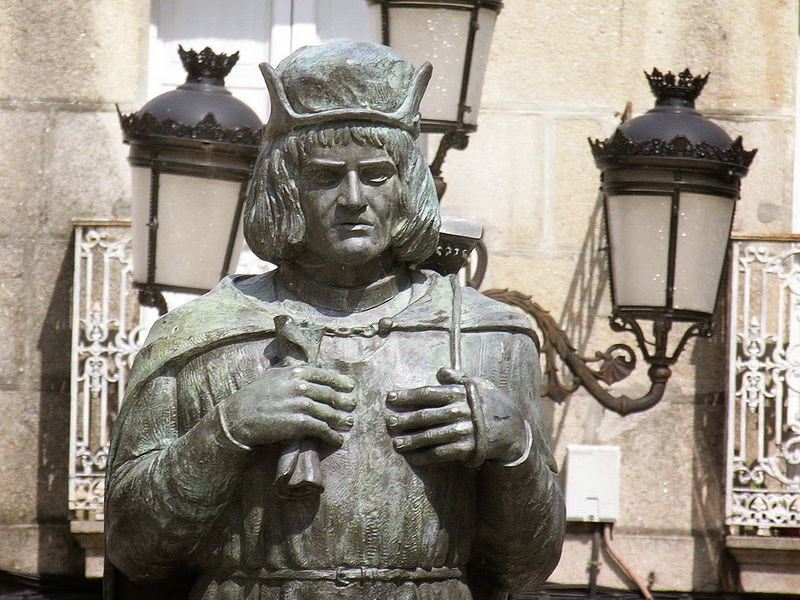
Statue of the 14th-century troubadour, Macías "The Lover," in Galicia
Reading literature aloud and listening to it recited offers such a vastly different experience with a story than does reading in silence. I cannot fathom why reading or reciting creative works aloud has faded almost entirely away from mainstream popular culture, especially since books are more portable and accessible than ever thanks to new reading technology.

In yesterday's post, I encouraged you to read aloud from Tolkien's stories. I read several of the poems from the Hobbit and the Lord of the Rings out loud, to the bewilderment of my sole audience member: my elderly dog. But oral recitation used to be one of the most important methods of narrative transmission. Mediterranean courts of the medieval period, for example, prized highly troubadours gifted with the ability to write and perform poetic works. 

A far cry from Tolkien - the 14th-century poetry of Macías The Lover
One such troubadour, Macías "The Lover" from Galicia, was not only a gifted courtier poet, but he also posthumously became a character in poems, stories and plays all over the Iberian peninsula. His life became his greatest work of art; the legends that sprang up after his death were recited and performed more often than the poems he wrote. The mythologizing of this particular troubadour assured him eternal life in the creative circles in which he had worked, and in literary history in general.

Some verses inspired by Macías' legend in a poem by Juan Rodríguez de Padrón, 15th-century poet

The legend of his life is a tragic story of love and self-punishment. The story goes that Macías, hopelessly in love with a lady of the court, focused all of his verses on extolling her qualities, putting his all of his poetic talent in the service of her beauty and virtue. After a time, however, this lady was wed to another man. Macías had pledged to only love and serve this lady for his entire life, and he honored this pledge. 

One day, as Macías lingered near a bridge, the now-married lady appeared on her horse. She wished to cross the bridge, but Macías asked her to dismount and speak with him for only a moment. Acquiescing to his request, the lady dismounted and listened as Macías reaffirmed his love for her and his pledge to serve her forever, even though it had to be from a distance. The lady was stunned by his words and, getting back on her horse, fled across the bridge. 

Neither Macías nor the lady had been aware that nearby, hiding in some bushes, was the lady's husband. As soon as the lady had departed, the husband leaped onto the bridge and ran Macías through with his lance. As he lay in the middle of the bridge dying, Macías' last words were said to have been yet another pledge to the lady, this time vowing to serve her from the far-off reaches of death. 
Some verses from a poem by Macías - the poem starts out "Cruel and determined love"... 

The real events of Macías' life have been so conflated with this legend that it is difficult to distinguish truth from fiction. Although that hardly matters, as the legend of his life is what became immortal and the inspiration for much subsequent literary production. I am interested in Macías' legend because it ended up playing an enormously influential role in the "sentimental romance" tradition, popular in 15th-century Iberia. The genre enjoyed huge reader success, reaching its apogee in 1492 with the publication of Diego de San Pedro's work, The Prison of Love. 

The novela sentimental follows a narrative arch that is almost identical to the Macías legend. One young person falls desperately in love with another young person; for some reason they are not permitted to be together; both suffer physical and emotional trauma because of the intensity of their love (or the lack thereof); one or both lovers die a horribly tragic death, which is merely an anticipation of the eternal condemnation their restless soul will doubtless experience in its afterlife. 

What interests me most about this genre is the way in which love and pain interact necessarily as part of the plot and character development. Here we have a genre of storytelling that reduces love to a rhetorical plot device, while pain takes center-stage and is explored on psychological, poetic, and social planes. It seems to me, then, that love was not the cause of suffering but rather an excuse to suffer. 

I will be doing a series of posts on the interaction of pain and love in the coming weeks. This theme is, in fact, the central idea of one of the term papers I will be writing over the course of the next month. Check back often to see who is bitterly weeping tears of blood for a distant object of desire! 


***
Who are your favorite doomed lovers? Why do you think there is a necessary connection between pleasure and pain in tales of love? 

Until next time - keep rustling! 

{Note: all photos in this post except the first one were taken by me of a book called Macías el Enamorado y Juan Rodríguez del Padrón by Carlos Martinez-Barbeito, 1951 edition.}


Tuesday, March 25, 2014

The Gray Pilgrim


Today - March 25 - marks the day in which Sauron, the strongest lieutenant of Morgoth, was defeated in the Lord of the Rings trilogy. Every year, this day is commemorated by fans and scholars of J.R.R. Tolkien as a day in which to read and reflect on his writing. The Tolkien Society has suggested that, as we read our favorite passages of Tolkien's writing today, we reflect on the theme "Hope."

My reading material for today, a nice cuppa, and my husband's briar pipe

The Gray Pilgrim, in my opinion, represents "Hope" more than any other character in the Tolkien canon. Known to the Valar as Olórin, to the Elves as Mithrandir, and to Men from the North as Gandalf, this gray-clad traveler roamed Middle-earth as its protector and friend. Gandalf was always getting up to something, checking on things, listening. He loved Middle-earth and its inhabitants, and countless times put his own life at stake to battle the threatening darkness of Sauron and his hoards.

The Lord of the Rings Sketchbook by artist Alan Lee, open to the pages on Ganfalf 
Gandalf was equipped with great power, especially in the manipulation of fire, but chose to dress in a cloak the color of ash and display his power only for the mirth of the folk - in the form of fireworks - so that his influence never derived from fear.

Gandalf's qualities were unique among the Istari, the order of wizards from which he came, and he was the only one out of the 5 Istari who stayed true to their original mission. Tolkien writes of the order, and Gandalf's unique role in it, in an essay that first appeared in 1954 and is now part of the compiled works in Unfinished Tales, edited by his son, Christopher Tolkien. Here is a passage from that essay:

"Indeed, of all the Istari, one only remained faithful, and he was the last-comer. For Radagast, the fourth, became enamored of the many beasts and birds that dwelt in Middle-earth, and forsook Elves and Men, and spent his days among the wild creatures. ... And Curunír 'Lân, Saruman the White, fell from his high errand, and becoming proud and impatient and enamored of power sought to have his own will by force, and to oust Sauron; but he was ensnared by that dark spirit, mightier than he.

But the last-comer was named among the Elves Mithrandir, the Grey Pilgrim, for he dwelt in no place, and gathered to himself neither wealth nor followers, but ever went to and fro in the Westlands from Gondor to Angmar, and from Lindon to Lórien, befriending all folk in times of need. Warm and eager was his spirit ... for he was the Enemy of Sauron, opposing the fire that devours and wastes with the fire that kindles, and succors in wanhope and distress; but his joy, and his swift wrath, were veiled in garments grey as ash, so that only those that knew him well glimpsed the flame that was within."

Detail from Alan Lee's painting of Gandalf and Frodo
It was Gandalf's express purpose to provide council and hope to the good folk of Middle-earth, and not only did he do that, he also single handedly set in motion the events that would turn in to The Hobbit and the Lord of the Rings trilogy. Gandalf appears on the doorstep of Bilbo Baggins, revealing before anything else that he is funny, and soon begins to fluster the furry-footed Hobbit with wordplay and talk of adventures...

"By some curious chance one morning long ago in the quiet of the world, when there was less noise and more green, and the hobbits were still numerous and prosperous, and Bilbo Baggins was standing at his door after breakfast smoking an enormous long wooden pipe that reached nearly down to his woolly toes (neatly brushed) - Gandalf came by. Gandalf! If you had heard very little of all there is to hear, you would be prepared for any sort of remarkable tale. Tales and adventures sprouted up all over the place wherever he went, in the most extraordinary fashion."
...
" -'I beg your pardon, I haven't asked for anything!" [said Bilbo]
  -'Yes, you have! Twice now. My pardon. I give it to you. In fact I will go so far as to send you on this adventure. Very amusing for me, very good for you - and profitable too, very likely, if you ever get over it.'
  -'Sorry! I don't want any adventures, thank you. Not today. Good morning! But please come to tea - any time you like! Why not tomorrow? Come tomorrow! Good bye!' With that the hobbit turned and scuttled inside his round green door, and shut it as quickly as he dared, not to seem rude. Wizards after all are wizards. ... Gandalf in the meantime was still standing outside the door, and laughing long but quietly. After a while he stepped up, and with the spike on his staff scratched a queer sign on the hobbit's beautiful green front-door. Then he strode away, just about the time when Bilbo was finishing his second cake and beginning to think that he had escaped adventures very well."

"Gandalf returns to Hobbiton" by John Howe
Gandalf is my favorite Tolkien character - which is saying a lot, as Tolkien made sure his readers had no shortage of wonderful characters from which to chose a favorite. I like Gandalf so much because in spite of the enormous power he wielded as a result of his magic, he chose more often than not to use his wits and wisdom, the everyday "magic" of language.

Gandalf seemed to always understand when to use kind or harsh words; he knew when to remain silent and allow the truth to reveal itself. The hope and power that Gandalf brings to Middle-earth is contained in the everyday magic of language. By studying and respecting and practicing the magic of language, Gandalf helped defeat a looming evil power. Most importantly, he never abandoned Middle-earth, even after his "death." In many ways, Tolkien has done the same, providing generation after generation with a new worlds and languages to combat the encroaching apathy of the mechanized modern world.

I am fascinated by Peter Jackson's film adaptations of Tolkien's most famed novels, in part because they use modern machinery and technology to enter into those worlds and languages in a new way. I adore the films and could think of no finer actor to portray Gandalf than Sir Ian McKellen. The second film installment of The Hobbit was released today to coincide with this special day of commemoration of Tolkien's work. This evening, after reading aloud from the books, my husband and I plan to watch this film (after only having gotten the chance to see it twice while in theaters).

I wish you all a happy Tolkien Reading Day, and hope that the magic of Gandalf's words provides you with some small but significant miracle today...

Waking up early to read from The Silmarillion
I will leave you with one final quote - this time from a letter Tolkien wrote - in which Tolkien himself discusses the way Gandalf gave hope to his friends by sacrificing the hope of his own personal fame or even survival:

"Gandalf alone [among the wizards] passes the tests ... For in his condition it was for him a sacrifice to perish on the Bridge in defense of his companions, less perhaps than for a mortal Man or Hobbit, since he had a far greater inner power than they; but also more, since it was a humbling and abnegation of himself in conformity to 'the Rules': for all he could know at that moment he was the only person who could direct the resistance to Sauron successfully, and all his mission was vain. He was handing over to the Authority that ordained the Rules, and giving up personal hope of success."
(Excerpt taken from a letter written to Robert Murray, S.J. as printed in The Letters of JRR Tolkien, edited by Humphrey Carpenter.)

***
Who are your favorite Tolkien characters? What passages will you be reading this evening?


Saturday, March 8, 2014

Art and Voodoo

Today was beautifully sunny and the smell of fresh spring grass filled the air. The optimistic sound of melting snow could be heard around every corner. The snow that was melting all day today, however, only fell just yesterday... it snowed all day yesterday! To beat the gloomy weight of the gray sky, my husband and I spent the day in Denver. We went to see the brand new exhibit at the Denver Art Museum called "Modern Masters." I'm so glad we went - the exhibit was fantastic and we spent an amazing day exploring the city.   

Frida Kahlo - now on view at the
Denver Art Museum
The art exhibit displayed works that ranged from 1880-1980, demonstrating the trajectory of visual vocabularies throughout the twentieth century. Emiliano remarked that this exhibit would've been the "whole chapter" in an art text book on the 20th century, and I agree with him - all the canonical artists were there, from Georgia O'Keeffe to Roy Lichtenstein. There were several rooms filled with pieces from the early avant-garde of the 10s, 20s and 30s, and other rooms displaying pieces from the avant-garde's subsequent resurgence in the 60s and 70s. Art decorated room after room of gallery space, leading the viewer on a journey through some of the most iconic images of the last century.

I learned so much at this exhibit. For instance, I learned that I am a huge fan of Arthur Dove and Clyfford Still, of Chaïm Soutine and Giacomo Balla. I also had the opportunity to see, for the first time in person, some works with which I already felt a great connection. One of those works was a self-portrait by Frida Kahlo. I had never seen her work up-close and personal before, and it was truly a different experience than looking at reproductions in books. To the chagrin of several other museum-goers, I stared at the piece for quite a long while...

Recently, my attention has been so focused on medieval art and writing; perhaps for this reason I found myself shocked and almost overwhelmed with surprise in this exhibit. I had a sense, as I moved from room to room, that the twentieth century was already a distant past of human history - no more distant or near to us as than the medieval. But how can that be? I was born in the 20th century!

The themes and techniques of the Modern Masters on display in Denver seemed, in many ways, to be of a bygone era. The 20th-century sensibility: informed by two world wars and a cold war, death and rebirth on national scales, the advent of the modern car, the dishwasher, the video camera, the home computer, and a moon landing. The demands on artists and art viewers seem to have been so different then - with artists often seeking deliberately to antagonize their viewers and their viewers frequently responding with defiant enthusiasm. The role of the academy even seems to have been more successfully eschewed by artists prolifically producing new aesthetics faster than the academy could appropriate and normalize them.

This feeling that the 20th-century was now a distant past became especially acute when I approached what became one of my favorite pieces of the entire exhibit: "Dynamism of a Dog on a Leash" by Giacomo Balla (1912). The study of movement, reproduced in paint almost "frame by frame" in a pre-film art world:
Giacomo Balla - now on view at the Denver Art Museum
Yet at the same time, as I look again at this piece, I realize that maybe the concerns of 20th-century artists are closer than I think. Are we not still grappling with understanding how the world moves and how we witness that movement or mark our time spent moving in it? Isn't that what 21st-century performance art and installation art attempts to address, at least to some extent? What do you think?

While it is true that we now have tiny universes in our palms (smart phones) and that we can photograph or film anything we want whenever we wish, we are still astonished by our own movement, shadow, landscape, transparency, time. Painting is a technology, just like a tablet or a smart phone. We are still obsessed with putting our technologies at the service of artistic aesthetics, still using it to launch ourselves faster into the future of cultural production, evading standardization.

I have so many thoughts on the exhibit and plan to dedicate some future posts to artists that I discovered there. In the meantime, here are some photos from the rest of the day, which included wandering around the permanent collections, grabbing an amazing fish-fry, and then standing in line (in the snow) for about half an hour to experience the mind-blowingly delicious doughnuts of Voodoo Doughnuts.


***

Until next time - keep rustling!

Tuesday, March 4, 2014

Medieval Women (and their fans)

Miniature of a woman painting, from a 1440 manuscript of Boccaccio's "De claris mulieribus"
The role of women in medieval mediterranean culture was the subject of a large-scale debate, carried out in the writing of various intellectuals throughout the XV century. Not only male intellectuals but also several women writers participated in the debate. Among the female writers who offered contributions to the discourse on women was Sor Teresa de Cartagena. She suffered illness most of her life and subsequently penned the "Grove of the Infirm," a work which extolled the inherent virtues of women and the holiness of all those who suffered bodily sickness. Her stance is considered today (somewhat anachronistically) as "proto-feminist," although I think that a more appropriate designation would be "pro-women," as the term "feminism" tends to conjure up a repertoire of 20th-century issues and stances not present in the medieval mediterranean context.
Woman painting self-portrait; from 1440 manuscript of Boccaccio's "De claris mulieribus"
The work of the poet and humanist of the French court, Christine de Pizan, also circulated widely and was responsible for adding formidable arguments to the debate: she demonstrated both in her writing and in the example of her own life, the many ways women could enrich intellectual and political culture.

These women's voices were joined by male contemporaries, such as Diego Valera and Juan Rodríguez de la Cámara, who both defended the value and virtue of Christian women by revindicating the narrative of Eve, displacing to Adam any role in the Fall and the creation of Original Sin. Martín de Córdoba added to this chorus of male voices with his El jardín de nobles doncellas ("The Garden of Noble Maidens"), which was written specifically for the soon-to-be Queen Isabel the Catholic.

A significant contributor to the debate over women was the courtier, Álvaro de Luna. The Libro de las virtuosos e claras mugeres ("Book of Virtuous and True Women") is a collection of exemplary tales that he wrote about illustrious female figures from the Bible, Greek and Roman mythology, and ancient history. He begins this work with the Virgin Mary, whom Álvaro de Luna writes is responsible for the reversal of Original Sin. He follows his marian narrative with the story of Eve, in which he relieves her of any guilt in the Fall, placing blame instead on Adam, in line with the reasoning of the other authors mentioned above. He continues to enumerate the exceptional lives of various biblical women (including Judith, one of my favorites).

Peter Paul Rubens, "Cimon and Pero" c. 1630
Example after example of extraordinary women makes up the body of Álvaro de Luna's text. Like female Hercules they form a pro-woman narrative that makes women seem saintly, unerring, and ever-wise. In two short chapters, the author recalls the Classic stories of women who allowed their parents to survive dire circumstances by feeding them with their breast milk. The proliferation of stories of women doing whatever necessary to ensure the utmost moral conduct eventually begins to make the mere mortal female reader (such as myself) doubt her ability to ever live up to such expectations - or even wish to. The physical and psychological torment that many of these exemplary women experience makes it seem near impossible to live a comfortable life and be a virtuous woman. The women of the Libro are prepared to endure hideous torture and death to preserve their extraordinary virtue, guided always by their own moral compass and the hand of God Himself. Meanwhile, a contemporary text that addresses virtuous men, written by Fernando del Pulgar, offers a much more attainable vision of masculine virtue (think: "sure, he may have committed adultery a bunch of times... but he's such a great soldier!").

And yet Álvaro de Luna's enthusiasm for women resounds with an optimism for the future role of women in his society. His series of prologues offers the reader an important framework with which to understand the rest of his text. On multiple occasions, he notes that women are not "inherently" bad or good, they are a product of their habits and habitual actions, as are men. Last week I got the opportunity to discuss this work with my colleagues in a seminar and we all noted how modern Álvaro de Luna's thesis seemed to be. After discussing his Libro, we proceeded to read aloud several of his poems. ...They were so saucy! I can't say that I was surprised to read sensual poems about being hopelessly in love with women (including women other than his wife) from a man who vehemently defended his female contemporaries.
Woman painting self-portrait from 1440 manuscript of Boccaccio's "De claris mulieribus" 
Álvaro de Luna's Libro was greatly influenced by Di claris mulieribus by Italian author, Boccaccio. Interestingly, Boccaccio wrote works that fit into both the pro-women and the anti-women categories. Of course, Di claris mulieribus fits into the former category. Although I have not yet read the Italian author's text, I plan to do so soon, especially after finding this article which displays various miniatures adorning the original manuscript and depicts women as painters and sculptures!

Finally, in honor of today being Fat Tuesday, I leave you with a picture of my 9-year-old self at carnivale in Venice. Donning a mask my parents got for me earlier that day from a magical little mask shop perching above the glass-green water of the canal, I have my arms outstretched, as if trying to embrace the whole city, all of its masked inhabitants, and the women-loving tricksters that had populated its narrow streets since medieval times...

***
Happy Fat Tuesday!

Until next time -- keep rustling!

Monday, March 3, 2014

Found in Translation

February was a month of discovery for me. I attended a symposium here on campus, called "Cultural Translation in Medieval and Early-Modern Studies," which brought together scholars from around the country (and even from exotic Canada!) to talk about themes and issues associated with medieval translation. The speakers included professors in religious studies departments, modern language departments (Spanish, Portuguese, Italian, French), history, art history, and classics departments. The talks covered a range of problems associated with medieval translation projects - from the way medieval Christian scholars translated the Qur'an to contemporary translations of Marco Polo's travel writing (originally written in the coiné, Franco-Italian).

Marco Polo
Professor Sharon Kinoshita gave the talk on Marco Polo, and I had the privilege of picking her up from the airport - an opportunity graduate students covet, as it provides an hour of one-on-one conversation with the professor. Her work is fascinating to me because she approaches medieval literature as part of broader process of cultural production, one that stretched across linguistic, geographic, and socio-economic boundaries. While she specializes in Francophone medieval literature, Professor Kinoshita (and a growing number of her colleagues) views the entire Mediterranean region as a highly communicative community of cultural production (see her most recent book). This community often shared interests and imagination and responded to one another's experiences through writing. This interaction is exemplified by translations of a diverse array of texts that circulated the Mediterranean region.

Professor Kinoshita addressed one case in particular, Marco Polo's The Travels, a work for which no two translations seemed to be the same. In some translated versions, entire passages were changed to reflect local fears or perceptions of "the Other" (who, in this case, happened to be dog-headed cannibalistic Africans). In other translators' versions, the style was altered to enhance the literary beauty of the text (a controversial choice, made even by today's translators of the work-- see: the Penguin edition). In the translation that Professor Kinoshita herself is elaborating, Marco Polo's repetitive style in the original Franco-Italian is more faithfully transmitted, allowing the reader to fully experience the barebones language of the coiné. 

St. Bernard Vanquishing the Devil
German, XV-century
Metropolitan Museum of Art collection 
Side note: This summer, I'll be taking Italian lessons so that I too can approach medieval literary production as an element of a broader Mediterranean culture. I plan to develop a corpus for my dissertation which incorporates Castilian, Portuguese, and Italian literature - the tricksy devil character pops up all over the Mediterranean region in varying guises, responding to both local and universal perceptions of evil and punishment...

Another of my favorite moments from the symposium was Professor Mark Meyerson's talk on ritual violence during Holy Week in medieval Valencia. His talk featured a particular case dating back to 1380, a case that he discovered while researching in judicial archives. Apparently, every year during Holy Week (the week preceding Easter in the Catholic tradition), the Christian community of Valencia would engage in ritualized, performative acts of destruction and violence that consisted mainly of throwing rocks at the wall surrounding the Jewish quarter. In many cases, Christians and Jews were neighbors and friends, living in such close proximity that they even shared walls. Christian and Jewish families remained friends before and after Holy Week, in spite of this destructive ritual performance.

Detail from "Feast of the Passover" by
Dieric the Elder Boutis
circa 1465
Rarely did Jewish families protest this ritual - only in extreme cases of injury, death, or property destruction did they bring complaints to the King. For the most part, this ritual was viewed simply as part of the collective judeo-christian calendar. Some scholars have understood the tradition as a performance that, rather than teach Christian children to hate Jews, taught them about the shared history of Christians and Jews and jewish custom, and served as a "release valve" for the Christian community during the most intense week of the liturgical calendar.

Professor Meyerson's talk detailed a special (and tragic) case from the year 1380 that he discovered in the archives. The story was preserved in the form of juridical documents from the proceedings of a murder trail, in which two jewish men were accused of causing the death of a young Christian boy. The accused men were thought to have perpetrated an act of retaliatory violence against the Christian community, in the wake of Holy Week activities.

The distraught father of the deceased child levied accusations against Salamo and Mosae, jewish residents from his same neighborhood. According to the legal documents, witnesses informed the boy's father that they'd seen an arm throw a rock from the window the Salamo and Mosae's house. The rock struck the boy's head as he walked his dog below, and the head wound he sustained killed him several days later.

Of the 20 witnesses for the defense, however, 17 were the Christian neighbors of the two young Jewish men. They testified that it seemed extremely unlikely to them that these stand-up citizens would be capable of harming a child. One of the Christian witnesses for the defense even displayed his knowledge of jewish custom claiming that, as the fateful event took place on the Sabbath, the young men's own religious tradition would have prohibited carrying out this work. The defense's explanation of the events posited that, as many rocks had been thrown at the house the day before the boy was struck, it was likely that one of the rocks had been up on the roof and was simply blown off in a high wind and fell accidentally on the poor boy's head.

Surprisingly, there was no lynch mob. In spite of heightened emotions during Holy Week, the two young men received due process and were defended by their neighbors, Christians and Jews alike. In the end, however, some damning evidence against one of the young men was brought forth and he was sentenced to death. Although we will never know if the sentenced man was truly guilty or not, the case provided many interesting details of quotidian life in Valencia in the late fourteenth-century - details about how Christian and Jewish children played together every night in the street, and how Christian families would have their fancy Easter clothes made and tailored by Jews who, the day before, had been targets of the Holy Week rock-throwing.

These are the kinds of cases that really make a girl want to dig in to some vellum archives! Which is why, since the symposium, I have been investigating the collections of different libraries' medieval texts. Through this research, I've found my newest fascination: the Merton University Library. Merton is the world's oldest, continuously active university library, located in Oxford, England. Take a look at its unparalleled beauty:

I can't imagine a more perfect place on earth. 
Merton University Library was constructed and began housing books in 1276 and has provided a space for scholars to read and learn since then. This week, I went to our campus library and checked out the (gigantic) index book of all the medieval texts Merton houses. I am looking through this index now, to try to find some relevant texts for my dissertation... I'm hoping there's a trip to Merton in my not-so-distant future!

Luttrell Psalter, "Milking Sheep," England - circa 1325-1340
British Library collection 
I am riding a wave of inspiration from this medieval translation symposium, organized by my advisor, Professor Núria Silleras-Fernández, and her husband, Professor Brian Catlos, and also included incredible talks by Professors Thomas Burman and John Slater (which each could've been the subject of an entire post!)...

***
What have you been up to recently, fair petticoat rustlers? Where is your favorite library?

Until next time - keep rustling!

Tuesday, January 28, 2014

Tricksters and Devils

Source
Recently my reading has focused on the evolution of the devil figure in mythic and folkloric narrative of the judeo-christian tradition. In order to understand how he came to be depicted in both the comical and moralizing verse in 20th century Brazil, I wanted to know how readers' or audiences' attitudes towards this figure evolved over time; what socio-cultural narratives may have contributed to the image of the devil found in modern cordel literature.

One of the devil's most important proxies is the Trickster. With the audacity to reveal our base human impulses, and with the wisdom to annunciate core philosophical realities of human experience, the Trickster is a near-ubiquitous character in folk narrative - from all over the world. There are striking similarities in the way in which the devil and the Trickster are portrayed. 

Although I am but a beginner in Trickster studies, Professor Harold Scheub is most certainly not. His book, Trickster and Hero (2012), provides a global perspective on the Trickster figure... Here are some excepts from his fantastic book, which I've been simply devouring. Accompanying his insights are some images of the Zanni tricksters of the Commedia Dell'arte repertoire. 

Jacques Callot (1592-1635) Engraving
"The profane or earth-bound trickster is, like the divine trickster, obscene, aggressive, selfish, amoral. In this, he is closest to the basest of humans. ... Yet, in a way, the profane trickster does retain an echo of the divine connection, if tenuously: he also creates in the sense that he creates a world of illusion; he imposes his own corrupt sense of order on the real world. An agent of chaos, he disrupts harmony; when he establishes harmony, it is according to his own whim, his own sense of order. Trickster combines horror and glee: his is the comedy of the grotesque." 

"The trickster through performance binds present and past. The tale is the moment in which past and present are blended in a performance." 

"Trickster would have no existence, would have no meaning, would make no sense whatsoever if we did not understand the frame in which he operates. He is forever theatrical. He creates theater in the world that we know, the real world. Without that frame, Trickster's antics are merely obscene and silly But within that frame, he becomes significant and eternal. Trickster makes the flawed moment eternal." 

"There are mighty forces, represented by God, Leopard, Lion. The weak cannot prevail over them, they have all the power. They create, they establish boundaries. But in the trickster tale, those boundaries are loosened, violated; the power of gods, of the great animals, is called into question, and chaos results." 

Source
***
Who are your favorite tricksters? What are your favorite books about the history of the trickster or devil? 

Until next time - keep rustling!

Thursday, January 9, 2014

The Devil on the Road Home

"Landscape with the Temptation of Christ," Pieter Bruegel the Elder; mid-18th century
Yesterday's post described the tumultuous public life of Antônio José da Silva, "The Jew," and offered a brief overview of his artistic production. This post will be dedicated to one of his works in particular: Obras do diabinho da mão furada, which can be roughly translated as: Tales of the devil with the pierced hand. Other versions of this story have surfaced in alternate re-copyings of the original manuscript under the title Obras do fradinho da mão furada which replaces the word "devil" with the word "friar."

Published in the early part of the 18th century, a time in which the Inquisition retained a strong and widespread presence throughout the Iberian peninsula and its colonies, da Silva's portrayal of the devil disguised as a friar both in the story and in the story's title was potentially quite risky -- especially given his already-tenuous relationship with the Holy Office. However, the devil dressed in a friar's robes was not without its precedent in Europe by the time da Silva wrote his tale.

In the German tradition, for instance, plays and pamphlets about Bruder Rausch ("Friar Rush") enjoyed several centuries of success. First appearing in the high middle ages, the story of this demonic trickster in holy garb was reworked and retold throughout Germany from the 15th-19th centuries, including a contribution from Stuttgart native, Wilhelm Hertz, who published a novel-length tale based on the Friar Rush lore in 1882.

Although it is difficult to say if these German tales were retold in Portugal, the devil-disguised-as-friar motif was undoubtedly widespread in Europe since as early as the 15th century. Manuscript marginalia produced by monastic scribes of the medieval period made healthy use of the motif. In her book on humor in the middle ages, Valarie Allen has written about a recurring image of a wolf in Dutch marginalia: a wolf in friar's robes preaching to a flock of sheep.

Da Silva's devil-disguised-as-friar narrative, in spite of these possible influences, is truly unique thanks to the devil's supporting lead character. André Peralta is a broke and weary soldier, trying to make his home to Lisbon after almost a decade of continuous battle in Flanders. The story opens in the midst of a terrible nighttime storm; Perlata is on the road, still far from Lisbon, and desperately he seeks some kind of refuge from the tempest.
"Soldiers in landscape," Pieter Bruegel the Younger; 16th century
Before long, he comes upon what appeared to be an unoccupied house. After warming himself by a fire and consuming the last of his food provisions, he drifts off to sleep, only to be awakened at midnight. Standing before him is a hideous old man, dressed as a friar, with cloven feet.

After only a few minutes of conversation, Peralta figures out who his new companion is, and he is appropriately wary and guarded, trying at the same time not to anger the "friar" nor coalesce with his plans entirely. During their first conversation, the devil tells Peralta that he will accompany him on the rest of his journey home. Peralta quickly declines this offer, whereupon the devil makes the rain pour inside the house, as a warning.

The devil explains that because Peralta has chosen to take refuge the devil's own house, he must show the devil some respect. The devil adds, however, that he feels compelled by some "causa secreta" ("secret cause") to help the poor soldier through to the end of his journey. This is a fairly transparent threat: the "secret cause" that inspires the devil to "help" Peralta is most likely the same impulse the devil has to meddle in anyone's life -- he wants to stir up mischief, hopefully leading to Peralta's downfall, and the devil will not be denied.

Without any other recourse, Peralta agrees, but makes it clear that he has made several promises to God that he will not break, considering the fact that it was God who helped him survive the hideous, endless battles. The pact is sealed. 

From here, a series of fantastical encounters unfold along way home, each one affecting Peralta more and more. The first night, the devil hosts a meeting of witches where he praises them for having sucked the lifeblood from unbaptized children. The next night, Peralta has a Dantesque dream (which may be also understood as "reality") in which his devil companion leads him through Hell.  

Unlike Dante's vision of Hell, there is no hierarchical organization -- things are quite chaotic and there is a lot of running around. Instead of orderly levels that descend into ultimate evil, Peralta seems to be making his way through a series of rooms or caves that have no particular order, a vision of Hell that recalls Spaniard Francisco de Quevedo's early 17th-century Sueños.

Many of the condemned quarrel with their demonic tortures, requesting an audience with Satan himself, arguing that their punishment should be forgiven because their sins helped the cause of Hell. After a while, Peralta approaches the most graphically and painfully tortured residents of Hell, those who do not even try to grapple with their torturers. These poor souls, the devil informs him, are those who in life "judged others" and "interfered with religion" -- an overt allusion to the Inquisition. 

I would argue, too, that an implicit critique of the Inquisition lies in the general chaotic nature of Hell itself. The self-righteous arguing of the condemned with their torturers, the requests to "see the boss," as if they'd be able to reach a deal if only they could talk to someone in charge -- all of these actions seem very, very like the way people (especially powerful people) interacted with the secular bureaucracy of the time. 

"A peasant brawl," Lucas Vorsterman I, circa 1620
When Peralta wakes up from this dream, the two continue their journey. Along the way, the soldier witnesses the way in which the devil sows mischief and anger everywhere he goes. He repeatedly insights townspeople to "jurar," or "swear," with popular expressions of exasperation: "Devil may take it," or "Devil take you!" As people utter these curses, the devil collects what has been commended to him. These scenes are more funny than cautionary, full of scatological and sexual anecdotes, along with a favorite source of humor during the day, a woman's wrath. 

In another folio, the devil shows Peralta a vision in a river that depicts palaces of the 7 deadly sins, personified allegorically as women, inviting sinners into their dwellings. The soldier is almost trapped permanently in this vision by Greed, who does not want to let him go. Her silent bodyguard, Midas, approaches Peralta with fingers outstretched, attempting to turn him into gold so his master can keep him forever. 
"The Allegory of Greed," Pieter Bruegel the Younger, early 16th century
What makes this scene particularly interesting, aside from the fact that da Silva has mixed medieval judeo-christian allegory with Greek mythology, is that in the first folio the devil helped Peralta dig up a forgotten chest of gold. Peralta sowed the coins into his clothes, so that the devil could not take them back. In a way, then, Peralta's physical person is already covered in "bedeviled" gold. This gold eventually serves to help Peralta escape his companion, when Peralta offers it all to a traveling priest's monastery if Peralta is allowed to take the cloth there.

In the end, Peralta succeeds in tricking the devil. He sneaks off one morning while the devil is settling a score with some boatmen (the devil had it in for the boatmen because he heard local people swearing that lot was worse than the devil, replacing their popular curses with "Boatman make take you!"). Peralta enters the monastery, thereby commending his own soul to God and the devil's gold to the service of Good. This ending reveals Peralta to be a more picaresque character than he initially appeared. The devil continues to wander in his friar's robes, recalling another classic trope, the Wandering Jew, as he travels from town to town, never settling, alway meddling.

I find this story fascinating not only because of the political risks it takes but also its mastery of popular style, humor and wisdom. Da Silva deftly interweaves a complex Good and a complex Bad, refusing paradoxically to allow the archetypal characters to occupy 2-dimensional roles. His idiosyncratic portrayal Hell and even the allegorical figures demonstrates his intense creativity and the high literary merit of his writing. Although his life was short, his writing has become immortal and echoes da Silva's criticisms, jokes... and ultimately, his deepest fears.

***
What are your favorite tales about the devil or other tricksters? How are they outwitted?

Until next time -- keep rustling!