Showing posts with label reading. Show all posts

Monday, October 13, 2014

From the Desk to the Great Beyond of Books

A good place to imagine a medieval world
This is the chair in which I read a great deal about the denizens of medieval Europe and imagine, in as much detail as possible, the minutiae of their world: their gestures, their speech, their petty grudges and their epic grievances. The work of visualizing this world often prompts me to sit, looking out the window next to my chair, and muse on many of the details omitted from or glossed in historical texts.

Though it now seems an obvious and necessary facet of visualizing medieval culture, one of the things that I had not envisioned was what I would look like in this world. I spend my days bent over a computer, a notebook, or a book, mostly working from this chair or the kitchen table. But scribes and scholars of the premodern era had different furniture for studying and writing, which necessarily made their work look and feel differently.

So - how did medieval academic work look and feel? This weekend, Erik Kwakkel, of the Medieval Books blog, posted a most enlightening article addressing this very topic, describing a variety of medieval and renaissance desks and study practices (with pictures!).

Detail of Albrecht Dürer's 1526 portrait of Erasmus. Image from Medieval Books.
Like the space I use at home for my own studying, medieval study spaces tended to be limited and allowed for only one book to be in use at a time, as seen above. Kwakkel explains, however, that these limitations were readily circumvented by various space-saving inventions.

Rotating book wheel. Image from
Medieval Books.
Scribes would have a stacked desk, with the manuscript to be copied perched above the scribe's own copies. Others would have long desks, allowing for side-by-side reference of several books. In both cases, the desks were tilted to almost a 45 degree angle, likely to assuage wrist cramping or back discomfort caused by hunching over a text.

In my opinion, the most ingenious of these desk arrangements were those that rotated, like a lazy-Susan, enabling the reader to view multiple open books at a time without taking up more space than would a regular desk. This design was rendered, in the 17th century, into a rather large rotating book wheel (see image at right) that permits the simultaneous browsing of many books.

As much as I would love to use a desk that revolved and allowed for easy use of 5 or more open books at a time , I also appreciate the way limited space narrows my focus and forces me to deeply read a single volume, operated solely by my hands.

The reading technology of today allows for an almost infinite number of books to simultaneously appear on one's "desktop," but I suspect that the practice of envisioning precise details and specific emotional contexts of medieval people and events could be damaged by an over-commitment to too many sources simultaneously.

One book, one chair, one dog. It's a good ratio.
In the intense weeks of actually writing an article, books lay open all about the house, covering any available surface (like they do in the image of Christine de Pisan below). But this is only after I have looked closely at each one individually and am able to see the cover and know the sights and sounds of the world contained within.

Christine de Pisan applying the classic method of propping books open all
over her desks. Image from Medieval Books
I have been doing so much reading lately, for both work and pleasure, that it makes sense to reflect on the mechanics of how that reading gets done. If we owned a couch, I am sure I would prefer to stretch out there. But for now I am happy to sit in my comfy chair, with two of my most loyal companions: my dog and a good book.

"You can never get a cup of tea large enough or a book long enough to suit me." -CS Lewis
***
Until next time - keep rustling!


Sunday, July 20, 2014

On Horse, In Saddle

After almost four full months of silence I am finally back on the horse, firmly in the blogging saddle, grasping the reigns of recreational writing. Several significant life events have kept me away from the blogosphere for these past couple of months, but I have missed it so much and am really glad to now be back!

By way of reintroducing myself after this lengthy hiatus, I thought it would be fun to share some of what I've been reading recently - both for pleasure and for work. I hope you find something that interests you!

Our kitchen table, on any given morning...
Research for my dissertation has been taking some interesting twists and turns. I've been looking at various accounts of journeys to the afterlife, composed by writers from across the Mediterranean region. The way in which these cross-cultural narratives intersect seems to provide insight into Mediterranean perceptions of the afterlife and, in particular, the extent to which these divine spaces of the afterlife were accessible to the living.

My new best friends.
One medieval narrative of divine space seems of particular interest, as it extends across several geographic and linguistic communities. The narrative, retold throughout the region and down through the ages, leads the reader into a dark and mysterious cave in the northeastern region of Ireland.

The cave was known as Saint Patrick's Purgatory and was said to have been the earthly site of Purgatory. This concrete physical location became a vastly important pilgrimage site for both natives of Ireland as well as curious travelers. These pilgrimages continue to take place, and in fact you can go yourself if you like, although the cave itself was filled in during the mid-XVIII century and replaced with a chapel.

Books from left to right: The Voyage of Saint Brendan - Journey to the Promised Land, trans. John O'Meara; Viaje al Purgatorio by Ramón de Perellós; Visions of Heaven and Hell Before Dante by Eileen Gardener
I recently read a version of this narrative that fascinated me, written by the Catalan diplomat, Ramón de Perellós, right-hand man to king Juan I of Aragón (XIV century). Following the king's sudden death in a hunting accident, Perellós made the journey to the cave of purgatory in Ireland, in hopes of speaking with the deceased king and discovering the fate of his soul. This appeared to be, then, a diplomatic journey to Purgatory, aimed at settling a matter of State. The yellow book in the photo above is a modern copy of his 1397 account, Journey to Purgatory (my translation).

In spite of the stated purpose for the journey, Perellós' account of covers little of his encounter with the deceased king he successfully visited in purgatory, glossing over a brief conversation in which Perellós confirms that, indeed, the king died in an accident and was destined for paradise after purging the final stains of venial sins.

Perellós went into great detail, however, about the demons that accosted him, the dark and narrow tunnels he traveled through, the immense joy and relief he experienced upon arriving in the anteroom to heaven, and the dread and tearful departure he made from there, returning to the mouth of the cave and the rest of the world to go on living. Rather than recount a "diplomatic mission" (albeit a cosmic one), Perellós ends up with a travel diary that includes detailed descriptions of evil and divine space.

What makes Journey to Purgatory so different from Dante's Divine Comedy is that Perellós' journey has been historically documented and was considered to be not a work of poetry but an autobiographical composition by a respected courtier. Perellós brought several companions with him, received several letters of recommendation from French and British monarchs, documented his expenses and the stops he made along the way; in other words, historians can confirm that he actually did travel to Ireland and actually did enter the cave thought to be the mouth of Purgatory. The way his work was read and interpreted would've differed greatly from the way people read and interpreted Dante. ...More on Perellós to come!

The beauty of painted vellum and historiated initial letters.
When not reading about caves and demons, much of my pleasure reading has been centered on how medieval texts were made, stored, and circulated. I have subsequently spent a good deal of time in the Special Collections Library, taking advantage of their collection of pre-modern manuscripts.

If you are interested in learning more about how manuscripts were made prior to the advent of the printing press, check out this fantastic video produced by the Getty Museum: 

Finally, because making one's way through histories of purgatory and heaven and hell can be daunting, it is important to temper the heaviosity with puppies. That's right. PUPPIES. I'm not just talking about the adorable youtube snugglers that steal my heart on a daily basis, I'm talking about medieval pets. Thank goodness I found Kathleen Walker-Meikle's well-researched and thoughtfully written volume, Medieval Pets (2012).  

Two of the books at the top of my pleasure reading stack.
I wish I could read two things at once so that I could get to these all the many wonderful books I've collected before the summer slips away and the Fall semester takes over my life. The good news is that I will certainly not lack for good reading adventures to share with you, dear petticoat rustlers! More to come soon on the beauty of vellum, the foul stench of hell, the promise of purgatory, the lives of Portuguese clerics, the medieval Mediterranean identity, and of course, puppies.....

Book stacks unnumbered!
Until next time -- keep rustling!

Wednesday, March 26, 2014

Macías, The Lover

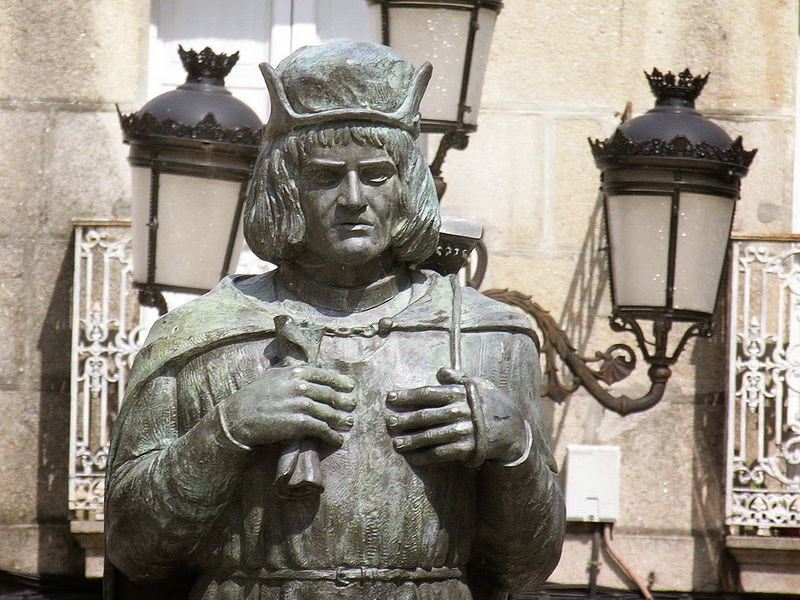
Statue of the 14th-century troubadour, Macías "The Lover," in Galicia
Reading literature aloud and listening to it recited offers such a vastly different experience with a story than does reading in silence. I cannot fathom why reading or reciting creative works aloud has faded almost entirely away from mainstream popular culture, especially since books are more portable and accessible than ever thanks to new reading technology.

In yesterday's post, I encouraged you to read aloud from Tolkien's stories. I read several of the poems from the Hobbit and the Lord of the Rings out loud, to the bewilderment of my sole audience member: my elderly dog. But oral recitation used to be one of the most important methods of narrative transmission. Mediterranean courts of the medieval period, for example, prized highly troubadours gifted with the ability to write and perform poetic works. 

A far cry from Tolkien - the 14th-century poetry of Macías The Lover
One such troubadour, Macías "The Lover" from Galicia, was not only a gifted courtier poet, but he also posthumously became a character in poems, stories and plays all over the Iberian peninsula. His life became his greatest work of art; the legends that sprang up after his death were recited and performed more often than the poems he wrote. The mythologizing of this particular troubadour assured him eternal life in the creative circles in which he had worked, and in literary history in general.

Some verses inspired by Macías' legend in a poem by Juan Rodríguez de Padrón, 15th-century poet

The legend of his life is a tragic story of love and self-punishment. The story goes that Macías, hopelessly in love with a lady of the court, focused all of his verses on extolling her qualities, putting his all of his poetic talent in the service of her beauty and virtue. After a time, however, this lady was wed to another man. Macías had pledged to only love and serve this lady for his entire life, and he honored this pledge. 

One day, as Macías lingered near a bridge, the now-married lady appeared on her horse. She wished to cross the bridge, but Macías asked her to dismount and speak with him for only a moment. Acquiescing to his request, the lady dismounted and listened as Macías reaffirmed his love for her and his pledge to serve her forever, even though it had to be from a distance. The lady was stunned by his words and, getting back on her horse, fled across the bridge. 

Neither Macías nor the lady had been aware that nearby, hiding in some bushes, was the lady's husband. As soon as the lady had departed, the husband leaped onto the bridge and ran Macías through with his lance. As he lay in the middle of the bridge dying, Macías' last words were said to have been yet another pledge to the lady, this time vowing to serve her from the far-off reaches of death. 
Some verses from a poem by Macías - the poem starts out "Cruel and determined love"... 

The real events of Macías' life have been so conflated with this legend that it is difficult to distinguish truth from fiction. Although that hardly matters, as the legend of his life is what became immortal and the inspiration for much subsequent literary production. I am interested in Macías' legend because it ended up playing an enormously influential role in the "sentimental romance" tradition, popular in 15th-century Iberia. The genre enjoyed huge reader success, reaching its apogee in 1492 with the publication of Diego de San Pedro's work, The Prison of Love. 

The novela sentimental follows a narrative arch that is almost identical to the Macías legend. One young person falls desperately in love with another young person; for some reason they are not permitted to be together; both suffer physical and emotional trauma because of the intensity of their love (or the lack thereof); one or both lovers die a horribly tragic death, which is merely an anticipation of the eternal condemnation their restless soul will doubtless experience in its afterlife. 

What interests me most about this genre is the way in which love and pain interact necessarily as part of the plot and character development. Here we have a genre of storytelling that reduces love to a rhetorical plot device, while pain takes center-stage and is explored on psychological, poetic, and social planes. It seems to me, then, that love was not the cause of suffering but rather an excuse to suffer. 

I will be doing a series of posts on the interaction of pain and love in the coming weeks. This theme is, in fact, the central idea of one of the term papers I will be writing over the course of the next month. Check back often to see who is bitterly weeping tears of blood for a distant object of desire! 


***
Who are your favorite doomed lovers? Why do you think there is a necessary connection between pleasure and pain in tales of love? 

Until next time - keep rustling! 

{Note: all photos in this post except the first one were taken by me of a book called Macías el Enamorado y Juan Rodríguez del Padrón by Carlos Martinez-Barbeito, 1951 edition.}


Monday, December 30, 2013

Five For Fourteen

I am really looking forward to a new year of books! Here is a list of five books I'm especially excited to read in 2014...

5. The Baker Who Pretended to be King of Portugal by Ruth MacKay
I purchased this book in hardcover during this past semester and have looked longingly at its beautiful cover ever since. In the whir and swirl of the semester, I didn't have time to devote to pleasure reading, but now that I do, I'm happily and hungrily delving into this treat.

Ruth MacKay is a phenomenal historical writer. Last year I stumbled across her book Lazy Improvident People: Myth and Reality in the Writing of Spanish History and was delighted by her highly readable account of Spanish early modern work culture. She explored the perception of Spanish work/labor culture from both within Spain and among other European countries by consulting economic records and essays on the nature of work from the day.

In this book, she tells the story of a foiled attempt to convince the Portuguese people that their deceased--and heirless--monarch had returned from the grave to continue governing Portugal as a sovereign land. In the late 1500s, Sebastian "O Desejado" ("the Desired One") took the throne in his adolescence; he was "desired" because he was the last in a line of legitimate pretenders to the throne and stymied the consolidation of power under the Spanish crown, allowing Portugal to remain independent. But the 15-year-old king marched himself, and the majority of the country's young male nobles, into an unnecessary re-conquering battle in northern Africa, where he and almost all his companions met their end.

The throne of Portugal was vacated, with no legitimate successor, and thus was born sebastianismo, the belief that Sebastian was simply hiding or sleeping and would come back to Portugal's shores one misty morning to take up his crown once more... Though this was utterly untrue, the belief took a strong hold, especially because Portugal was forced to be governed by the Spanish crown thereafter for a period of about 60 years. BUT ANYWAY... This book details one of the most successful attempts to give the sebastianistas exactly what they were seeking: the returned king.

From the book's inside flap: "In one of the most famous of European impostors, Gabriel de Espinosa, an ex-soldier and baker by trade ... appeared in a Spanish convent town passing himself off as the lost monarch. The principals, along with a large cast of nuns, monks, and servants, were confined and questioned for nearly a year as a crew of judges tried to unravel the story, but the culprits when to their deaths with many questions left unanswered." SO EXCITED!

4. Renaissance Self-Fashioning: From More to Shakespeare by Stephen Greenblatt
Here is a literary criticism classic that I have shamefully not yet read. But it is not just shame that inspires me to read this volume-- it is also genuine interest in the central idea of the text.

Put simply: what is identity and how was it created during the Renaissance? Greenbalt's exploration of this topic was responsible for revolutionizing the way early modern texts and their authors were researched (see: new historicism).

From the book's back-cover: "[this book] is a study of sixteenth-century life and literature that spawned a new era of scholarly inquiry. Greenblatt examines that structure of selfhood as evidenced in major literary figures of the English Renaissance--More, Tyndale, Wyatt, Marlowe and Shakespeare--and finds that in the early modern period new questions surrounding the nature of identity heavily influenced the literature of the era."

Wild guess here: this book will be a challenging but rewarding read.


3. Brazil Imagined: 1500 to the present by Darlene J. Sadlier
A panoramic look at diverse modes of cultural production in Brazil throughout the centuries? YES, PLEASE.

In this book, Darlene Sadlier writes about a range of artistic production (such as literature, visual art, architecture, media, historiography, letters) in order to trace major themes in individual (and epochal) identity formation. Beginning with the arrival of Portuguese settlers in the year 1500, Sadlier marks the evolution of the imagined Brazil--from both within and without its borders.

From the back-cover: "Topics include the oscillating themes of Edenic and cannibal encounters, Dutch representations of Brazil, regal constructs, the literary imaginary, Modernist utopias, "good neighbor" protocols, and filmmakers' revolutionary and dystopian images of Brazil."

I'm expecting to get a lot of new reading material out of this one!


2. Obras do diabinho da mão furada attributed to Antônio José da Silva, "the Jew"
The title of this fictional work from the 1700s can be roughly translated as "The Little Pierced-Handed Devil." So far, I know very little about the work, but I've begun to learn about its author (I started on the introduction last night!)

Apparently, Antônio José da Silva "the Jew" was born in 1705 in Brazil. His family had converted to christianity before leaving Portugal--but they were extradited by the Holy Office to be tried as heretics and "Judaizers." His family was convicted and fined, which left them with too few resources to return to Brazil.

They settled in Lisbon, where Antônio studied law and began publishing plays and other writings. These writings were seething critiques of lisboeta society--and of christianity--of the early 18th century. At the age of 34, Antônio José da Silva was again brought before inquisitors, tried because of his writings, and sentenced to death by hanging and the public burning of his corpse.

This story is said to draw extensively from local folklore, combining Portuguese mythical creatures with the general narrative arc of the "Faust" stories (immortalized definitively in Goethe's tragic play). I haven't found an English translation of the book, so I promise to report back and let you know all the details!

1. Grande sertão: veredas by Guimarães Rosa
In the early 60s, this book was translated into English under the title The Devil to Pay in the Backlands. And it breaks my heart to report that it has since gone out of print, meaning that if you'd like a copy, you should be prepared to spend around $300. Ouch. Well, crack out that library card, because I am certain that any trouble you go through to get this book between your hot little hands will be worth it...

As I understand it, the central story is narrated by its main character, Riobaldo, a bandit traveling through the Brazilian backlands. To an (unknown?) listener, Riobaldo relates his strange and at times terrifying encounters in the desert. The Devil, it seems almost needless to say, will play a main role in this novel.

It is another classic that I am ashamed to admit I haven't read yet... but my shame is greatly overcome by my excitement to begin reading this immortal story. {Also, update: just found this blog dedicated solely to this novel!}

Oh, and by the way- check out these amazing photographs of the author, Guimarães Rosa...How ahead of his time was he?! A true pioneer of public cat obsession, in the pre-Internet era!


***
What are you most looking forward to reading in 2014? What authors do you think we should look out for? What's on your nightstand right now??

Until next time-- keep rustling!

Sunday, December 29, 2013

Five Favorites from 2013

There have been so, so many wonderful books I've had the chance to read over the course of the last year. In fact, not only have I gotten to read novels but poems, plays, history and critique, too. It was hard to select my five favorites, and I tried to have my list represent various of these genres as well as a range in historical and geographic contexts. It was difficult to chose only five, but I liked the alliteration of "Five Favorite" too much to turn back, so here we have it...

5. El libro de buen amor by Juan Ruiz, Arcipreste de Hita
This gem comes from the clever quill of a medieval priest of the Iberian peninsula. Juan Ruiz, the priest of Hita, was known as a cheeky but good-natured rogue, writing theological teachings in what would appear to be a guide to sensual delights.

You may remember I mentioned him a while ago, quoting a particularly brassy passage that taught readers not to be given the the sin of sloth because their sex lives would surly suffer.

"The Book of Good Love," as it is translated into English, is a romp through anthropomorphic tales of hapless lions, allegorical battles between Lady Lent and Master Meat, and a small peek into the life of "Trotaconventos" ("convent trotter"), a go-between nun. All of this is masterfully woven into rhyme, with heavenly lessons seemingly taught through earthly adventures. I loved this book and inadvertently dreamed in rhyme for at least a week after I finished reading it.

4. Fuenteovejuna by Lope de Vega 
Image source
Based on an historical event from medieval Spain, this play takes the name of a town, Fuenteovejuna, that allegedly banded together to overthrow--by pain of death--the malicious lord of their region.

Written around one hundred years after the event, this play was penned by the most prolific writer of the Spanish Baroque, Lope de Vega. In this play, Lope imagines the desperation and grief of the townspeople and their rally to rebellion.

On the wedding day of the central characters, Laurencia and Frondoso, the evildoing Comendador rides through the party and snatched up the two newlyweds, placing Frondoso in the dungeon of his castle and abusing Laurencia. When she makes her escape, she runs back to the town and, with blood on her face and her clothes torn, she shames all the gathered men of the town for cowering in fear rather than coming to her rescue.

As I read that monologue, tears streamed down my face. The the depth of her sense of betrayal, the intensity of her wrath and desire for revenge blaze like a hateful fire in the mouth of a once-delicate young woman. The town becomes changed into a bloodthirsty hoard that marches to the Comendador's castle, cuts him down, and celebrates with his head on a pike. Afterwards, Inquisitors are sent to the town with torture devices to try and discover who murdered the region's lord. But when asked who was responsible, even under the duress of torture, men, women and children of the town answer only: "¡Fuenteovejuna!"

Someday I would love to see this play in person. I have read some critiques of the play that claim Lope de Vega wrote it to show how terrifying the ignorant masses would be, if ever they learned of their power, and that power should always remain in the hands of discerning monarchs. But I'm not convinced of that cynical take on Lope's intension with the play. Rather, I think he chose to gaze unwaveringly at the terrifying capacity of the human spirit to be moved by its own righteousness.

Here is a clip showing Laurencia's famous speech-- it is in Spanish and there are no subtitles, but it will nonetheless convey to the fiery intensity I described even if you don't understand the words:


3. Auto da compadecida by Ariano Suassuna 
I loved this play so much that I dedicated an entire post to it, right after I finished reading it. A Brazilian comedy set in the northeastern backlands, the play pits the violent severity of a bandit against the wits of a poor trickster and a a cast of hapless characters caught in the middle--including the lusty unfaithful wife and her witless husband, a greedy sacristan, and an old dog wed to a money-shitting cat.

The humor of this play seems to be of the very same ilk I appreciated so much in the medieval text of the Arcipreste de Hita. Suassuna brilliantly weaves together the timelessly hilarious with the unmistakably Brazilian. This is another one I'd like to see performed live-- in addition to some of his other plays, namely A mulher vestida de sol (a Romeo and Juliet-like tragedy, whose title translates as The Woman Dressed in the Sun).  


2. Dom Casmurro by Machado de Assis
I read this book for a seminar this past semester and was delighted to have the chance to revisit the storytelling prowess of 19th century Brazilian author: Machado de Assis.

About a year ago, I had my first encounter with him, reading As memórias pósthumas de Brás Cubas (The Posthumous Memoirs of Brás Cubas), narrated by a "deceased-author" from beyond the grave. In it, the narrator turns an ironic gaze on the attendees at his funeral and on the memory of those who survived him as he recalls the events of his life.

In Dom Casmurro, the narrator is a cantankerous older man, barley able to hide his general displeasure and unease with the memories he recounts of the people and events that made up his youth and middle age. The narrator's sense of humor is so biting and his critical eye so piercing that the reader finds himself laughing while at the same time shaking his head, in one of those almost melancholic "funny-cuz-its-true" moments.

Machado de Assis' gift to literature was not only his sense of ironic humor; his innovative narrative style tested (and extended) the boundaries literary realism. The narrator of Dom Casmurro often speaks directly to the reader, integrating imagined readers into the narrative. At the time of its publication, the reading public in Brazil was relatively small, so the author simply invented his readers and placed them directly in dialogue with his narrator and characters. The imagine male readers received the literary equivalent of a "wink wink nudge nudge" and female readers, imagined as "proper" and full of false-piety, received equally false apologies that would end with an invitation to put down the book and not go on reading it if they were so easily offended (hmph!). The real reader ends up laughing at the characters, their narrator, and even these implied readers, who may truly have existed, in some form or another...

Unlike his contemporary in Portugal, Eça de Queirós, Machado's droll teasing of his characters ultimately had the aim of laughing with them, rather than at them. He loved his deeply flawed, pompous, silly, arrogant, racist and sexist characters--because if he didn't, who would there be left in the world for him to love? Though realism set out to reveal the naked truth about humans' deplorable qualities, Machado seemed to have decided that, even after careful inspection of these qualities, there still may be something worth adoring in people-- even those that die alone and absorbed in memories and old jealousies. While Eça de Queirós in Portugal and "Clarín" Leopoldo Alas in Spain wrote huge (and yes, enjoyable) novels filled with ridiculing irony that constantly laughed at the characters, especially when they were down, Machado de Assis embraces human imperfections, has a good laugh at them, and goes on loving them.

1. LITERATURA DE CORDEL!!!

YOU GUYS. I recently received a long-awaited package in the mail, all the way from Brazil. It was a box FULL of cordel chapbooks. I have begun reading them, and promise to devote future posts to them, as is only proper.

Putting an entire genre of poetry as my number-one-favorite is a total copout, and I know it. And yes, technically this should be in my list of things I'm looking forward to finishing reading in the coming year. But I had to cheat a little bit on this list because the pressure of naming a number one favorite of the year haunted me for days and kept me from writing the dang post at all.

I just couldn't bring myself to select only one book for the top slot in a year in which I also read, for my first timeEl Mio CidLa vida es sueñoLos pasos perdidosRios profundosLa ciudad y los perrosPrimo Basílio, The Hobbit, and others (links are to the English translations). It was a big year of big books. So my number one slot goes fittingly to a big array of big (little) books...


*Extra Credit: The Children of Húrin by J.R.R. Tolkein
Painting for the novel by Alan Lee
And because this is my blog, I can break my own rules and cheat some more and offer an "extra credit" title in my list. This isn't technically part of my "Five Favorites" for this year, but I wanted to include it because it is part of a broader new trend in the things I'm choosing to read for pleasure.

As a child, my mother read to me--and invented for me--a huge variety of folktales about faerie creatures that I believed to be real (or perhaps still do?). I grew up listening for songs in the woods and always watching out for a villain that plagued my nightmares for years, Red Cap.

Red Cap painting by Alan
Lee from his book, Faeries
Although I study literature as a grad student now, there are few if any folkloric tales assigned as required reading. That is not because they don't exist in Spanish- and Portuguese-speaking countries; I think it may simply owe to the way Academy tends to define "Literature" as a category separate and distant from "Lore."

Recently, I have felt a strong desire to go back to reading these tales in my spare time (and hopefully weaving some into my dissertation!). Specifically, I have a renewed interest in the writing of J.R.R. Tolkien (admittedly rekindled by Peter Jackson's translations of the Lord of the Rings and The Hobbit into the medium of film). I recently read The Hobbit for my first time ever in life (how has it taken me so long to read that book?!).

After a flurry of amazon-one-click-shopping, a box of Tolkien books showed up at our apartment door around Christmas time... one of the books I ordered was The Children of Húrin which I began reading yesterday and finished this morning. It was a fierce, serious book, with an entirely different tone from The Hobbit or the Lord of the Rings trilogy. There is none of Tolkein's humor here, nor does the power of good and truth overcome all evil. Rather, in this epic tale told in archaic-sounding language, a hero is born under a curse and in an utterly besieged Middle-earth; he must do whatever he can to survive, including join a band of outlaws and confront a dragon single-handedly.

There are so many old-sounding names--of people and creatures and places and swords--and each begs to be rolled around in the mouth and uttered aloud. The vastness of Tolkien's imagination is at once welcoming and overwhelming. I am inspired to read more of his canon, and most of all, to return to some of the tales that I remember from years and years ago...

***
What are your favorite books from this past year? What are some of your favorite books of all time?

Until next time-- keep rustling!

Tuesday, October 29, 2013

Faint Rustlings

Coffee and Vitamin C for fall mornings
My petticoats have been silent for a month! You must've begun thinking that I got too carried away with the apocalypse theme of the last post... But I'm back, and ready to begin rustling the crinolines of literature and art once more.

Colorado has been changing colors these days, going from green and gray to bright fiery reds, oranges and yellows. I will have to get out and take some photographs of all the beautiful leaves before we get a heavy snow (we've already had several light snows!). As a result of the changing weather, mornings have been filled with cozy sweaters, muted light, and the satisfying crunch of leaves under boots. I really love this time of year; it's great reading weather.

A short stack of reading materials and a devil sculpture made by my husband, Emiliano Lake-Herrera 
Recently, my dissertation theme has begun to take shape... a very recognizable shape, as a matter of fact, complete with pointy tail and horns. I have decided to investigate the figure of the devil in Brazilian literature, most likely as expressed through the poetry chapbooks, Literatura de Cordel. Now that I have a general direction in which to go with my research, I've happily begun shirking all other responsibilities in order to read broadly about the idea of the devil and the idea of Brazil...

                       
The devil is often portrayed not as a towering black beast, but as a man. In fact, he is so like man that characters often mistake him for a simple stranger initially (in contrast, if an angel were to appear in a narrative, there is no mistaking their presence and their divine importance). So the devil appears not as an external push towards sin or wrongdoing through fear or coercion, but rather he seems to work more like a magnet, drawing out our trickster qualities when he is near. And the human characters' task is to out trick him-- we must be more clever, better liars, and as sneaky as possible in our dealings with him (human characters must out-devil the devil!).

I am really excited to be working on this project and have already read some amazing things, including an ethnography on Candomblé (an African spiritous religion) and I should really do a whole post on that book alone! So much rustling to do, my friends...

 In the meantime, I'm just happy to be back on the blog. I hope you have all been doing well and finding good things to read. What has been on your bookshelves recently? What has been rustling your petticoats???
My most faithful reading companion, on the job, on a chilly morning

Until next time-- keep rustling!

Wednesday, May 29, 2013

A Reader's Studio

I am always jealous of the gorgeous, aesthetically meticulous studio spaces visual artists create for themselves. Their tools, paintbrushes, raw materials, and works-in-progress are arranged so as to be both accessible as well as sensorially engaging. There is usefulness and beauty in almost every object in the studio. Objects in the studio are not only there to help create a work of art, but also to inspire the artist to use them and appreciate them.
Source 
Source
Source
My husband is a visual artist and has had many different kinds of studios. Right now, he is looking for a new space; in the meantime, he's been working at home, but the space an artist can create in a studio is so important-- to be able to breath in the readiness of the materials is an essential part of the artistic process.
My husband, Emiliano Lake-Herrera, painting in one of his past studios. 
Recently, a dear friend of mine suggested that my husband and I look for a studio we could share. Doesn't that sound dreamy?! It does sound dreamy!! And yet... I immediately worried that my corner of the studio would be incredibly boring. I mean, the tools I use are a computer, a notebook, stacks on stacks of books, and lots of coffee cups.... my works-in-progress are Word documents and open books laying face-down... not very sensorially appealing...

But then I realized that, in fact, I do have a lovely corner in our apartment where I read, and that I do always want it to be beautiful and surrounded by books and objects that inspire me. Here are some photos of where I do the majority of my work:
The chair where I read... 
...is surrounded by books shelves.

...and friends to keep me on task.
Of course, everyone needs a snack while reading! 

Keeping the lonely lit critic company

My husband's art, a record player, a disco ball, and more books

In that same corner: our berimbaus, a kind of Brazilian stick and gourd instrument.

Brazilian woodblock prints

Freshly cut flowers 
Records, books
I'm not the only one who loves this space-- my most faithful reading companion does, too!
A lot of details from this tiny, bright corner!  

I hope you enjoyed seeing my "Reader's Studio"! Where do you most love reading, oh petticoat rufflers?!