Showing posts with label Spain. Show all posts

Thursday, March 27, 2014

Chivalry and the Sentimental Novel

Tristan and Iseult by Edmund Blair Leighton (1853-1922)
Yesterday's post began a discussion on the curious intersection of love and suffering in 14th and 15th century literature, specifically the sentimental romance. While we looked at the mythologized life story of Macías the Lover yesterday, today I would like to talk about some historical factors influencing the emergence of the genre.

The literature produced in this genre generally had an extremely predictable plot, which in turn placed greater emphasis on the authors' ability to invent and describe new forms of love-induced torture for their characters. Some of the suffering was allegorical (for example, The Prison of Love opens with the protagonist allowing himself to be lead by a wildman - symbol of loss of reason - into a tower where he sits upon a burning throne where he will always hurt but never be consumed - symbol of the burning passion of the heart and the fiery punishments for such passions awaiting him in hell). In other cases, the suffering was real and physical, and certainly the deaths at the end were always permanent. 
Entering the allegorical
"prison of love"

Unlike other European renditions of fated love stories (see the stories of Tristam or Lancelot), the characters in Iberian sentimental romances never enjoyed any kind of physical union - there was no kissing or embracing and there certainly was no sex. Frequently, the lovers only occupied the same physical space for a few brief, fleeting moments. The pain and punishment resulting from those few moments came in spite of an utter lack of hope that love would've ever manifested itself physically. Truly, then, this is a genre of all pain and no pleasure. The desire, it seems, grows in the pain and not the temporary fulfillment of sexual fantasy. 

In her book Clio, Eros, Thanatos: The 'Novela Sentimental' in Context, Theresa Ann Sears posits that a shift in social and economic relationships lead to such aesthetic trends in 15th and 16th century western European literature. "National monarchies had slowly undermined the feudal relationships based on exchanges of protection for goods and services," she writes. "Advances in weaponry were eroding the efficacy of troops of mounted, armored knights, putting greater emphasis on, on the one hand, a professional soldiery, and on the other, conscripted or hired infantries. Such changes resulted in an increasingly idle aristocracy that indulged (negatively) considerable social disruption and decadence, and (more ambiguously) in an aesthetization of its role." 
Image of Amadis of Gaul, Spain's most beloved
protagonist of a chivalric novel

These changes in social dynamics undoubtedly influenced artistic production. I believe that as the role of the knight became destabilized by changing strategies in armed conflict, a gap widened in the popular imagination of heroism. Slowly, the chivalric knight of the high middle ages faded - the noble and proud figure, mounted on his horse and prepared to suffer any hardship in service of his king, receded from reality into fiction. In the absence of a heroic cause for which to suffer and die, a different one was summoned to take its place: women. 

The so-called "religion of love" integrated religious imagery with sexual metaphors, blasphemously elevating the "perfect" feminine to god-like status (think: Act 1, Scene 5 of Romeo and Juliet, in which Romeo convinces Juliet to kiss him by equating their lips to the hands of saints that press together in prayer). Knights needed to serve a higher purpose, and if their king had no urgent save-the-Christian-world errand on which to send them, they remained at home, surrounded by the people who had always remained home (women!). Women became the inspiration for "heroic" deeds and tragically "noble" deaths. 

Frontispiece of La Celestina revealing
the text's ending
Of course, this lead to some problems for women (see my previous post on the wide-spread, public debate on women during this same time period). But this was also indicative of a growing problem for men. The masculine identity was in crisis, and I believe that the pain, torture, and deaths of the male characters in sentimental romances are indicative of this profound cultural crisis. Attempting to define themselves negatively (i.e. writing about the defining characteristics of women to indicate what men are not) only succeeded in turning the once-herioc male trope of chivalric novels into a purposeless, impotent, lost soul, pinning after little more than an affair.

Women were lambasted repeatedly and as a result the "religion of love." Clergy were scandalized by the idolatrous fascination with "perfect" women that were supposedly suddenly in abundance; other men of the court also rejected this idealized image of women. So the "religion of love" faltered - the perfect object of desire was now painted in popular imagination as nagging and emotionally unstable. Along with this debate, the sentimental romance genre waned in popularity until coming to an abrupt and definitive halt in 1499, with the publication of Fernando de Rojas' La Celestina
From Chapter 5 of La Celestina 
Note: Celestina is depicted as a nun
Written as if it were a play (though not necessarily intended to be performed), this text parodied all of the fundamental elements of the sentimental novel. The star-crossed lovers were not all that attractive, they were half-witted and decidedly uncharming, their servants found them pedantic and silly and made no effort to hide their disdain. Worst of all, rather than appealing to the "godliness" of the object of desire, the story appeals to the black magic of the alcahueta (go-between, procuress, "witch") who gives the work its name. (Interestingly, the title of the work was not originally La Celestina, but because this ugly, greedy, devil-consorting witch was such a great character, her name quickly replaced the original title to sell more copies).

Much of La Celestina is quite funny but it comes to the same customarily tragic ending that all sentimental novels do. But the damage to the genre has been done - the successful parody of the entire pleasure/pain trope had been reduced to foolhardiness and superstition.

Nevertheless, La Celestina came at the end of almost a century of sentimental romance production. The proliferation of Macías' story alone in these novels, in lyric, in Spain, in Portugal, is enough to indicate that pleasure and pain have a natural alliance, in spite of Fernando de Rojas' parody of the sentimental genre. I am interested in finding out more about how that alliance worked in the minds and hearts of 15th-century writers and readers... so stay tuned!

***
Until next time -- keep rustling!

Wednesday, March 26, 2014

Macías, The Lover

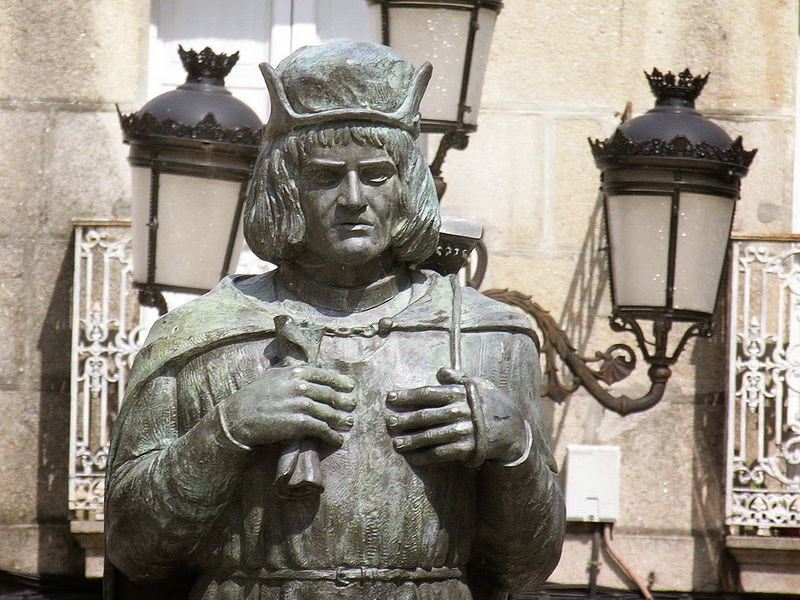
Statue of the 14th-century troubadour, Macías "The Lover," in Galicia
Reading literature aloud and listening to it recited offers such a vastly different experience with a story than does reading in silence. I cannot fathom why reading or reciting creative works aloud has faded almost entirely away from mainstream popular culture, especially since books are more portable and accessible than ever thanks to new reading technology.

In yesterday's post, I encouraged you to read aloud from Tolkien's stories. I read several of the poems from the Hobbit and the Lord of the Rings out loud, to the bewilderment of my sole audience member: my elderly dog. But oral recitation used to be one of the most important methods of narrative transmission. Mediterranean courts of the medieval period, for example, prized highly troubadours gifted with the ability to write and perform poetic works. 

A far cry from Tolkien - the 14th-century poetry of Macías The Lover
One such troubadour, Macías "The Lover" from Galicia, was not only a gifted courtier poet, but he also posthumously became a character in poems, stories and plays all over the Iberian peninsula. His life became his greatest work of art; the legends that sprang up after his death were recited and performed more often than the poems he wrote. The mythologizing of this particular troubadour assured him eternal life in the creative circles in which he had worked, and in literary history in general.

Some verses inspired by Macías' legend in a poem by Juan Rodríguez de Padrón, 15th-century poet

The legend of his life is a tragic story of love and self-punishment. The story goes that Macías, hopelessly in love with a lady of the court, focused all of his verses on extolling her qualities, putting his all of his poetic talent in the service of her beauty and virtue. After a time, however, this lady was wed to another man. Macías had pledged to only love and serve this lady for his entire life, and he honored this pledge. 

One day, as Macías lingered near a bridge, the now-married lady appeared on her horse. She wished to cross the bridge, but Macías asked her to dismount and speak with him for only a moment. Acquiescing to his request, the lady dismounted and listened as Macías reaffirmed his love for her and his pledge to serve her forever, even though it had to be from a distance. The lady was stunned by his words and, getting back on her horse, fled across the bridge. 

Neither Macías nor the lady had been aware that nearby, hiding in some bushes, was the lady's husband. As soon as the lady had departed, the husband leaped onto the bridge and ran Macías through with his lance. As he lay in the middle of the bridge dying, Macías' last words were said to have been yet another pledge to the lady, this time vowing to serve her from the far-off reaches of death. 
Some verses from a poem by Macías - the poem starts out "Cruel and determined love"... 

The real events of Macías' life have been so conflated with this legend that it is difficult to distinguish truth from fiction. Although that hardly matters, as the legend of his life is what became immortal and the inspiration for much subsequent literary production. I am interested in Macías' legend because it ended up playing an enormously influential role in the "sentimental romance" tradition, popular in 15th-century Iberia. The genre enjoyed huge reader success, reaching its apogee in 1492 with the publication of Diego de San Pedro's work, The Prison of Love. 

The novela sentimental follows a narrative arch that is almost identical to the Macías legend. One young person falls desperately in love with another young person; for some reason they are not permitted to be together; both suffer physical and emotional trauma because of the intensity of their love (or the lack thereof); one or both lovers die a horribly tragic death, which is merely an anticipation of the eternal condemnation their restless soul will doubtless experience in its afterlife. 

What interests me most about this genre is the way in which love and pain interact necessarily as part of the plot and character development. Here we have a genre of storytelling that reduces love to a rhetorical plot device, while pain takes center-stage and is explored on psychological, poetic, and social planes. It seems to me, then, that love was not the cause of suffering but rather an excuse to suffer. 

I will be doing a series of posts on the interaction of pain and love in the coming weeks. This theme is, in fact, the central idea of one of the term papers I will be writing over the course of the next month. Check back often to see who is bitterly weeping tears of blood for a distant object of desire! 


***
Who are your favorite doomed lovers? Why do you think there is a necessary connection between pleasure and pain in tales of love? 

Until next time - keep rustling! 

{Note: all photos in this post except the first one were taken by me of a book called Macías el Enamorado y Juan Rodríguez del Padrón by Carlos Martinez-Barbeito, 1951 edition.}


Tuesday, March 4, 2014

Medieval Women (and their fans)

Miniature of a woman painting, from a 1440 manuscript of Boccaccio's "De claris mulieribus"
The role of women in medieval mediterranean culture was the subject of a large-scale debate, carried out in the writing of various intellectuals throughout the XV century. Not only male intellectuals but also several women writers participated in the debate. Among the female writers who offered contributions to the discourse on women was Sor Teresa de Cartagena. She suffered illness most of her life and subsequently penned the "Grove of the Infirm," a work which extolled the inherent virtues of women and the holiness of all those who suffered bodily sickness. Her stance is considered today (somewhat anachronistically) as "proto-feminist," although I think that a more appropriate designation would be "pro-women," as the term "feminism" tends to conjure up a repertoire of 20th-century issues and stances not present in the medieval mediterranean context.
Woman painting self-portrait; from 1440 manuscript of Boccaccio's "De claris mulieribus"
The work of the poet and humanist of the French court, Christine de Pizan, also circulated widely and was responsible for adding formidable arguments to the debate: she demonstrated both in her writing and in the example of her own life, the many ways women could enrich intellectual and political culture.

These women's voices were joined by male contemporaries, such as Diego Valera and Juan Rodríguez de la Cámara, who both defended the value and virtue of Christian women by revindicating the narrative of Eve, displacing to Adam any role in the Fall and the creation of Original Sin. Martín de Córdoba added to this chorus of male voices with his El jardín de nobles doncellas ("The Garden of Noble Maidens"), which was written specifically for the soon-to-be Queen Isabel the Catholic.

A significant contributor to the debate over women was the courtier, Álvaro de Luna. The Libro de las virtuosos e claras mugeres ("Book of Virtuous and True Women") is a collection of exemplary tales that he wrote about illustrious female figures from the Bible, Greek and Roman mythology, and ancient history. He begins this work with the Virgin Mary, whom Álvaro de Luna writes is responsible for the reversal of Original Sin. He follows his marian narrative with the story of Eve, in which he relieves her of any guilt in the Fall, placing blame instead on Adam, in line with the reasoning of the other authors mentioned above. He continues to enumerate the exceptional lives of various biblical women (including Judith, one of my favorites).

Peter Paul Rubens, "Cimon and Pero" c. 1630
Example after example of extraordinary women makes up the body of Álvaro de Luna's text. Like female Hercules they form a pro-woman narrative that makes women seem saintly, unerring, and ever-wise. In two short chapters, the author recalls the Classic stories of women who allowed their parents to survive dire circumstances by feeding them with their breast milk. The proliferation of stories of women doing whatever necessary to ensure the utmost moral conduct eventually begins to make the mere mortal female reader (such as myself) doubt her ability to ever live up to such expectations - or even wish to. The physical and psychological torment that many of these exemplary women experience makes it seem near impossible to live a comfortable life and be a virtuous woman. The women of the Libro are prepared to endure hideous torture and death to preserve their extraordinary virtue, guided always by their own moral compass and the hand of God Himself. Meanwhile, a contemporary text that addresses virtuous men, written by Fernando del Pulgar, offers a much more attainable vision of masculine virtue (think: "sure, he may have committed adultery a bunch of times... but he's such a great soldier!").

And yet Álvaro de Luna's enthusiasm for women resounds with an optimism for the future role of women in his society. His series of prologues offers the reader an important framework with which to understand the rest of his text. On multiple occasions, he notes that women are not "inherently" bad or good, they are a product of their habits and habitual actions, as are men. Last week I got the opportunity to discuss this work with my colleagues in a seminar and we all noted how modern Álvaro de Luna's thesis seemed to be. After discussing his Libro, we proceeded to read aloud several of his poems. ...They were so saucy! I can't say that I was surprised to read sensual poems about being hopelessly in love with women (including women other than his wife) from a man who vehemently defended his female contemporaries.
Woman painting self-portrait from 1440 manuscript of Boccaccio's "De claris mulieribus" 
Álvaro de Luna's Libro was greatly influenced by Di claris mulieribus by Italian author, Boccaccio. Interestingly, Boccaccio wrote works that fit into both the pro-women and the anti-women categories. Of course, Di claris mulieribus fits into the former category. Although I have not yet read the Italian author's text, I plan to do so soon, especially after finding this article which displays various miniatures adorning the original manuscript and depicts women as painters and sculptures!

Finally, in honor of today being Fat Tuesday, I leave you with a picture of my 9-year-old self at carnivale in Venice. Donning a mask my parents got for me earlier that day from a magical little mask shop perching above the glass-green water of the canal, I have my arms outstretched, as if trying to embrace the whole city, all of its masked inhabitants, and the women-loving tricksters that had populated its narrow streets since medieval times...

***
Happy Fat Tuesday!

Until next time -- keep rustling!

Monday, March 3, 2014

Found in Translation

February was a month of discovery for me. I attended a symposium here on campus, called "Cultural Translation in Medieval and Early-Modern Studies," which brought together scholars from around the country (and even from exotic Canada!) to talk about themes and issues associated with medieval translation. The speakers included professors in religious studies departments, modern language departments (Spanish, Portuguese, Italian, French), history, art history, and classics departments. The talks covered a range of problems associated with medieval translation projects - from the way medieval Christian scholars translated the Qur'an to contemporary translations of Marco Polo's travel writing (originally written in the coiné, Franco-Italian).

Marco Polo
Professor Sharon Kinoshita gave the talk on Marco Polo, and I had the privilege of picking her up from the airport - an opportunity graduate students covet, as it provides an hour of one-on-one conversation with the professor. Her work is fascinating to me because she approaches medieval literature as part of broader process of cultural production, one that stretched across linguistic, geographic, and socio-economic boundaries. While she specializes in Francophone medieval literature, Professor Kinoshita (and a growing number of her colleagues) views the entire Mediterranean region as a highly communicative community of cultural production (see her most recent book). This community often shared interests and imagination and responded to one another's experiences through writing. This interaction is exemplified by translations of a diverse array of texts that circulated the Mediterranean region.

Professor Kinoshita addressed one case in particular, Marco Polo's The Travels, a work for which no two translations seemed to be the same. In some translated versions, entire passages were changed to reflect local fears or perceptions of "the Other" (who, in this case, happened to be dog-headed cannibalistic Africans). In other translators' versions, the style was altered to enhance the literary beauty of the text (a controversial choice, made even by today's translators of the work-- see: the Penguin edition). In the translation that Professor Kinoshita herself is elaborating, Marco Polo's repetitive style in the original Franco-Italian is more faithfully transmitted, allowing the reader to fully experience the barebones language of the coiné. 

St. Bernard Vanquishing the Devil
German, XV-century
Metropolitan Museum of Art collection 
Side note: This summer, I'll be taking Italian lessons so that I too can approach medieval literary production as an element of a broader Mediterranean culture. I plan to develop a corpus for my dissertation which incorporates Castilian, Portuguese, and Italian literature - the tricksy devil character pops up all over the Mediterranean region in varying guises, responding to both local and universal perceptions of evil and punishment...

Another of my favorite moments from the symposium was Professor Mark Meyerson's talk on ritual violence during Holy Week in medieval Valencia. His talk featured a particular case dating back to 1380, a case that he discovered while researching in judicial archives. Apparently, every year during Holy Week (the week preceding Easter in the Catholic tradition), the Christian community of Valencia would engage in ritualized, performative acts of destruction and violence that consisted mainly of throwing rocks at the wall surrounding the Jewish quarter. In many cases, Christians and Jews were neighbors and friends, living in such close proximity that they even shared walls. Christian and Jewish families remained friends before and after Holy Week, in spite of this destructive ritual performance.

Detail from "Feast of the Passover" by
Dieric the Elder Boutis
circa 1465
Rarely did Jewish families protest this ritual - only in extreme cases of injury, death, or property destruction did they bring complaints to the King. For the most part, this ritual was viewed simply as part of the collective judeo-christian calendar. Some scholars have understood the tradition as a performance that, rather than teach Christian children to hate Jews, taught them about the shared history of Christians and Jews and jewish custom, and served as a "release valve" for the Christian community during the most intense week of the liturgical calendar.

Professor Meyerson's talk detailed a special (and tragic) case from the year 1380 that he discovered in the archives. The story was preserved in the form of juridical documents from the proceedings of a murder trail, in which two jewish men were accused of causing the death of a young Christian boy. The accused men were thought to have perpetrated an act of retaliatory violence against the Christian community, in the wake of Holy Week activities.

The distraught father of the deceased child levied accusations against Salamo and Mosae, jewish residents from his same neighborhood. According to the legal documents, witnesses informed the boy's father that they'd seen an arm throw a rock from the window the Salamo and Mosae's house. The rock struck the boy's head as he walked his dog below, and the head wound he sustained killed him several days later.

Of the 20 witnesses for the defense, however, 17 were the Christian neighbors of the two young Jewish men. They testified that it seemed extremely unlikely to them that these stand-up citizens would be capable of harming a child. One of the Christian witnesses for the defense even displayed his knowledge of jewish custom claiming that, as the fateful event took place on the Sabbath, the young men's own religious tradition would have prohibited carrying out this work. The defense's explanation of the events posited that, as many rocks had been thrown at the house the day before the boy was struck, it was likely that one of the rocks had been up on the roof and was simply blown off in a high wind and fell accidentally on the poor boy's head.

Surprisingly, there was no lynch mob. In spite of heightened emotions during Holy Week, the two young men received due process and were defended by their neighbors, Christians and Jews alike. In the end, however, some damning evidence against one of the young men was brought forth and he was sentenced to death. Although we will never know if the sentenced man was truly guilty or not, the case provided many interesting details of quotidian life in Valencia in the late fourteenth-century - details about how Christian and Jewish children played together every night in the street, and how Christian families would have their fancy Easter clothes made and tailored by Jews who, the day before, had been targets of the Holy Week rock-throwing.

These are the kinds of cases that really make a girl want to dig in to some vellum archives! Which is why, since the symposium, I have been investigating the collections of different libraries' medieval texts. Through this research, I've found my newest fascination: the Merton University Library. Merton is the world's oldest, continuously active university library, located in Oxford, England. Take a look at its unparalleled beauty:

I can't imagine a more perfect place on earth. 
Merton University Library was constructed and began housing books in 1276 and has provided a space for scholars to read and learn since then. This week, I went to our campus library and checked out the (gigantic) index book of all the medieval texts Merton houses. I am looking through this index now, to try to find some relevant texts for my dissertation... I'm hoping there's a trip to Merton in my not-so-distant future!

Luttrell Psalter, "Milking Sheep," England - circa 1325-1340
British Library collection 
I am riding a wave of inspiration from this medieval translation symposium, organized by my advisor, Professor Núria Silleras-Fernández, and her husband, Professor Brian Catlos, and also included incredible talks by Professors Thomas Burman and John Slater (which each could've been the subject of an entire post!)...

***
What have you been up to recently, fair petticoat rustlers? Where is your favorite library?

Until next time - keep rustling!

Friday, March 29, 2013

The Golden Age of Cross-Dressing

Clothes make the man (even if you're a woman).
Still from a production of Life is a Dream (1635) by Calderón de la Barca. Image credit
Hello, dearest petticoat rustlers! I am happy to report that I've made it through the written exams and will move on to the oral exam coming up in the first week of April. Although the thrill of battle continues, I will be back to regularly posting here again!

Over the course of the past month, I've feverishly been reading, taking notes, reading notes and buying used paperbacks like some kind of literary doomsday-prepper. This was all in preparation for those 4 hours I was given in which to convince my professors that I understood what I had read and could string some coherent thoughts together about groups of books from certain geographic and historic categories. The questions I was asked were fantastic, and I really did have a great time writing responses for them. 

And yet, after a month of round-the-clock studying, intravenous coffee supply, and total immersion in the literature, I left the exam room feeling that there was so much more I was obsessed with longed to say about these books in which I'd been living. Chances are good that I'm not going to get any questions about cross-dressing in Golden Age literature, so I decided to regale you with some of my favorite gender swap scenes of 17th century Iberia. 

A scene from "Don Gil of the Green Breeches" by Tirso de Molina
Perhaps the most wonderful example of the glory of Golden Age cross-dressing comes from the hilarious play, Don Gil of the Green Breeches (c. 1615) by Tirso de Molina (author of The Trickster of Seville, a play about Don Juan's naughty--and fatal--sexcapades). The very crux of this play is the protagonist's skill in crossdressing and disguise. Doña Juana has been spurned by her lover, Don Martín after he and his father hatched a plan to marry him off to the far richer Doña Inés. 
Having given away her honor (virginity) in exchange for the promise of marriage, Doña Juana sets out to make Don Martín hold up his end of the bargain. She decides to foil his plans with Doña Inés by dressing up as a gentleman and courting her under the alias Don Gil--the very alias Don Martín planned to use (he couldn't have used his own name after already having announced his engagement to Doña Juana). 

Doña Juana, dressed in green breeches arrives first and presents herself as "Don Gil" to Doña Inés and her sister, Clara. Both women immediately become smitten with the crossdressed Juana. Don Martín shows up later and introduces himself as Don Gil, too, but the ladies claim to have already fallen in love with the Don Gil wearing green trousers. 

The plot then becomes extraordinarily twisted and complex, as Doña Juana dons other disguises, dressing as a lady of high society and moving in next to Doña Inés to befriend her and learn her secrets. 

Doña Juana beautifully manipulates everyone around her and executes so many unexpected tricks of wit both in and out of her green breeches. Towards the end of the play, everyone has become so jealous of the smooth-talking Don Gil that in one scene the majority of the characters (men and women) have all dressed up as Don Gil of the green breeches--and a very funny sword fight ensues! In the end, Doña Juana gets to reveal her many identities and the cunning way she got what she wanted-- as a man and as a woman. 
Segismundo, in chains.
Image source
Another example of a spurned woman dressing as a man in order to get back at a lover is found in the brilliantly intellectual play by Calderón de la Barca: Life is a Dream (1635). The cross-dressed woman in this play is not the protagonist; her narrative unfolds alongside the story of Segismundo, a man who grew up in chains in a secluded mountain tower, after his mother died during childbirth and his father, King Basilio, received prophetic warnings about his son taking over the kingdom violently. 

Rosaura (our cross-dresser) is out to get her ex-lover -- none other than Astolfo, Duke of Moscow. He'd promised to marry her, taken her honor, and then run off as to marry his cousin, Estrella, a princess of King Basilio's court. Basilio was getting old and seeking a successor; Astolfo and Estrella thought they could share in the inheritance of power by marrying. But when they arrive at the castle, the king informs them that he indeed had a son (and therefore successor) but that, like a complete cad, he'd kept the poor boy chained in a tower. 

The king's plan, then, was to drug Segismundo and transport him to the castle to test his temperament and see if he was fit to inherit the kingdom which was lawfully his. But this king was very cautious, and so he told everyone to remind Segismundo while he was in the castle that "this could all be a dream," so that if he behaved badly, they could simply take him back to the tower and tell him he'd dreamed the castle, the clothes, the servants, the sight of women. 

The play calls into question the construction of reality and the unstable relationship between dreaming and waking. The story of Rosaura shifts the idea of gender into this unstable plane-- when the play opens, she is dressed as a man, prepared to kill Astolfo for having spurned her love and made off with her virginity. In the middle of the play, she dresses as a lady-in-waiting for Estrella, as she tries to gather more information and get close enough to murder Astolfo. Finally, at the end of the play, a war has broken out and Rosaura dresses openly as a woman, but wearing masculine battle garments. It seems then, that her truest outward expression of gender is neither here nor there. 
"Decameron" by Franz Xaver Winterhalter
 Finally, the Golden Age text that most surprised and horrified and delighted me was The Disenchantments of Love (1637) by María de Zayas. Although many women wrote poetry, plays, and stories in Golden Age Spain, there was a stark disparity between the publishing rates of men and women. The works that we have today by María de Zayas are treasures of literature, not only because they represent an important part of a small number of texts published by female authors, but also because de Zayas was an incredible writer. 

Maria de Zayas, author of The Disenchantments of Love 
The Disenchantments are a series of 10 intensely violent, sexual, and tragic tales related by the female storytellers of a frame story that is itself full of tangled love triangles and vengeful plots.

After suffering a terrible heartbreak and subsequently life-threatening lovesickness precipitated by the fickle attentions of don Juan, Lisis, the protagonist of the frame story, begins regaining strength through the intersession of female friends and the marriage proposal of don Diego. On the three nights leading up to what was intended to be her wedding celebration with Diego, Lisis arranged for a group of her women friends to entertain and “disenchant” gathered spectators, whose numbers swell each night, until becoming a veritable crowd brimming with disapprovingly curious, novelty-seekers, and fellow disenchanted women. 

The stories these women tell contain the most sadistic punishments of the female body, the depths of the wickedness of both men and women who carry out unspeakable acts against innocent female victims. There is only one happy ending in all ten of these stories, and the favorable outcome is only due to the direct intervention of the Virgin Mary. The rest of the stories all end with the blood of a young woman.

The cross-dressing in the Disenchantments is different than the two dramaturgic examples described above. For instance, in one of the stories, it is a man who dresses as a woman so as to get close to the object of his desire-- he seduces her dressed as a woman. There are so many other little moments in these stories that are worth writing about-- so many that it would require another post! So my recommendation in the meantime: read this book! 


You look handsome, ma'am.
Image source
***
And so my dear petticoat rustlers, the variety of cross-dressing characters in these three examples alone leads me to believe that there is something more complex at work than the simple theatrical value of a woman putting on breeches or a man donning a dress. 

The definition of gender in the 17th century relied heavily upon wardrobe choices. Perhaps it is this very fact that enabled men and women to more readily break with the established gender roles. So much about gender was connected to one's ability to perceive reality through the use of their senses-- if she looked like a man, she was a man. 

And yet, in Life is a Dream, Segismundo learns that you cannot trust your senses in discerning what is a dream and what is real life. He rejects his ability to learn the truth through outward observations. The developments in physics at this time began questioning the efficacy of the senses in drawing accurate conclusions, as well. 

This is significant, as it has implications for the way we interpret the other gender-swap cases we've discussed: not only is it easy to pretend to be something you're not, you have in truth become that "other" thing based on the consensus of your community, if they use only their senses to evaluate who you are. (Eat your heart out, Judith Butler!) 

Ultimately, the (excessively) repeated mutilation of the female form in de Zayas' stories abuse and punish the senses. Women are tortured and murdered and suffer in horrible ways in each one of the stories (the protagonist of the one with the happy ending still has her eyes put out and is forced to live in a cave for 8 years). There is pain inscribed in the female body, and the impulse to cross-dress may present the promise of alleviating this pain. But whether dressed as a woman or dressed as a man, one cannot rely on their senses to know the truth--the female body as an object of desire but also an object of violent scorn underscores the tragedy of acting upon only one's fickle senses.
***

What are your favorite cross-dressing moments in literature? 

Until next time-- keep the petticoats a'ruffling!