Showing posts with label poetry. Show all posts

Tuesday, April 1, 2014

In Dog Years

My dog and I, almost 10 years ago, walking into the Pacific Ocean. 
Today was my dog Buju's 10th birthday. This is a significant milestone - he's 70 in dog years! I met Buju while walking along the Pacific coast in Costa Rica what seems like several lifetimes ago. My life was very different then; I was 18 and just starting to learn Spanish. I was on my own for my first time, playing violin and waiting tables in a small coastal town. My world was full of uncertainty, a fact which lead to not a small number of missteps.

At 18, I allowed initial gut reactions to guide my decision-making process. This was a process that, although on the one hand had significant drawbacks, on the other hand had glorious and unexpected triumphs. Inviting Buju into my life was definitely one of the triumphant decisions I made because not only have I been able to watch him grow into the great dog that he is, but also because he immediately set about making me into a better person with his humble, unwavering presence.
Inquisitive nose, floppy paws
Together, we have lived 8 degrees off the equator in Costa Rica, in the Arizona desert, and in my native Wisconsin. He has been a steadfast traveling companion, a watchdog over many sad nights filled with tears, and the comic relief in tense moments. He always wants to be near me when I am reading, which gave me the solace and fortitude I needed in the many late nights I spent in preparation for my Masters Exams last year.

His guileless gaze greets me everyday, his intense curiosity forces me to breath fresh air no matter what the weather. And that's Buju: making me better, no matter what the weather.
The art of the nap
I wrote a lot of poetry as an adolescent and into my early 20s. I haven't written anything in a very long time, but I thought in honor of Buju's special day, I'd write a little something dedicated to him...

The cautious tilt of earth
brings you closer to
a season
of shedding.

The lingering flavor of bones –
tiny deaths of squirrels
and memories
of autumn.

The persistent dents of your dreams
pressed onto the aging foam 
of the raft 
on which you drift in sleep.

The kettle in the morning –
Whines before it whistles;
A daily pricking up
of ears.

Your face observing my breakfast
from the rounding
and rounding
of my knee.


Sunday, March 30, 2014

Spring is Like a Perhaps Hand

Allegory of Spring by Sandro Botticelli, c. 1482
Spring is nearly upon us. To celebrate: e.e. cummings and Renaissance paintings featuring the spirit of the season.

"Spring is like a perhaps hand" - e.e. cummings

Spring is like a perhaps hand
(which comes carefully
out of Nowhere) arranging
a window, into which people look (while
people stare
arranging and changing placing
carefully there a strange
thins and a known thing here) and

changing everything carefully

spring is like a perhaps
Hand in a window
(carefully to
and fro moving New and
Old things, while
people stare carefully
moving a perhaps
fraction of a flower here placing
an inch of air there) and

without breaking anything.

Spring by Pieter Brueghel the Younger, c. 1622-35
[in Just -] - e.e. cummings

in Just-
spring         when the world is mud-
luscious the little
lame balloonman

whistles       far      and wee

and eddieandbill come
running from marbles and
piracies and it's
spring

when the world is puddle-wonderful

the queer
old balloon man whistles
far      and         wee
and bettyandisbel come dancing

from hop-scotch and jump-rope and

it's
spring
and

     the

          goat-footed

balloonMan       whistles

far
and
wee

Nymph of Spring by Lucas Cranach the Younger, c. 1545-50
***

Until next time - keep rustling!

Thursday, March 27, 2014

Chivalry and the Sentimental Novel

Tristan and Iseult by Edmund Blair Leighton (1853-1922)
Yesterday's post began a discussion on the curious intersection of love and suffering in 14th and 15th century literature, specifically the sentimental romance. While we looked at the mythologized life story of Macías the Lover yesterday, today I would like to talk about some historical factors influencing the emergence of the genre.

The literature produced in this genre generally had an extremely predictable plot, which in turn placed greater emphasis on the authors' ability to invent and describe new forms of love-induced torture for their characters. Some of the suffering was allegorical (for example, The Prison of Love opens with the protagonist allowing himself to be lead by a wildman - symbol of loss of reason - into a tower where he sits upon a burning throne where he will always hurt but never be consumed - symbol of the burning passion of the heart and the fiery punishments for such passions awaiting him in hell). In other cases, the suffering was real and physical, and certainly the deaths at the end were always permanent. 
Entering the allegorical
"prison of love"

Unlike other European renditions of fated love stories (see the stories of Tristam or Lancelot), the characters in Iberian sentimental romances never enjoyed any kind of physical union - there was no kissing or embracing and there certainly was no sex. Frequently, the lovers only occupied the same physical space for a few brief, fleeting moments. The pain and punishment resulting from those few moments came in spite of an utter lack of hope that love would've ever manifested itself physically. Truly, then, this is a genre of all pain and no pleasure. The desire, it seems, grows in the pain and not the temporary fulfillment of sexual fantasy. 

In her book Clio, Eros, Thanatos: The 'Novela Sentimental' in Context, Theresa Ann Sears posits that a shift in social and economic relationships lead to such aesthetic trends in 15th and 16th century western European literature. "National monarchies had slowly undermined the feudal relationships based on exchanges of protection for goods and services," she writes. "Advances in weaponry were eroding the efficacy of troops of mounted, armored knights, putting greater emphasis on, on the one hand, a professional soldiery, and on the other, conscripted or hired infantries. Such changes resulted in an increasingly idle aristocracy that indulged (negatively) considerable social disruption and decadence, and (more ambiguously) in an aesthetization of its role." 
Image of Amadis of Gaul, Spain's most beloved
protagonist of a chivalric novel

These changes in social dynamics undoubtedly influenced artistic production. I believe that as the role of the knight became destabilized by changing strategies in armed conflict, a gap widened in the popular imagination of heroism. Slowly, the chivalric knight of the high middle ages faded - the noble and proud figure, mounted on his horse and prepared to suffer any hardship in service of his king, receded from reality into fiction. In the absence of a heroic cause for which to suffer and die, a different one was summoned to take its place: women. 

The so-called "religion of love" integrated religious imagery with sexual metaphors, blasphemously elevating the "perfect" feminine to god-like status (think: Act 1, Scene 5 of Romeo and Juliet, in which Romeo convinces Juliet to kiss him by equating their lips to the hands of saints that press together in prayer). Knights needed to serve a higher purpose, and if their king had no urgent save-the-Christian-world errand on which to send them, they remained at home, surrounded by the people who had always remained home (women!). Women became the inspiration for "heroic" deeds and tragically "noble" deaths. 

Frontispiece of La Celestina revealing
the text's ending
Of course, this lead to some problems for women (see my previous post on the wide-spread, public debate on women during this same time period). But this was also indicative of a growing problem for men. The masculine identity was in crisis, and I believe that the pain, torture, and deaths of the male characters in sentimental romances are indicative of this profound cultural crisis. Attempting to define themselves negatively (i.e. writing about the defining characteristics of women to indicate what men are not) only succeeded in turning the once-herioc male trope of chivalric novels into a purposeless, impotent, lost soul, pinning after little more than an affair.

Women were lambasted repeatedly and as a result the "religion of love." Clergy were scandalized by the idolatrous fascination with "perfect" women that were supposedly suddenly in abundance; other men of the court also rejected this idealized image of women. So the "religion of love" faltered - the perfect object of desire was now painted in popular imagination as nagging and emotionally unstable. Along with this debate, the sentimental romance genre waned in popularity until coming to an abrupt and definitive halt in 1499, with the publication of Fernando de Rojas' La Celestina
From Chapter 5 of La Celestina 
Note: Celestina is depicted as a nun
Written as if it were a play (though not necessarily intended to be performed), this text parodied all of the fundamental elements of the sentimental novel. The star-crossed lovers were not all that attractive, they were half-witted and decidedly uncharming, their servants found them pedantic and silly and made no effort to hide their disdain. Worst of all, rather than appealing to the "godliness" of the object of desire, the story appeals to the black magic of the alcahueta (go-between, procuress, "witch") who gives the work its name. (Interestingly, the title of the work was not originally La Celestina, but because this ugly, greedy, devil-consorting witch was such a great character, her name quickly replaced the original title to sell more copies).

Much of La Celestina is quite funny but it comes to the same customarily tragic ending that all sentimental novels do. But the damage to the genre has been done - the successful parody of the entire pleasure/pain trope had been reduced to foolhardiness and superstition.

Nevertheless, La Celestina came at the end of almost a century of sentimental romance production. The proliferation of Macías' story alone in these novels, in lyric, in Spain, in Portugal, is enough to indicate that pleasure and pain have a natural alliance, in spite of Fernando de Rojas' parody of the sentimental genre. I am interested in finding out more about how that alliance worked in the minds and hearts of 15th-century writers and readers... so stay tuned!

***
Until next time -- keep rustling!

Wednesday, March 26, 2014

Macías, The Lover

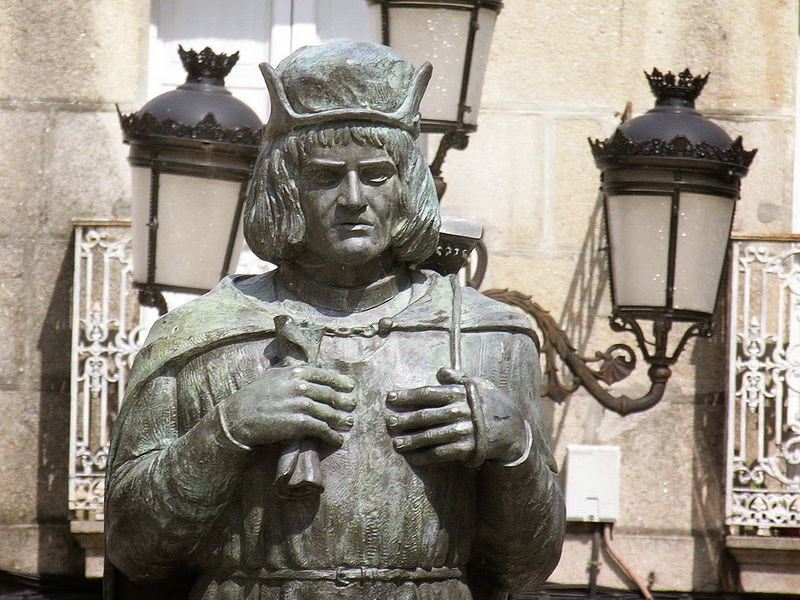
Statue of the 14th-century troubadour, Macías "The Lover," in Galicia
Reading literature aloud and listening to it recited offers such a vastly different experience with a story than does reading in silence. I cannot fathom why reading or reciting creative works aloud has faded almost entirely away from mainstream popular culture, especially since books are more portable and accessible than ever thanks to new reading technology.

In yesterday's post, I encouraged you to read aloud from Tolkien's stories. I read several of the poems from the Hobbit and the Lord of the Rings out loud, to the bewilderment of my sole audience member: my elderly dog. But oral recitation used to be one of the most important methods of narrative transmission. Mediterranean courts of the medieval period, for example, prized highly troubadours gifted with the ability to write and perform poetic works. 

A far cry from Tolkien - the 14th-century poetry of Macías The Lover
One such troubadour, Macías "The Lover" from Galicia, was not only a gifted courtier poet, but he also posthumously became a character in poems, stories and plays all over the Iberian peninsula. His life became his greatest work of art; the legends that sprang up after his death were recited and performed more often than the poems he wrote. The mythologizing of this particular troubadour assured him eternal life in the creative circles in which he had worked, and in literary history in general.

Some verses inspired by Macías' legend in a poem by Juan Rodríguez de Padrón, 15th-century poet

The legend of his life is a tragic story of love and self-punishment. The story goes that Macías, hopelessly in love with a lady of the court, focused all of his verses on extolling her qualities, putting his all of his poetic talent in the service of her beauty and virtue. After a time, however, this lady was wed to another man. Macías had pledged to only love and serve this lady for his entire life, and he honored this pledge. 

One day, as Macías lingered near a bridge, the now-married lady appeared on her horse. She wished to cross the bridge, but Macías asked her to dismount and speak with him for only a moment. Acquiescing to his request, the lady dismounted and listened as Macías reaffirmed his love for her and his pledge to serve her forever, even though it had to be from a distance. The lady was stunned by his words and, getting back on her horse, fled across the bridge. 

Neither Macías nor the lady had been aware that nearby, hiding in some bushes, was the lady's husband. As soon as the lady had departed, the husband leaped onto the bridge and ran Macías through with his lance. As he lay in the middle of the bridge dying, Macías' last words were said to have been yet another pledge to the lady, this time vowing to serve her from the far-off reaches of death. 
Some verses from a poem by Macías - the poem starts out "Cruel and determined love"... 

The real events of Macías' life have been so conflated with this legend that it is difficult to distinguish truth from fiction. Although that hardly matters, as the legend of his life is what became immortal and the inspiration for much subsequent literary production. I am interested in Macías' legend because it ended up playing an enormously influential role in the "sentimental romance" tradition, popular in 15th-century Iberia. The genre enjoyed huge reader success, reaching its apogee in 1492 with the publication of Diego de San Pedro's work, The Prison of Love. 

The novela sentimental follows a narrative arch that is almost identical to the Macías legend. One young person falls desperately in love with another young person; for some reason they are not permitted to be together; both suffer physical and emotional trauma because of the intensity of their love (or the lack thereof); one or both lovers die a horribly tragic death, which is merely an anticipation of the eternal condemnation their restless soul will doubtless experience in its afterlife. 

What interests me most about this genre is the way in which love and pain interact necessarily as part of the plot and character development. Here we have a genre of storytelling that reduces love to a rhetorical plot device, while pain takes center-stage and is explored on psychological, poetic, and social planes. It seems to me, then, that love was not the cause of suffering but rather an excuse to suffer. 

I will be doing a series of posts on the interaction of pain and love in the coming weeks. This theme is, in fact, the central idea of one of the term papers I will be writing over the course of the next month. Check back often to see who is bitterly weeping tears of blood for a distant object of desire! 


***
Who are your favorite doomed lovers? Why do you think there is a necessary connection between pleasure and pain in tales of love? 

Until next time - keep rustling! 

{Note: all photos in this post except the first one were taken by me of a book called Macías el Enamorado y Juan Rodríguez del Padrón by Carlos Martinez-Barbeito, 1951 edition.}


Wednesday, January 1, 2014

HAPPY NEW YEAR!

Well hello there, New Year's Reveler. I hope you're getting some hot coffee and a big plate of bacon and eggs to ease the pain of last year's parting gift-- a hangover.

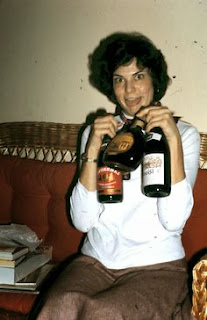
Once you've got your coffee and your fork, go ahead and start 2014 off right: by looking at old polariods of strangers that I found on pinterest, accompanied by the witty words of great authors and poets.


"New Years Day: Now is the accepted time to make your regular annual good resolutions. Next week you can begin paving hell with them as usual." - Mark Twain

***
 "For last year's words belong to last year's language / And next year's words await another voice."

"What we call the beginning is often the end / And to make an end is to make a beginning."

-both from the poem "Little Gidding"by T.S. Eliot (sections II and IV, respectively)

***
"I tasted -- careless -- then
I did not know the Wine
Came once a world -- did you?"

-from the poem "One Year Ago -- jots what?" by Emily Dickinson 
***
"Only a night from old to new;
Only a sleep from night to morn.
The new is but the old come true;
Each sunrise sees a new year born." 

-from the poem "New Year's Morning" by Helen Hunt Jackson 

***
"Be always at war with your vices, at peace with your neighbors, and let each new year find you a better man." -Benjamin Franklin 

***
Feliz año, este año, para ti, para todos
los hombres, y las tierras, Araucanía amada.
Entre tú y mi existencia hay esta noche nueva
que nos separa, y bosques y ríos y caminos.
Pero hacia ti, pequeña patria mía,
como un caballo oscuro mi corazón galopa:
entro por sus desiertos de pura geografía,
paso los valles verdes donde la uva acumula
sus verdes alcoholes, el mar de sus racimos.


Happy year to you, this year, to all
mankind and lands, beloved Araucania.
Between you and my existence a new night
separates us, an forests and rivers and roads.
But my heart gallops towards you
like a dark horse, my little land:
I enter deserts of pure geography,
pass green valleys where the grape accumulates
its green alcohols, the sea of its clusters. 

-from the poem "Feliz año a mi patria en tinieblas" ("Happy Year to my Country in Darkness") by Pablo Neruda; translation by Jack Schmitt 

 
"Yesterday, everybody smoked his last cigar, took his last drink, and swore his last oath. Today, we are a pious and exemplary community. Thirty days from now, we will shall have cast our reformation to the winds and gone to cutting our ancient shortcomings considerably shorter than ever." -Mark Twain

Thursday, December 26, 2013

Winter Trees


Dear Petticoat Rustlers- Merry Christmas!
I hope you've gotten to enjoy some quality time with your family and friends in these past days. Last year my husband and I started a tradition that we continued this year-- we make some tasty food, take a long hike, and then come home and watch all 9 hours of the Lord of the Rings trilogy. It was awesome!
What are your traditions for the season?

As the year grows old and wise and draws to a close, I thought it would be a good idea to reflect on some of the best things I read this year and some of the things I'm most looking forward to reading (and writing about) in 2014. So for the remaining days of this year, I'll be doing a series of posts on these books- stay tuned!

For today, I will leave you with some photos of our Christmas tree and a brilliant little William Carlos Williams poem...

Winter trees 

All the complicated details 
of the attiring and 
the disattiring are completed!
A liquid moon 
moves gently among
the long branches.
Thus having prepared their buds
against a sure winter
the wise trees
stand sleeping in the cold. 


***
Until next time-- keep rustling!

Friday, June 14, 2013

America in Color

And speaking of old photographs...

"Bound for Glory: America in Color" was the name of the 2006 exhibit that displayed photographs of American life in the late 30s, early 40s. Taken by the Farm Security Administration/Office of War Information and preserved today in the Library of Congress, these photographs are reproductions made from color slides - which gives them the distinction of being some of the only color images of the effects of the Depression on rural communities. 

These images are beautiful and painful - the resilience of the human spirit and the misery of extreme rural poverty are shown in full, brilliant color. 

Here are just a few of the images: 
Dancing
Playing
Selling
Hauling 
Planting
Posing
Praying
Chatting


Waiting
Smoking
Swilling

Eating
You may view the rest of the photos here- they are captivating. 

Long before these photos were taken, Emily Dickinson wrote a poem acalled "There's a certain slant of light" that I think fits with these rare color photos of post-depression America, as communities struggled to emerge from the "scar" and "internal difference" of hard times...

There's a certain slant of light,
On winter afternoons,
That oppresses, like the weight
Of cathedral tunes.


Heavenly hurt it gives us;
We can find no scar,
But internal difference
Where the meanings are.


None may teach it anything,
'Tis the seal, despair,-
An imperial affliction
Sent us of the air.


When it comes, the landscape listens,
Shadows hold their breath;
When it goes, 't is like the distance
On the look of death.


***
What do you think of the photographs? What is your favorite Emily Dickinson poem? Until next time, kept rustling!

Thursday, May 30, 2013

Cowpuncher Poets

A cup of coffee and Richard Slatta's book Cowboys of the Americas (1990) means I'm fixin' to write about cowboys!
Howdy, Petticoat Rustlers and Wranglers! Today I spent a good deal of time in my reader's studio, pursuing some of the books I have on Cowboy mythology and history. In a post I did several months ago, I promised that I would do a series on cowboy literature and lore. To keep that promise, I have three posts coming up this weekend that will each investigate different aspects of the cowboy narrative from both the United States and Latin America. Today's topic - Cowboy Poets!
Typical Cowboys, American Heroes
Buffalo Bill Poster shows that cowboys are
not even phased by bucking
Mustangs between their legs.
The cowpunchers of the United States elicit a sense of nostalgic wonderment in many Americans. Through film, music, and mythology, the American cowboy has come to embody the spirit of perseverance, honor, and heroism.

Beginning in the early 1880s, the image of the American Cowboy developed into the chivalric hero we think of today; the triumph of independence, courage, and a deep connection with nature came to represent not only the Cowboy himself, but the core of American values. Buffalo Bill Cody's Wild West Show was instrumental in propelling the romanticized vision of the cowboy to a vast audience in both the United States and Europe. The image of the stoic, humble range rider - who possessed unimaginable skill - captivated audiences worldwide and eventually inspired dime novels, circus sideshows, radio, films, and television.

Much of the hardship of the range riding lifestyle was glossed over by whimsical notions of cowboy life. The poor pay and dangerous working conditions, the uncertainty of the future, and the rambling life of a man who followed cattle and spent many hours (sometimes many days) alone were renarrativized as a man living in harmony with nature and animals, and upon whom Nature bestowed bountiful gifts as a reward for his skill and tenacity.
The determined face of a cowboy who
knows he can harness (literally and
figuratively) the wildness of Nature.
The myth of the American cowboy has an incredible cultural significance, both historically and contemporarily. Richard Slatta describes its importance by tracing the development of the mythology through country-western music beginning in the 30s, the cowboy films of the 50s and 60s, Ronald Reagan's cowboy personae in the 80s, and so on. He says that "...cowboy culture is a constant factor in American life. Many Americans still believe in the efficacy of what they define as the frontier experience. ... The cowboy is one of the most potent shorthand cultural symbols in America."

At the end of this chapter on the "fictional" myth developed about the American cowboy, Slatta remarks on what he considers to be the "real" cowboys of today, saying: "...some of today's working cowboys object to the romanticized, commercialized distortions of the cowboy imagery. Cowhands are reviving traditional skills, such as making tack and... singers have kept traditional cowboy music alive."

I find these remarks ironic, as Richard Slatta reveals himself to be given to the same romanticized "distortions" he claims to be able to see through - he simply establishes his preference for cowboys who reject the "mythology" in favor of the "real" story of a cowhand. He solidifies his preference for contemporary cowboys over the "commercialized" ones of the 30s-80s by failing to mention any working cowboys who embrace the mythological vision of their lives.

So, is it possible to interpret the cowboy without being swayed by a deeply internalized cultural understanding of the American cowboy? And what about cowboys themselves? Do they adopt a romanticized vision of their own lives? Have they contributed to the literature written about them? Indeed, they have.
From left to right: Slim Kite, Wally McRae, and Waddie Mitchell. Legendary cowboy poets. 
Recently, I came across a wonderful documentary on cowboy poets. The documentary followed three generations of (unrelated) men who worked in different capacities as cowboys in the American southwest and who all composed poetry about their life, their work, their fellow cowboys, questions of mortality and eternity, and the uniquely mortal and eternal lives of cowboys.

The documentary is called Cowboy Poets (1988) and is made available thanks to Folkstreams.net, a website that serves as "National Preserve of Documentary Films about American Roots Cultures." (If you have not yet pursued this site, I highly recommend it!) It is a fascinating look at three different interpretations of the cowboy life, all from men who identify as cowboys and write/recite original and traditional cowboy poetry.

Cover for Waddie Mitchell's CD of recited poems
Each one of these men were born into very different circumstances- Slim Kite was born around the turn of the century and worked as a cowboy in the 20s, until he couldn't make a living doing it anymore and had to settle down on a ranch of his own (which he considered the end of his cowboying). The youngest cowboy poet in the documentary, Waddie Mitchell, works as a hired cowhand but dreams of being able to have his own ranch someday (what he would consider the beginning of his cowboy career). Wally McRae works as a cowboy alongside new coal mines, gazing with ambivalence at the progress of the world around him and continuing to recite poems that extol the open, untouched, virgin plains.

The three interpretations suggest a unification of both the realities of American cowboy life over the last century and the truth of the mythologies it inspired. It also seems to answer the question I posed above: the mythology and the reality of cowboy life has become inextricably intertwined. Furthermore, there is an interplay of presence and absence inherent in the American cowboy that seems to mystify even the men who have done the job, who have spent days covered in blood and manure, and who have laid on their backs, looked at the stars, and composed verse about their memories.

I think the most vivid example of this interplay coincides with the most poignant moment of the Cowboy Poets documentary. The filmmakers ask Slim Kite if there is any advice he can offer them, after leading a fully cowboy life. After joking that he'd offer advice they wouldn't want to take, he suddenly becomes very solemn, and recites a traditional cowboy poem  called "The Last Longhorn" that has been passed down to generations of cowboys since the 20s. Kite changes slightly the last stanza and recites it like this:

The cowboy rose up sadly n' mounted his cayuse, 
saying "The time has come when cowboys and longhorns are no use!" 
He rode off, a-gazing backward upon the dead bovine 
His bronco stepped in a foghole, fell down and broke his spine

Now you'll miss 'im at the round up,
It's gone - his merry shout...
The cowboy's left the country 
and the campfire's gone out. 

As he recites this poem about the death of the Cowboy, Slim Kite's eyes indeed fill with tears. He at once represents a mythical figure of the Cowboy in the poem and at the same time he is inescapably the very real old man who worked as a cowboy all his life. The original author of this poem is unknown, adding to its mythic and almost inherent quality, as if every American Cowboy that ever existed has thought these verse and considered himself to be living the last days of the true cowboy life.

***
What are your favorite cowboy poems? What do you think about the American Cowboy mythology versus reality? I'd love to hear your thoughts on this post and the documentary (it is only 50 minutes and well worth every second of your time!)

Until next time - keep ruffling your petticoats!


Tuesday, May 28, 2013

"Anágua" is Portuguese for Petticoat

Dearest wild petticoat rustlers! I have much good news to share! There has been a lot happening recently; some very exciting new literary horizons are coming into view. For instance, I graduated from my Masters program and was accepted to the phD program...YAY!
My husband and I in front of the Spanish and Portuguese building on commencement day. 
My wonderful parents came up from Arizona to see the graduation and celebrate with us! 
Isn't my building such a beautiful place?! So academic-y. 
My dog got his Master's in Cutenessology.
In my application to the phD program, I proposed to study Brazilian oral narrative of the sertão region (a large region that spans from the northeastern to the southeastern corner of the country). I will have to work this summer to define more precisely what stories I will be studying, so I have been catching up on a lot of great lusophone literature! I am searching high and low for any stories cowboy-related... let me know if you've read any Brazilian cowboy novels, poems or short stories!

Not too long ago, I discovered the work of Luís Fabini, an Uruguayan photographer living and working with cowboy communities all over the Americas. The photographs he took of the pantaneiros or vaqueiros (as cowboys are known in Brazil) are really inspiring me. Here are a couple of my favorites:


In addition to studying cowboys, for many years I've been reading and researching the hybrid poetic tradition known as literatura de cordel (I did a whole post on this poetic tradition!). I am hoping to incorporate this poetry into my thesis as well-- I'll keep you posted!

And that brings me to some really exciting news... I'm going to Brazil! In order to kickstart my research and gather hard-to-find Brazilian books, I will be attending two conferences this summer in the Brazilian state of Maranhão. I will be there towards the end of June, during a traditional folk festival called "Bumba meu boi." This is an all-night festival that includes elaborate costumes and rhythmic music, played collectively by the entire community.

Through the middle of the streets, a mythological story is enacted, involving a bull (boi) who is killed and then later resurrected.

This folk tradition has been around since the 18th century, taking place every year during the junina festival, which celebrates the nativity of Saint John the Baptist.

Check out this video to get an idea of what it is going to be like! (The first 30 seconds of the video is just talking, but then it starts to show the festival.) I am so excited to be able to witness this first hand!


***
I hope that all of you have some good new reading material for summer, too! What's on your shelf? Any poetry? Any cowboy stories? As always, keep rustling!