Showing posts with label medieval. Show all posts

Tuesday, October 28, 2014

The Life and Afterlife of Things

Things, and the preservation of things, was as important in the Middle Ages as today. Image from a 15th-century edition of Boccaccio's Decameron. 
A network of medieval scholars from multiple different departments here on campus organized an incredible event that took place this last weekend. The Medieval Materialities conference brought together a huge variety of academics who, as the conference's title implies, are all working on projects that approach medieval history through specific objects or bodies, presenting ideas about the "life and afterlife of things."

The conference opened with what was for me the highlight of the event: a plenary discussion by the esteemed professor, Caroline Walker Bynum. I had just begun reading what is considered one of Bynum's most important books, Holy Feast and Holy Fast (1987), a book that recounts the fascinating role of food in medieval religious practice, particularly among women. After reading only the first chapter of this text, I knew I wanted to hear her speak in person, and am so glad I had the opportunity - Professor Bynum delivered a dynamite presentation. 

Her talk began with a paradox: the world's best preserved Catholic reliquaries and altars are to be found today, not in Rome or Castile, but in Protestant Saxony. While it is true that Rome's and other historically Catholic countries' museums are bursting with medieval objects of devotion, they are no longer in situ, a fact which changes their context and thus our ability to observe how medieval communities interacted with these objects. To illustrate this point, Bynum traced the histories of three particular objects of devotion that reside today in their original medieval location, Saxony, beautifully preserved. 
"Holy Blood Altar" in Rothenburg. The center
cross contains the relic. Image source.
She began in Rothenburg ob der Tauber, the location of the "Holy Blood Altar." This magnificent altarpiece was hand carved in the 15th-century by Tilman Riemenschneider, and features Judas as the central figure. The monstrance of this altarpiece was at some point replaced with a cross, delicately constructed to hold a crystal receptacle containing a small amount of Christ's blood. The continued and undisturbed presence of this relic as part of a main altarpiece complicated previous periodization theories of Protestantism's entrance into Saxony. 

Bynum explained that some scholars have ventured explanations for this curious persistence of Catholic practices in Protestant areas of Europe throughout early-modern history by studying Martin Luther's teachings. Luther believed that objects had no inherent sacrality and that likewise, images (art), were indifferent. This objection to the use of religious iconography as an integral part of worship accompanied by a staunch opposition to any form of iconoclasm. This has lead several researchers to posit what they consider a particularly Protestant method of "accidental" preservation: as the image is neither sacred nor a source of conflict, they must simply be left where they were found. 

Bynum's talk put forth a more nuanced theory by demonstrating that while the "let it be" theory seems satisfactory on the surface, it begins to lose ground when applied to Catholic objects that were preserved, not by Protestant indifference, but by continued and intense interaction with these objects through worship. 

The Holy Sepulcher in the Wienhausen cloister church. Ignore the little red circle on the tomb - this was the only image online I could find! Image source

In the Wienhausen cloister in lower Saxony, a figure of the dead Christ with exposed wounds rests in a decorated tomb. The Christ figure was made around 1290, when it came into the possession of the nuns of the Wienhausen cloister, and remains there today. Several marks and even medieval graffiti on the figure indicate to art historians that this Christ was approached from the right-hand side by the congregation, on a very regular basis, for devotional practices including the anointing of his forehead. Though nailed down now, the figure is hollow and believed to have been processed in performative styles of worship. Furthermore, there is evidence that a reliquary bundle had been inserted into his head. 

St. Barbara, painted in the 15th
century by the Master of Frankfurt
Bynum had examined multiple historical documents from the cloister which revealed the intensity with which the nuns protected this figure and fought to keep it in their church. Several abbesses outright defied the direct orders of Protestant bishops, who had told the sisters to send the statute to a museum. The abbesses cited the strong devotion of the community as their reason for noncompliance.  The continued use and vehement defense of this statue problematizes not only the periodization of Protestantism's entrance into Saxony, but also the reasons for the preservation of certain Catholic devotional objects and practices. 

Towards the end of her talk, Bynum highlighted the practice of sewing and embroidering clothes for statues of saints and angels, a devotional practice surviving in parts of Saxony long past Protestantism's supposed entrance into the region. She displayed images of the beautiful garments, full of ornamental embroidery, created by the nuns of the cloister for their church's statuary. Each saint and angel had several different outfits, reserved for different feast days and special moments in the liturgical calendar. Tags were sewn into the garments with the saint or angel's name and the day on which they were to dress the statues with these particular articles of clothing. (Unfortunately, for all the wonders of the Internet, I was unable to find images of the beautifully detailed garments professor Bynum showed. She did, however, mention the Madonna of 115th Street as a modern example of a similar practice.)

In the end, Bynum pointed to a fundamental disagreement people had then and continue to have today over the meaning of objects and our interactions with them. While one school of thought proposes that, in dressing and manipulating objects in the ways described above, we subject them to our authority and demonstrate their lifelessness by exerting our power over them. On the other hand, the contrasting school of thought believes that these practices enhance the mystery and aura of an object, giving it more life than they would've had without our interaction and, in some cases, turn the objects into a material connection to the divine. This question, Bynum indicated, is at the heart of the debate over medieval devotional objects and that our ability to reconcile the two polar opposite schools of thought is likely related to our understanding of performance. 

The remainder of the conference exposed the vast array of intellectual interpretations of medieval materialities, some related to devotion and others related to daily life: literature, architecture, gifts, birthmarks (!), pastimes. I believe, though, that each panel related back to professor Bynum's initial plenary session, by asking the question which ultimately needed to lay at the heart of a conference on Medieval Materiality: "What does the object do and, more importantly, what does it make me do?" 

***
The conference was full of so many engaging discussions - hopefully a few more of them will make it onto the blog! 

Until next time - keep rustling!

Tuesday, October 21, 2014

Painted Geneology


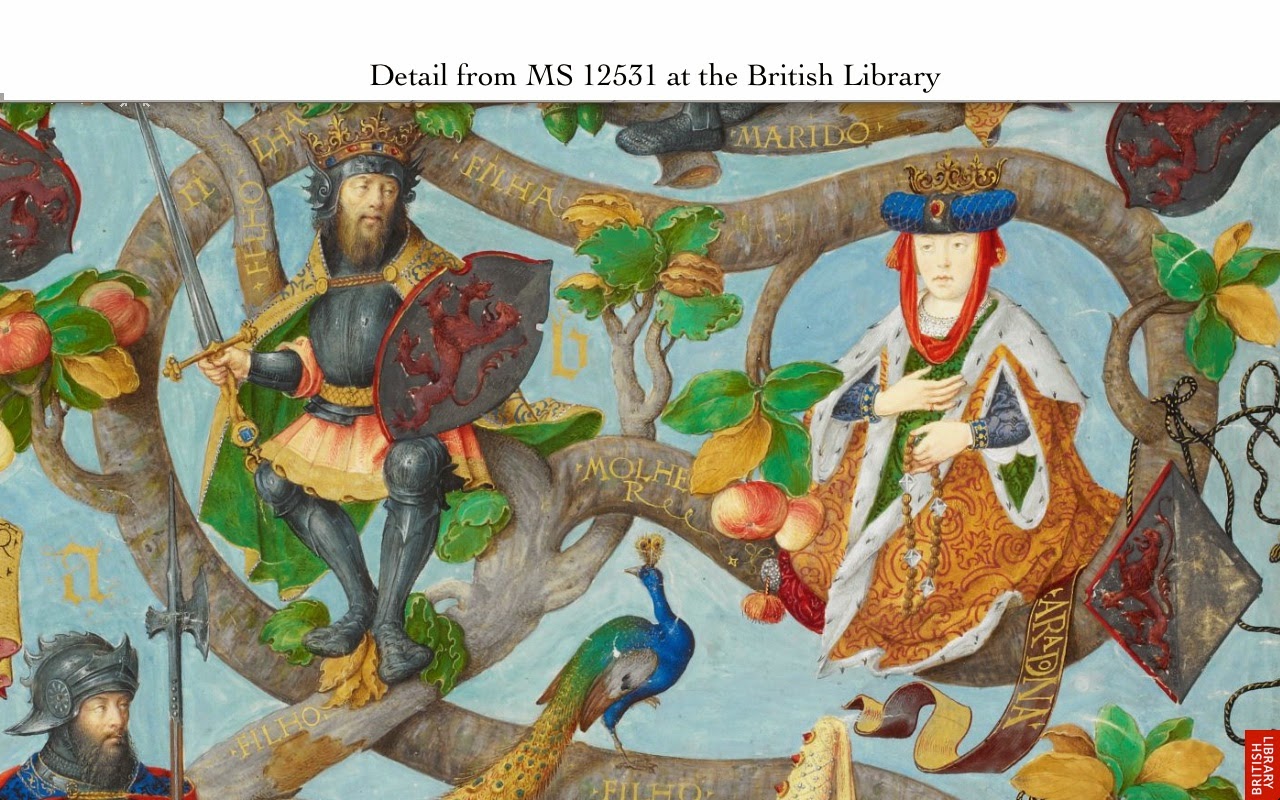
As will happen while obsessively pursuing details about the life and posthumous fame of a single historical figure, a moment of pure serendipity has granted me a rare look at a beautiful (and relevant!) illuminated manuscript. As I was preparing my post last week on Saint Isabel, I searched for images of her online to help tell her story.

The two XVII-century paintings I found, little did I know at the time, turned out to be a part of a never-completed pictorial genealogy of Portuguese kings and queens. Thanks to the expediency of digital technology, I was able to easily track down the manuscript and happily find its digitized version on the British Library website.


The images in this post are my own screen-captures of that manuscript which, although unfinished, boasts several gorgeous and richly detailed miniatures and full-page paintings. There are large blank spaces where the text would have gone, but as the manuscript was never completed (that we know of), these 11 leaves provide an interesting look at the process of illumination, including unpainted drawings.


I invite you to look closely at these incredible leaves, available on the British Library site here. To find the images of Saint Isabel, you will find them on the Recto side of the 9th leaf - she is down at the very bottom of the page, elaborated with surprisingly precise and prolific detail, in spite of being quite tiny.

***
Until next time -- keep rustling!

Monday, October 20, 2014

Sorbus Domestica

The blooming Sorbus domestica
Over the weekend, I indulged in some well-deserved pleasure reading. A new book, The King in the North (2013), by Max Adams, details the life of VII-century warrior king, Oswald of Northumbria. As a young boy, Oswald had fled his homeland in the midst of heavy fighting and carnage. As a man, known as Whiteblade, he returned with a force of his fellow exiled Northumbrians as a Christian warrior-king to reclaim his kingdom and take back his seat on the throne. In c. 634, he and his men succeeded in destroying the Welsh host occupying Northumbria.

I originally became interested in this history because Oswald of Northumbria was apparently the historical figure upon which JRR Tolkien loosely based Aragorn, one of the main characters in the Lord of the Rings trilogy.

While I have only just begun reading, I am already being treated to various unexpected historical details. One such detail concerns the Sorbus domestica, or "service tree."

In the first chapter of his book, Adams uses the Sorbus domestica to illustrate the rich and complex array of medieval beliefs that, though may initially seem strange, turn out to be no stranger nor any less real than the world in which we live today:

One of the Wonders of Britain, from a list written down at the beginning of the ninth century but surely recited to children and kings for hundreds of years before and after, was an ash tree that grew on the banks of the River Wye and which was said to bear apples. Such poetic imaginings are easily dismissed by academics as fancy; and yet the distinguished woodland historian Oliver Rackham has recently shown that the famous tree in question must have been a very rare Sorbus domestica, the true service tree, which has leaves like a rowan or ash, and which bears tiny apple- or pear-shaped fruit. In 1993, one was found growing on cliffs in the Wye Valley in Wales. Early Medieval Britain was full of such eccentricities ... 

I love this small, yet relevant, example of the infinite world we study when we look into history; not a distant and unknowable collection of places and people, but rather, a part of our own continuing human drama. The magic and mystery of the past remains part of our lives today, hovering in the bows of rare and common trees alike, waiting for us to once again pay attention to it. I am reassured by this little episode that all of the reading I am doing for my thesis, about great battles and modest miracles, will reveal a small but significant piece of magic from both Saint Isabel's world as well as from my own.

***
Until next time -- keep rustling!


Monday, October 13, 2014

From the Desk to the Great Beyond of Books

A good place to imagine a medieval world
This is the chair in which I read a great deal about the denizens of medieval Europe and imagine, in as much detail as possible, the minutiae of their world: their gestures, their speech, their petty grudges and their epic grievances. The work of visualizing this world often prompts me to sit, looking out the window next to my chair, and muse on many of the details omitted from or glossed in historical texts.

Though it now seems an obvious and necessary facet of visualizing medieval culture, one of the things that I had not envisioned was what I would look like in this world. I spend my days bent over a computer, a notebook, or a book, mostly working from this chair or the kitchen table. But scribes and scholars of the premodern era had different furniture for studying and writing, which necessarily made their work look and feel differently.

So - how did medieval academic work look and feel? This weekend, Erik Kwakkel, of the Medieval Books blog, posted a most enlightening article addressing this very topic, describing a variety of medieval and renaissance desks and study practices (with pictures!).

Detail of Albrecht Dürer's 1526 portrait of Erasmus. Image from Medieval Books.
Like the space I use at home for my own studying, medieval study spaces tended to be limited and allowed for only one book to be in use at a time, as seen above. Kwakkel explains, however, that these limitations were readily circumvented by various space-saving inventions.

Rotating book wheel. Image from
Medieval Books.
Scribes would have a stacked desk, with the manuscript to be copied perched above the scribe's own copies. Others would have long desks, allowing for side-by-side reference of several books. In both cases, the desks were tilted to almost a 45 degree angle, likely to assuage wrist cramping or back discomfort caused by hunching over a text.

In my opinion, the most ingenious of these desk arrangements were those that rotated, like a lazy-Susan, enabling the reader to view multiple open books at a time without taking up more space than would a regular desk. This design was rendered, in the 17th century, into a rather large rotating book wheel (see image at right) that permits the simultaneous browsing of many books.

As much as I would love to use a desk that revolved and allowed for easy use of 5 or more open books at a time , I also appreciate the way limited space narrows my focus and forces me to deeply read a single volume, operated solely by my hands.

The reading technology of today allows for an almost infinite number of books to simultaneously appear on one's "desktop," but I suspect that the practice of envisioning precise details and specific emotional contexts of medieval people and events could be damaged by an over-commitment to too many sources simultaneously.

One book, one chair, one dog. It's a good ratio.
In the intense weeks of actually writing an article, books lay open all about the house, covering any available surface (like they do in the image of Christine de Pisan below). But this is only after I have looked closely at each one individually and am able to see the cover and know the sights and sounds of the world contained within.

Christine de Pisan applying the classic method of propping books open all
over her desks. Image from Medieval Books
I have been doing so much reading lately, for both work and pleasure, that it makes sense to reflect on the mechanics of how that reading gets done. If we owned a couch, I am sure I would prefer to stretch out there. But for now I am happy to sit in my comfy chair, with two of my most loyal companions: my dog and a good book.

"You can never get a cup of tea large enough or a book long enough to suit me." -CS Lewis
***
Until next time - keep rustling!


Sunday, July 20, 2014

On Horse, In Saddle

After almost four full months of silence I am finally back on the horse, firmly in the blogging saddle, grasping the reigns of recreational writing. Several significant life events have kept me away from the blogosphere for these past couple of months, but I have missed it so much and am really glad to now be back!

By way of reintroducing myself after this lengthy hiatus, I thought it would be fun to share some of what I've been reading recently - both for pleasure and for work. I hope you find something that interests you!

Our kitchen table, on any given morning...
Research for my dissertation has been taking some interesting twists and turns. I've been looking at various accounts of journeys to the afterlife, composed by writers from across the Mediterranean region. The way in which these cross-cultural narratives intersect seems to provide insight into Mediterranean perceptions of the afterlife and, in particular, the extent to which these divine spaces of the afterlife were accessible to the living.

My new best friends.
One medieval narrative of divine space seems of particular interest, as it extends across several geographic and linguistic communities. The narrative, retold throughout the region and down through the ages, leads the reader into a dark and mysterious cave in the northeastern region of Ireland.

The cave was known as Saint Patrick's Purgatory and was said to have been the earthly site of Purgatory. This concrete physical location became a vastly important pilgrimage site for both natives of Ireland as well as curious travelers. These pilgrimages continue to take place, and in fact you can go yourself if you like, although the cave itself was filled in during the mid-XVIII century and replaced with a chapel.

Books from left to right: The Voyage of Saint Brendan - Journey to the Promised Land, trans. John O'Meara; Viaje al Purgatorio by Ramón de Perellós; Visions of Heaven and Hell Before Dante by Eileen Gardener
I recently read a version of this narrative that fascinated me, written by the Catalan diplomat, Ramón de Perellós, right-hand man to king Juan I of Aragón (XIV century). Following the king's sudden death in a hunting accident, Perellós made the journey to the cave of purgatory in Ireland, in hopes of speaking with the deceased king and discovering the fate of his soul. This appeared to be, then, a diplomatic journey to Purgatory, aimed at settling a matter of State. The yellow book in the photo above is a modern copy of his 1397 account, Journey to Purgatory (my translation).

In spite of the stated purpose for the journey, Perellós' account of covers little of his encounter with the deceased king he successfully visited in purgatory, glossing over a brief conversation in which Perellós confirms that, indeed, the king died in an accident and was destined for paradise after purging the final stains of venial sins.

Perellós went into great detail, however, about the demons that accosted him, the dark and narrow tunnels he traveled through, the immense joy and relief he experienced upon arriving in the anteroom to heaven, and the dread and tearful departure he made from there, returning to the mouth of the cave and the rest of the world to go on living. Rather than recount a "diplomatic mission" (albeit a cosmic one), Perellós ends up with a travel diary that includes detailed descriptions of evil and divine space.

What makes Journey to Purgatory so different from Dante's Divine Comedy is that Perellós' journey has been historically documented and was considered to be not a work of poetry but an autobiographical composition by a respected courtier. Perellós brought several companions with him, received several letters of recommendation from French and British monarchs, documented his expenses and the stops he made along the way; in other words, historians can confirm that he actually did travel to Ireland and actually did enter the cave thought to be the mouth of Purgatory. The way his work was read and interpreted would've differed greatly from the way people read and interpreted Dante. ...More on Perellós to come!

The beauty of painted vellum and historiated initial letters.
When not reading about caves and demons, much of my pleasure reading has been centered on how medieval texts were made, stored, and circulated. I have subsequently spent a good deal of time in the Special Collections Library, taking advantage of their collection of pre-modern manuscripts.

If you are interested in learning more about how manuscripts were made prior to the advent of the printing press, check out this fantastic video produced by the Getty Museum: 

Finally, because making one's way through histories of purgatory and heaven and hell can be daunting, it is important to temper the heaviosity with puppies. That's right. PUPPIES. I'm not just talking about the adorable youtube snugglers that steal my heart on a daily basis, I'm talking about medieval pets. Thank goodness I found Kathleen Walker-Meikle's well-researched and thoughtfully written volume, Medieval Pets (2012).  

Two of the books at the top of my pleasure reading stack.
I wish I could read two things at once so that I could get to these all the many wonderful books I've collected before the summer slips away and the Fall semester takes over my life. The good news is that I will certainly not lack for good reading adventures to share with you, dear petticoat rustlers! More to come soon on the beauty of vellum, the foul stench of hell, the promise of purgatory, the lives of Portuguese clerics, the medieval Mediterranean identity, and of course, puppies.....

Book stacks unnumbered!
Until next time -- keep rustling!

Monday, March 31, 2014

Medieval Manuscripts in the Digital Age

Matteo da Milano (active 1492-1523) - Getty
The sturdy vellum pages of pre- and early- modern manuscripts will likely prove capable of outliving our current digital processing systems, which have already been reinvented several times in the span of the last three decades. Crafted with extraordinary skill and care, these old manuscripts have for centuries preserved images and texts essential to understanding our artistic and cultural heritage legacy. The materials used in their creation has allowed them to weather the passage of a significant amount of time without falling apart.

I remember going to the Special Collections library and, for my first time, touching a book from the 17th-century. I gingerly approached the cradle in which it rested, trying not to even breathe on it, for fear that I'd somehow ruin it. A professor who had arranged the trip to the library leaned in and said something to the effect of: "Go ahead, turn the page. These things are quite durable. Vellum: undoubtedly a superior technology." 

It's true, of course, that vellum and rag-paper used in the early modern period remains a far stronger material than the thin sheets of paper on which books are now printed. These manuscripts were also hand-sown, hand-bound into leather, and sometimes even hand-painted with incredible miniatures. 

Although the bookmaking methods of the early modern period may have resulted in more resilient book objects, the digital age has been making those texts more and more readily available for study and enjoyment. As an increasing number of medieval manuscripts are digitized and sent into the world via the Internet, the more opportunity there is for discovery. 

Discovery of these digitized manuscripts is significantly helped along by museum websites and blogs dedicated to the subject. For example, if you're not following Sexy Codicology, you're missing out. Their blog highlights at least one manuscript a week, exploring it with high resolution images of the text and its miniatures. They also have a sister project, the Digitized Medieval Manuscripts Maps (DMMmaps) project, which allows viewers to interact with maps and texts as well as contribute data, via their crowd-source format. 
Court workshop of Ludwig I of Lignite - Getty 
Recently, over at the DMMmaps blog, they did a piece on the Getty collection of digitized manuscripts. It is a treat for the eyes, complete with images and video of some of the many incredible book objects the Getty has in its collection. 

I am thrilled that modern technology allows for such an incredible level of accessibility to these manuscripts, but at the same time I resent looking at them on the computer (not least because it means universities are more apt to withhold travel funding now that texts magically appear on the Internet for free). Seeing these old books in person - smelling them, seeing their enormous physical weight, touching the binding where the hands of a 16th-century bookbinder sewed together the folios - its all part of the way the book is read. 
Unknown illuminator - "The Lamb Defeating the Ten Kings" (c. 1220-35) - Getty 
I am grateful to have a world of images at my fingertips through my computer, but I am also increasingly aware that reading a book is more than making sense of the words and images on the page... it is reading what went into making the page, binding the pages together, where the ink came from and how it flowed out into words, how hundreds of brush strokes and gold leaf made an image, hiding inside a letter "R" come to life. 

Recently, I watched a documentary on the making of museum-grade copies of one of the world's most treasured atlases, which hails from a slightly later time period than the texts pictured above. Nevertheless, I highly recommend taking a peek at this fascinating story, that tells of both the atlas' original creation and its modern re-creation in facsimile. 


There is an almost meditative quality about the slow and meticulous processes of producing a book you know will be able to last for a long time into the future. The original context in which the Atlas Blaeu Van der Hem was produced required hours upon hours of artists, working at their craft, traveling across oceans into completely unknown lands. I like that here, the folks reproducing the Atlas Blaeu go through a slow and meticulous process also, but in a completely modern way. They travel into the field of digital technology and emerge with a new/old book that has apparently married the last 600 years of bookmaking methods.
Unknown illuminator -
"Inhabited initial letter 'B'"
(c. 1153) - Getty 
This is one of those stories that gives me hope that the digital age is likely very compatible with the study and appreciation of medieval texts. Which is good news, because I've been drooling over the Getty images all weekend. 
***
What are your favorite old books? Have you ever had the chance to read from a book several hundred years old? 
Until next time - keep rustling!

Friday, March 28, 2014

They Stand on the Earth and They Cast Their Own Shadows

Detail from Masaccio's painting of the Expulsion of Adam and Eve in the Brancacci Chapel

The many star-crossed lovers of yesterday's post may have come from different literary traditions, but they were all unified by the way in which suffering and desire became hopelessly and fatally tangled in their stories. These tragedies, unfolding at the intersection of pleasure and pain, presented themselves as not only believable love stories but natural ones. The sentimental romances and lyric of the late-Medieval/early-Renaissance Mediterranean make it seem hauntingly natural that the birth of love should lead to the death of lovers.
Masaccio's painting of
Adam and Eve in the
Brancacci Chapel

In grappling with what makes death and desire so inextricably linked in the literary production of this time period, I decided my research needed to go back to the beginning - all the way to the beginning - in order to ascertain the origin of this link. And by "the beginning," I mean the book of Genesis.

The story of Adam and Eve sheds a great deal of light on the connection of desire and death. As a result of their expulsion, they became mortal and died. But at this same moment death becomes their reality, they are born into their humanity and therefore sexuality. As Adam and Eve leave the garden, they experience a sudden awareness of their bodies. This awareness inspires both a tragic self-consciousness full of shame and a thrilling awakening to the possibilities of material connection with one another. In the story of Adam and Eve the origin of human death and suffering is also the origin of human sexuality.

Although it was not the love Adam and Eve had for one another that caused their suffering, as is the case in the sentimental romances, their relationship was defined by the moment in which they became fully human and began experiencing together love, suffering, and death. This confused and terrible moment of leaving Eden unites Adam and Eve (archetypes of all women and men) in both love and death forever.

Patricia Grieve, in her book Desire and Death in the Sentimental Romance, has referred to love and death as the two great mysteries of humanity and thus as necessarily occurring side-by-side in literary representation: "As the two great topics of poetry - unsolvable mysteries both - it is no surprise that [love and death] should appear with great frequency in literature."

Masaccio, the Italian painter of the 15th-century, had a profound influence on other painters of his century and on the Renaissance in general. His depiction of the Expulsion of Adam and Eve in the Brancacci Chapel eloquently narrates a scene of great suffering and great beauty, all embodied by the human form.

When renowned art historian and critic, Sister Wendy, contemplated this image, she noted how representational it was of the overarching ethos of the Renaissance. To the denizens of the Renaissance world, humanity was dignified, in spite of the suffering and grief with which it also constantly had to contend. "They stand on the earth and they cast their own shadows," Sister Wendy said, "that's what the Renaissance was about: humanity as upright, suffering but responsible."

This insight, I believe, is crucial to understanding the link between desire and death in Renaissance works of literature. The overwhelming feelings of love experienced by the protagonists of 15th-century sentimental romances were invariably accompanied by a sense of immense responsibility owed to the object of their feelings. Love allowed the protagonist to encounter the eternal for the first time - feeling love was connecting with a never-ending current of human emotion. But the precarious business of ensuring that their love was fully requited by the object of their desire endangered their experience of the "eternal" nature of love. This caused great anxiety and suffering until it seemed their only recourse was to experience eternity in the only other bodily way available: death.

***
To hear the rest of Sister Wendy's incredibly preceptive discussion of Masaccio's painting, watch this video from minutes 2:00 - 5:00. If you happen to have 30 minutes available, I highly recommend watching the entire episode.


***
Until next time - kept rustling!

Wednesday, March 26, 2014

Macías, The Lover

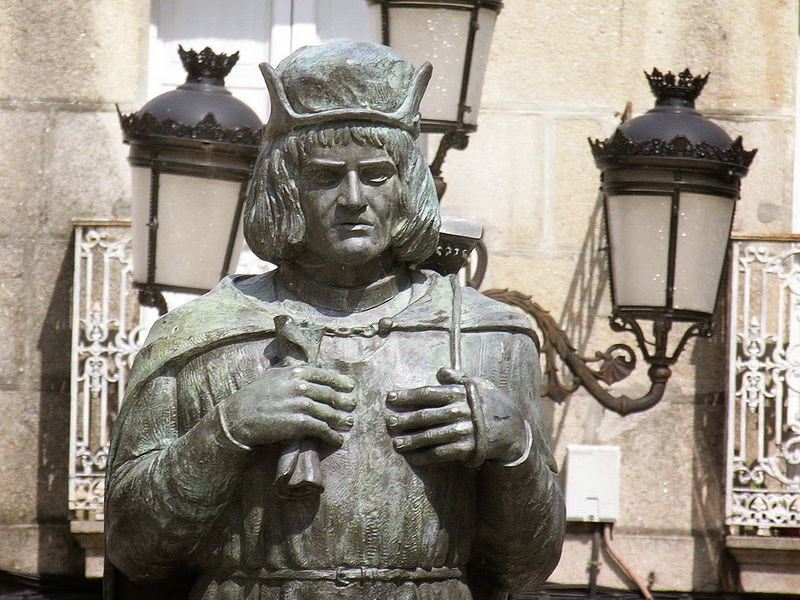
Statue of the 14th-century troubadour, Macías "The Lover," in Galicia
Reading literature aloud and listening to it recited offers such a vastly different experience with a story than does reading in silence. I cannot fathom why reading or reciting creative works aloud has faded almost entirely away from mainstream popular culture, especially since books are more portable and accessible than ever thanks to new reading technology.

In yesterday's post, I encouraged you to read aloud from Tolkien's stories. I read several of the poems from the Hobbit and the Lord of the Rings out loud, to the bewilderment of my sole audience member: my elderly dog. But oral recitation used to be one of the most important methods of narrative transmission. Mediterranean courts of the medieval period, for example, prized highly troubadours gifted with the ability to write and perform poetic works. 

A far cry from Tolkien - the 14th-century poetry of Macías The Lover
One such troubadour, Macías "The Lover" from Galicia, was not only a gifted courtier poet, but he also posthumously became a character in poems, stories and plays all over the Iberian peninsula. His life became his greatest work of art; the legends that sprang up after his death were recited and performed more often than the poems he wrote. The mythologizing of this particular troubadour assured him eternal life in the creative circles in which he had worked, and in literary history in general.

Some verses inspired by Macías' legend in a poem by Juan Rodríguez de Padrón, 15th-century poet

The legend of his life is a tragic story of love and self-punishment. The story goes that Macías, hopelessly in love with a lady of the court, focused all of his verses on extolling her qualities, putting his all of his poetic talent in the service of her beauty and virtue. After a time, however, this lady was wed to another man. Macías had pledged to only love and serve this lady for his entire life, and he honored this pledge. 

One day, as Macías lingered near a bridge, the now-married lady appeared on her horse. She wished to cross the bridge, but Macías asked her to dismount and speak with him for only a moment. Acquiescing to his request, the lady dismounted and listened as Macías reaffirmed his love for her and his pledge to serve her forever, even though it had to be from a distance. The lady was stunned by his words and, getting back on her horse, fled across the bridge. 

Neither Macías nor the lady had been aware that nearby, hiding in some bushes, was the lady's husband. As soon as the lady had departed, the husband leaped onto the bridge and ran Macías through with his lance. As he lay in the middle of the bridge dying, Macías' last words were said to have been yet another pledge to the lady, this time vowing to serve her from the far-off reaches of death. 
Some verses from a poem by Macías - the poem starts out "Cruel and determined love"... 

The real events of Macías' life have been so conflated with this legend that it is difficult to distinguish truth from fiction. Although that hardly matters, as the legend of his life is what became immortal and the inspiration for much subsequent literary production. I am interested in Macías' legend because it ended up playing an enormously influential role in the "sentimental romance" tradition, popular in 15th-century Iberia. The genre enjoyed huge reader success, reaching its apogee in 1492 with the publication of Diego de San Pedro's work, The Prison of Love. 

The novela sentimental follows a narrative arch that is almost identical to the Macías legend. One young person falls desperately in love with another young person; for some reason they are not permitted to be together; both suffer physical and emotional trauma because of the intensity of their love (or the lack thereof); one or both lovers die a horribly tragic death, which is merely an anticipation of the eternal condemnation their restless soul will doubtless experience in its afterlife. 

What interests me most about this genre is the way in which love and pain interact necessarily as part of the plot and character development. Here we have a genre of storytelling that reduces love to a rhetorical plot device, while pain takes center-stage and is explored on psychological, poetic, and social planes. It seems to me, then, that love was not the cause of suffering but rather an excuse to suffer. 

I will be doing a series of posts on the interaction of pain and love in the coming weeks. This theme is, in fact, the central idea of one of the term papers I will be writing over the course of the next month. Check back often to see who is bitterly weeping tears of blood for a distant object of desire! 


***
Who are your favorite doomed lovers? Why do you think there is a necessary connection between pleasure and pain in tales of love? 

Until next time - keep rustling! 

{Note: all photos in this post except the first one were taken by me of a book called Macías el Enamorado y Juan Rodríguez del Padrón by Carlos Martinez-Barbeito, 1951 edition.}


Tuesday, March 4, 2014

Medieval Women (and their fans)

Miniature of a woman painting, from a 1440 manuscript of Boccaccio's "De claris mulieribus"
The role of women in medieval mediterranean culture was the subject of a large-scale debate, carried out in the writing of various intellectuals throughout the XV century. Not only male intellectuals but also several women writers participated in the debate. Among the female writers who offered contributions to the discourse on women was Sor Teresa de Cartagena. She suffered illness most of her life and subsequently penned the "Grove of the Infirm," a work which extolled the inherent virtues of women and the holiness of all those who suffered bodily sickness. Her stance is considered today (somewhat anachronistically) as "proto-feminist," although I think that a more appropriate designation would be "pro-women," as the term "feminism" tends to conjure up a repertoire of 20th-century issues and stances not present in the medieval mediterranean context.
Woman painting self-portrait; from 1440 manuscript of Boccaccio's "De claris mulieribus"
The work of the poet and humanist of the French court, Christine de Pizan, also circulated widely and was responsible for adding formidable arguments to the debate: she demonstrated both in her writing and in the example of her own life, the many ways women could enrich intellectual and political culture.

These women's voices were joined by male contemporaries, such as Diego Valera and Juan Rodríguez de la Cámara, who both defended the value and virtue of Christian women by revindicating the narrative of Eve, displacing to Adam any role in the Fall and the creation of Original Sin. Martín de Córdoba added to this chorus of male voices with his El jardín de nobles doncellas ("The Garden of Noble Maidens"), which was written specifically for the soon-to-be Queen Isabel the Catholic.

A significant contributor to the debate over women was the courtier, Álvaro de Luna. The Libro de las virtuosos e claras mugeres ("Book of Virtuous and True Women") is a collection of exemplary tales that he wrote about illustrious female figures from the Bible, Greek and Roman mythology, and ancient history. He begins this work with the Virgin Mary, whom Álvaro de Luna writes is responsible for the reversal of Original Sin. He follows his marian narrative with the story of Eve, in which he relieves her of any guilt in the Fall, placing blame instead on Adam, in line with the reasoning of the other authors mentioned above. He continues to enumerate the exceptional lives of various biblical women (including Judith, one of my favorites).

Peter Paul Rubens, "Cimon and Pero" c. 1630
Example after example of extraordinary women makes up the body of Álvaro de Luna's text. Like female Hercules they form a pro-woman narrative that makes women seem saintly, unerring, and ever-wise. In two short chapters, the author recalls the Classic stories of women who allowed their parents to survive dire circumstances by feeding them with their breast milk. The proliferation of stories of women doing whatever necessary to ensure the utmost moral conduct eventually begins to make the mere mortal female reader (such as myself) doubt her ability to ever live up to such expectations - or even wish to. The physical and psychological torment that many of these exemplary women experience makes it seem near impossible to live a comfortable life and be a virtuous woman. The women of the Libro are prepared to endure hideous torture and death to preserve their extraordinary virtue, guided always by their own moral compass and the hand of God Himself. Meanwhile, a contemporary text that addresses virtuous men, written by Fernando del Pulgar, offers a much more attainable vision of masculine virtue (think: "sure, he may have committed adultery a bunch of times... but he's such a great soldier!").

And yet Álvaro de Luna's enthusiasm for women resounds with an optimism for the future role of women in his society. His series of prologues offers the reader an important framework with which to understand the rest of his text. On multiple occasions, he notes that women are not "inherently" bad or good, they are a product of their habits and habitual actions, as are men. Last week I got the opportunity to discuss this work with my colleagues in a seminar and we all noted how modern Álvaro de Luna's thesis seemed to be. After discussing his Libro, we proceeded to read aloud several of his poems. ...They were so saucy! I can't say that I was surprised to read sensual poems about being hopelessly in love with women (including women other than his wife) from a man who vehemently defended his female contemporaries.
Woman painting self-portrait from 1440 manuscript of Boccaccio's "De claris mulieribus" 
Álvaro de Luna's Libro was greatly influenced by Di claris mulieribus by Italian author, Boccaccio. Interestingly, Boccaccio wrote works that fit into both the pro-women and the anti-women categories. Of course, Di claris mulieribus fits into the former category. Although I have not yet read the Italian author's text, I plan to do so soon, especially after finding this article which displays various miniatures adorning the original manuscript and depicts women as painters and sculptures!

Finally, in honor of today being Fat Tuesday, I leave you with a picture of my 9-year-old self at carnivale in Venice. Donning a mask my parents got for me earlier that day from a magical little mask shop perching above the glass-green water of the canal, I have my arms outstretched, as if trying to embrace the whole city, all of its masked inhabitants, and the women-loving tricksters that had populated its narrow streets since medieval times...

***
Happy Fat Tuesday!

Until next time -- keep rustling!

Monday, March 3, 2014

Found in Translation

February was a month of discovery for me. I attended a symposium here on campus, called "Cultural Translation in Medieval and Early-Modern Studies," which brought together scholars from around the country (and even from exotic Canada!) to talk about themes and issues associated with medieval translation. The speakers included professors in religious studies departments, modern language departments (Spanish, Portuguese, Italian, French), history, art history, and classics departments. The talks covered a range of problems associated with medieval translation projects - from the way medieval Christian scholars translated the Qur'an to contemporary translations of Marco Polo's travel writing (originally written in the coiné, Franco-Italian).

Marco Polo
Professor Sharon Kinoshita gave the talk on Marco Polo, and I had the privilege of picking her up from the airport - an opportunity graduate students covet, as it provides an hour of one-on-one conversation with the professor. Her work is fascinating to me because she approaches medieval literature as part of broader process of cultural production, one that stretched across linguistic, geographic, and socio-economic boundaries. While she specializes in Francophone medieval literature, Professor Kinoshita (and a growing number of her colleagues) views the entire Mediterranean region as a highly communicative community of cultural production (see her most recent book). This community often shared interests and imagination and responded to one another's experiences through writing. This interaction is exemplified by translations of a diverse array of texts that circulated the Mediterranean region.

Professor Kinoshita addressed one case in particular, Marco Polo's The Travels, a work for which no two translations seemed to be the same. In some translated versions, entire passages were changed to reflect local fears or perceptions of "the Other" (who, in this case, happened to be dog-headed cannibalistic Africans). In other translators' versions, the style was altered to enhance the literary beauty of the text (a controversial choice, made even by today's translators of the work-- see: the Penguin edition). In the translation that Professor Kinoshita herself is elaborating, Marco Polo's repetitive style in the original Franco-Italian is more faithfully transmitted, allowing the reader to fully experience the barebones language of the coiné. 

St. Bernard Vanquishing the Devil
German, XV-century
Metropolitan Museum of Art collection 
Side note: This summer, I'll be taking Italian lessons so that I too can approach medieval literary production as an element of a broader Mediterranean culture. I plan to develop a corpus for my dissertation which incorporates Castilian, Portuguese, and Italian literature - the tricksy devil character pops up all over the Mediterranean region in varying guises, responding to both local and universal perceptions of evil and punishment...

Another of my favorite moments from the symposium was Professor Mark Meyerson's talk on ritual violence during Holy Week in medieval Valencia. His talk featured a particular case dating back to 1380, a case that he discovered while researching in judicial archives. Apparently, every year during Holy Week (the week preceding Easter in the Catholic tradition), the Christian community of Valencia would engage in ritualized, performative acts of destruction and violence that consisted mainly of throwing rocks at the wall surrounding the Jewish quarter. In many cases, Christians and Jews were neighbors and friends, living in such close proximity that they even shared walls. Christian and Jewish families remained friends before and after Holy Week, in spite of this destructive ritual performance.

Detail from "Feast of the Passover" by
Dieric the Elder Boutis
circa 1465
Rarely did Jewish families protest this ritual - only in extreme cases of injury, death, or property destruction did they bring complaints to the King. For the most part, this ritual was viewed simply as part of the collective judeo-christian calendar. Some scholars have understood the tradition as a performance that, rather than teach Christian children to hate Jews, taught them about the shared history of Christians and Jews and jewish custom, and served as a "release valve" for the Christian community during the most intense week of the liturgical calendar.

Professor Meyerson's talk detailed a special (and tragic) case from the year 1380 that he discovered in the archives. The story was preserved in the form of juridical documents from the proceedings of a murder trail, in which two jewish men were accused of causing the death of a young Christian boy. The accused men were thought to have perpetrated an act of retaliatory violence against the Christian community, in the wake of Holy Week activities.

The distraught father of the deceased child levied accusations against Salamo and Mosae, jewish residents from his same neighborhood. According to the legal documents, witnesses informed the boy's father that they'd seen an arm throw a rock from the window the Salamo and Mosae's house. The rock struck the boy's head as he walked his dog below, and the head wound he sustained killed him several days later.

Of the 20 witnesses for the defense, however, 17 were the Christian neighbors of the two young Jewish men. They testified that it seemed extremely unlikely to them that these stand-up citizens would be capable of harming a child. One of the Christian witnesses for the defense even displayed his knowledge of jewish custom claiming that, as the fateful event took place on the Sabbath, the young men's own religious tradition would have prohibited carrying out this work. The defense's explanation of the events posited that, as many rocks had been thrown at the house the day before the boy was struck, it was likely that one of the rocks had been up on the roof and was simply blown off in a high wind and fell accidentally on the poor boy's head.

Surprisingly, there was no lynch mob. In spite of heightened emotions during Holy Week, the two young men received due process and were defended by their neighbors, Christians and Jews alike. In the end, however, some damning evidence against one of the young men was brought forth and he was sentenced to death. Although we will never know if the sentenced man was truly guilty or not, the case provided many interesting details of quotidian life in Valencia in the late fourteenth-century - details about how Christian and Jewish children played together every night in the street, and how Christian families would have their fancy Easter clothes made and tailored by Jews who, the day before, had been targets of the Holy Week rock-throwing.

These are the kinds of cases that really make a girl want to dig in to some vellum archives! Which is why, since the symposium, I have been investigating the collections of different libraries' medieval texts. Through this research, I've found my newest fascination: the Merton University Library. Merton is the world's oldest, continuously active university library, located in Oxford, England. Take a look at its unparalleled beauty:

I can't imagine a more perfect place on earth. 
Merton University Library was constructed and began housing books in 1276 and has provided a space for scholars to read and learn since then. This week, I went to our campus library and checked out the (gigantic) index book of all the medieval texts Merton houses. I am looking through this index now, to try to find some relevant texts for my dissertation... I'm hoping there's a trip to Merton in my not-so-distant future!

Luttrell Psalter, "Milking Sheep," England - circa 1325-1340
British Library collection 
I am riding a wave of inspiration from this medieval translation symposium, organized by my advisor, Professor Núria Silleras-Fernández, and her husband, Professor Brian Catlos, and also included incredible talks by Professors Thomas Burman and John Slater (which each could've been the subject of an entire post!)...

***
What have you been up to recently, fair petticoat rustlers? Where is your favorite library?

Until next time - keep rustling!