Showing posts with label love. Show all posts

Friday, March 28, 2014

They Stand on the Earth and They Cast Their Own Shadows

Detail from Masaccio's painting of the Expulsion of Adam and Eve in the Brancacci Chapel

The many star-crossed lovers of yesterday's post may have come from different literary traditions, but they were all unified by the way in which suffering and desire became hopelessly and fatally tangled in their stories. These tragedies, unfolding at the intersection of pleasure and pain, presented themselves as not only believable love stories but natural ones. The sentimental romances and lyric of the late-Medieval/early-Renaissance Mediterranean make it seem hauntingly natural that the birth of love should lead to the death of lovers.
Masaccio's painting of
Adam and Eve in the
Brancacci Chapel

In grappling with what makes death and desire so inextricably linked in the literary production of this time period, I decided my research needed to go back to the beginning - all the way to the beginning - in order to ascertain the origin of this link. And by "the beginning," I mean the book of Genesis.

The story of Adam and Eve sheds a great deal of light on the connection of desire and death. As a result of their expulsion, they became mortal and died. But at this same moment death becomes their reality, they are born into their humanity and therefore sexuality. As Adam and Eve leave the garden, they experience a sudden awareness of their bodies. This awareness inspires both a tragic self-consciousness full of shame and a thrilling awakening to the possibilities of material connection with one another. In the story of Adam and Eve the origin of human death and suffering is also the origin of human sexuality.

Although it was not the love Adam and Eve had for one another that caused their suffering, as is the case in the sentimental romances, their relationship was defined by the moment in which they became fully human and began experiencing together love, suffering, and death. This confused and terrible moment of leaving Eden unites Adam and Eve (archetypes of all women and men) in both love and death forever.

Patricia Grieve, in her book Desire and Death in the Sentimental Romance, has referred to love and death as the two great mysteries of humanity and thus as necessarily occurring side-by-side in literary representation: "As the two great topics of poetry - unsolvable mysteries both - it is no surprise that [love and death] should appear with great frequency in literature."

Masaccio, the Italian painter of the 15th-century, had a profound influence on other painters of his century and on the Renaissance in general. His depiction of the Expulsion of Adam and Eve in the Brancacci Chapel eloquently narrates a scene of great suffering and great beauty, all embodied by the human form.

When renowned art historian and critic, Sister Wendy, contemplated this image, she noted how representational it was of the overarching ethos of the Renaissance. To the denizens of the Renaissance world, humanity was dignified, in spite of the suffering and grief with which it also constantly had to contend. "They stand on the earth and they cast their own shadows," Sister Wendy said, "that's what the Renaissance was about: humanity as upright, suffering but responsible."

This insight, I believe, is crucial to understanding the link between desire and death in Renaissance works of literature. The overwhelming feelings of love experienced by the protagonists of 15th-century sentimental romances were invariably accompanied by a sense of immense responsibility owed to the object of their feelings. Love allowed the protagonist to encounter the eternal for the first time - feeling love was connecting with a never-ending current of human emotion. But the precarious business of ensuring that their love was fully requited by the object of their desire endangered their experience of the "eternal" nature of love. This caused great anxiety and suffering until it seemed their only recourse was to experience eternity in the only other bodily way available: death.

***
To hear the rest of Sister Wendy's incredibly preceptive discussion of Masaccio's painting, watch this video from minutes 2:00 - 5:00. If you happen to have 30 minutes available, I highly recommend watching the entire episode.


***
Until next time - kept rustling!

Thursday, March 27, 2014

Chivalry and the Sentimental Novel

Tristan and Iseult by Edmund Blair Leighton (1853-1922)
Yesterday's post began a discussion on the curious intersection of love and suffering in 14th and 15th century literature, specifically the sentimental romance. While we looked at the mythologized life story of Macías the Lover yesterday, today I would like to talk about some historical factors influencing the emergence of the genre.

The literature produced in this genre generally had an extremely predictable plot, which in turn placed greater emphasis on the authors' ability to invent and describe new forms of love-induced torture for their characters. Some of the suffering was allegorical (for example, The Prison of Love opens with the protagonist allowing himself to be lead by a wildman - symbol of loss of reason - into a tower where he sits upon a burning throne where he will always hurt but never be consumed - symbol of the burning passion of the heart and the fiery punishments for such passions awaiting him in hell). In other cases, the suffering was real and physical, and certainly the deaths at the end were always permanent. 
Entering the allegorical
"prison of love"

Unlike other European renditions of fated love stories (see the stories of Tristam or Lancelot), the characters in Iberian sentimental romances never enjoyed any kind of physical union - there was no kissing or embracing and there certainly was no sex. Frequently, the lovers only occupied the same physical space for a few brief, fleeting moments. The pain and punishment resulting from those few moments came in spite of an utter lack of hope that love would've ever manifested itself physically. Truly, then, this is a genre of all pain and no pleasure. The desire, it seems, grows in the pain and not the temporary fulfillment of sexual fantasy. 

In her book Clio, Eros, Thanatos: The 'Novela Sentimental' in Context, Theresa Ann Sears posits that a shift in social and economic relationships lead to such aesthetic trends in 15th and 16th century western European literature. "National monarchies had slowly undermined the feudal relationships based on exchanges of protection for goods and services," she writes. "Advances in weaponry were eroding the efficacy of troops of mounted, armored knights, putting greater emphasis on, on the one hand, a professional soldiery, and on the other, conscripted or hired infantries. Such changes resulted in an increasingly idle aristocracy that indulged (negatively) considerable social disruption and decadence, and (more ambiguously) in an aesthetization of its role." 
Image of Amadis of Gaul, Spain's most beloved
protagonist of a chivalric novel

These changes in social dynamics undoubtedly influenced artistic production. I believe that as the role of the knight became destabilized by changing strategies in armed conflict, a gap widened in the popular imagination of heroism. Slowly, the chivalric knight of the high middle ages faded - the noble and proud figure, mounted on his horse and prepared to suffer any hardship in service of his king, receded from reality into fiction. In the absence of a heroic cause for which to suffer and die, a different one was summoned to take its place: women. 

The so-called "religion of love" integrated religious imagery with sexual metaphors, blasphemously elevating the "perfect" feminine to god-like status (think: Act 1, Scene 5 of Romeo and Juliet, in which Romeo convinces Juliet to kiss him by equating their lips to the hands of saints that press together in prayer). Knights needed to serve a higher purpose, and if their king had no urgent save-the-Christian-world errand on which to send them, they remained at home, surrounded by the people who had always remained home (women!). Women became the inspiration for "heroic" deeds and tragically "noble" deaths. 

Frontispiece of La Celestina revealing
the text's ending
Of course, this lead to some problems for women (see my previous post on the wide-spread, public debate on women during this same time period). But this was also indicative of a growing problem for men. The masculine identity was in crisis, and I believe that the pain, torture, and deaths of the male characters in sentimental romances are indicative of this profound cultural crisis. Attempting to define themselves negatively (i.e. writing about the defining characteristics of women to indicate what men are not) only succeeded in turning the once-herioc male trope of chivalric novels into a purposeless, impotent, lost soul, pinning after little more than an affair.

Women were lambasted repeatedly and as a result the "religion of love." Clergy were scandalized by the idolatrous fascination with "perfect" women that were supposedly suddenly in abundance; other men of the court also rejected this idealized image of women. So the "religion of love" faltered - the perfect object of desire was now painted in popular imagination as nagging and emotionally unstable. Along with this debate, the sentimental romance genre waned in popularity until coming to an abrupt and definitive halt in 1499, with the publication of Fernando de Rojas' La Celestina
From Chapter 5 of La Celestina 
Note: Celestina is depicted as a nun
Written as if it were a play (though not necessarily intended to be performed), this text parodied all of the fundamental elements of the sentimental novel. The star-crossed lovers were not all that attractive, they were half-witted and decidedly uncharming, their servants found them pedantic and silly and made no effort to hide their disdain. Worst of all, rather than appealing to the "godliness" of the object of desire, the story appeals to the black magic of the alcahueta (go-between, procuress, "witch") who gives the work its name. (Interestingly, the title of the work was not originally La Celestina, but because this ugly, greedy, devil-consorting witch was such a great character, her name quickly replaced the original title to sell more copies).

Much of La Celestina is quite funny but it comes to the same customarily tragic ending that all sentimental novels do. But the damage to the genre has been done - the successful parody of the entire pleasure/pain trope had been reduced to foolhardiness and superstition.

Nevertheless, La Celestina came at the end of almost a century of sentimental romance production. The proliferation of Macías' story alone in these novels, in lyric, in Spain, in Portugal, is enough to indicate that pleasure and pain have a natural alliance, in spite of Fernando de Rojas' parody of the sentimental genre. I am interested in finding out more about how that alliance worked in the minds and hearts of 15th-century writers and readers... so stay tuned!

***
Until next time -- keep rustling!

Wednesday, March 26, 2014

Macías, The Lover

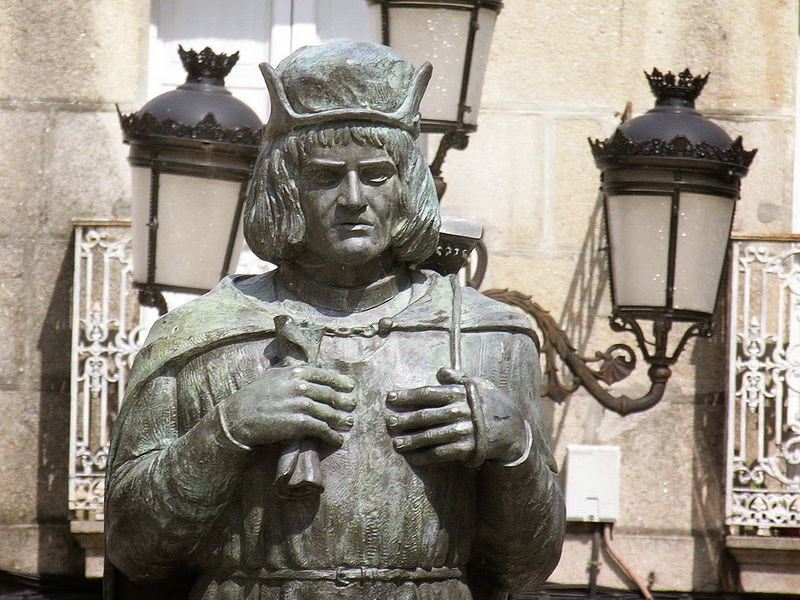
Statue of the 14th-century troubadour, Macías "The Lover," in Galicia
Reading literature aloud and listening to it recited offers such a vastly different experience with a story than does reading in silence. I cannot fathom why reading or reciting creative works aloud has faded almost entirely away from mainstream popular culture, especially since books are more portable and accessible than ever thanks to new reading technology.

In yesterday's post, I encouraged you to read aloud from Tolkien's stories. I read several of the poems from the Hobbit and the Lord of the Rings out loud, to the bewilderment of my sole audience member: my elderly dog. But oral recitation used to be one of the most important methods of narrative transmission. Mediterranean courts of the medieval period, for example, prized highly troubadours gifted with the ability to write and perform poetic works. 

A far cry from Tolkien - the 14th-century poetry of Macías The Lover
One such troubadour, Macías "The Lover" from Galicia, was not only a gifted courtier poet, but he also posthumously became a character in poems, stories and plays all over the Iberian peninsula. His life became his greatest work of art; the legends that sprang up after his death were recited and performed more often than the poems he wrote. The mythologizing of this particular troubadour assured him eternal life in the creative circles in which he had worked, and in literary history in general.

Some verses inspired by Macías' legend in a poem by Juan Rodríguez de Padrón, 15th-century poet

The legend of his life is a tragic story of love and self-punishment. The story goes that Macías, hopelessly in love with a lady of the court, focused all of his verses on extolling her qualities, putting his all of his poetic talent in the service of her beauty and virtue. After a time, however, this lady was wed to another man. Macías had pledged to only love and serve this lady for his entire life, and he honored this pledge. 

One day, as Macías lingered near a bridge, the now-married lady appeared on her horse. She wished to cross the bridge, but Macías asked her to dismount and speak with him for only a moment. Acquiescing to his request, the lady dismounted and listened as Macías reaffirmed his love for her and his pledge to serve her forever, even though it had to be from a distance. The lady was stunned by his words and, getting back on her horse, fled across the bridge. 

Neither Macías nor the lady had been aware that nearby, hiding in some bushes, was the lady's husband. As soon as the lady had departed, the husband leaped onto the bridge and ran Macías through with his lance. As he lay in the middle of the bridge dying, Macías' last words were said to have been yet another pledge to the lady, this time vowing to serve her from the far-off reaches of death. 
Some verses from a poem by Macías - the poem starts out "Cruel and determined love"... 

The real events of Macías' life have been so conflated with this legend that it is difficult to distinguish truth from fiction. Although that hardly matters, as the legend of his life is what became immortal and the inspiration for much subsequent literary production. I am interested in Macías' legend because it ended up playing an enormously influential role in the "sentimental romance" tradition, popular in 15th-century Iberia. The genre enjoyed huge reader success, reaching its apogee in 1492 with the publication of Diego de San Pedro's work, The Prison of Love. 

The novela sentimental follows a narrative arch that is almost identical to the Macías legend. One young person falls desperately in love with another young person; for some reason they are not permitted to be together; both suffer physical and emotional trauma because of the intensity of their love (or the lack thereof); one or both lovers die a horribly tragic death, which is merely an anticipation of the eternal condemnation their restless soul will doubtless experience in its afterlife. 

What interests me most about this genre is the way in which love and pain interact necessarily as part of the plot and character development. Here we have a genre of storytelling that reduces love to a rhetorical plot device, while pain takes center-stage and is explored on psychological, poetic, and social planes. It seems to me, then, that love was not the cause of suffering but rather an excuse to suffer. 

I will be doing a series of posts on the interaction of pain and love in the coming weeks. This theme is, in fact, the central idea of one of the term papers I will be writing over the course of the next month. Check back often to see who is bitterly weeping tears of blood for a distant object of desire! 


***
Who are your favorite doomed lovers? Why do you think there is a necessary connection between pleasure and pain in tales of love? 

Until next time - keep rustling! 

{Note: all photos in this post except the first one were taken by me of a book called Macías el Enamorado y Juan Rodríguez del Padrón by Carlos Martinez-Barbeito, 1951 edition.}